

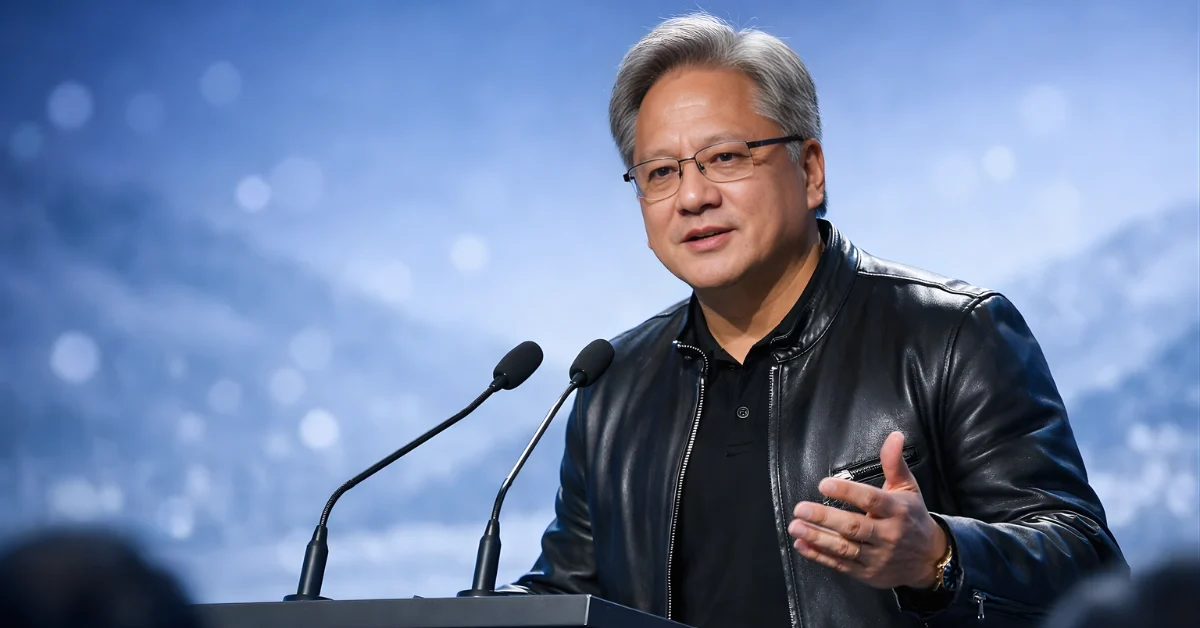
Nvidia President and CEO Jensen Huang told a World Economic Forum audience in Davos that countries should treat artificial intelligence as core infrastructure, comparing it to essentials like electricity and roads and urging national leaders to build AI systems that reflect their own language and culture. In the same discussion, Huang praised Anthropic’s Claude for coding and reasoning and said software companies should use it, describing the tool as “incredible” and a major leap forward.
Huang made the remarks in a conversation with BlackRock CEO Laurence D. Fink at Davos on January 21, according to both a published report and the event video transcript. He argued that AI is becoming foundational to economic growth, productivity, and the next wave of applications across industries, and he framed today’s AI moment as a major “platform shift,” similar to past shifts to PCs, the internet, and mobile computing.
Why he says AI must be national infrastructure
Huang said every country should “get involved” in building AI infrastructure and developing “your own AI,” so a nation’s “language and culture” can become part of its “national intelligence” and broader ecosystem. He also emphasized “sovereign data,” saying nations should integrate AI into core infrastructure to protect and leverage it.
While Huang said countries can import AI, he argued that training models has become more accessible, especially with the availability of open models and local expertise that can shape tools for national needs. In his view, this is why AI belongs alongside other national buildouts: “You should have AI as part of your infrastructure,” he said during the Davos discussion.
The “five-layer AI cake” and a massive buildout
In the Davos conversation, Huang described AI as a “five layer cake,” starting with energy at the bottom, then chips and computing infrastructure, cloud services, AI models, and finally applications on top. He said the application layer is where broad economic benefit ultimately appears, and he linked recent progress in AI models to a growing ability to build real products in fields such as financial services, healthcare, and manufacturing.
Huang also said AI is driving what he called “the largest infrastructure buildout in human history,” pointing to global investment across energy, chip factories, computer factories, and “AI factories.” He and Fink discussed the scale of infrastructure spending, and Huang argued that large investments are connected to the need to build the layers underneath AI models so applications can run at scale.
Claude, coding, and “get involved”
Huang called Claude “incredible” and said Anthropic made a “huge” leap in coding and reasoning, adding that Nvidia uses it widely inside the company. He also said that “anybody who has a software company really ought to get involved and use it,” while separately describing ChatGPT as a highly successful consumer AI because of its ease of use and approachability.
Huang repeatedly framed AI adoption as a practical skill, saying it is “essential” to learn how to use, prompt, manage, and evaluate AI systems. He also described AI as “the easiest software to use in history,” and he linked that ease to rapid adoption, saying the user base has grown to nearly a billion people in just a few years.
His view on breakthroughs and jobs
Huang said three major developments in 2025 pushed AI forward: models becoming better grounded and more capable of step-by-step planning (which he described as “agentic” systems), progress in open models (including open reasoning models), and advances in “physical AI,” meaning systems that understand more than language, such as proteins, chemicals, and aspects of the physical world.
On jobs, Huang pushed back on simple displacement narratives and argued that the AI buildout will create work, including trade and technical roles tied to infrastructure. He also gave examples from healthcare, saying AI has diffused into radiology while the number of radiologists has increased, and he said AI tools can reduce documentation burdens for nurses so they can spend more time with patients.
