

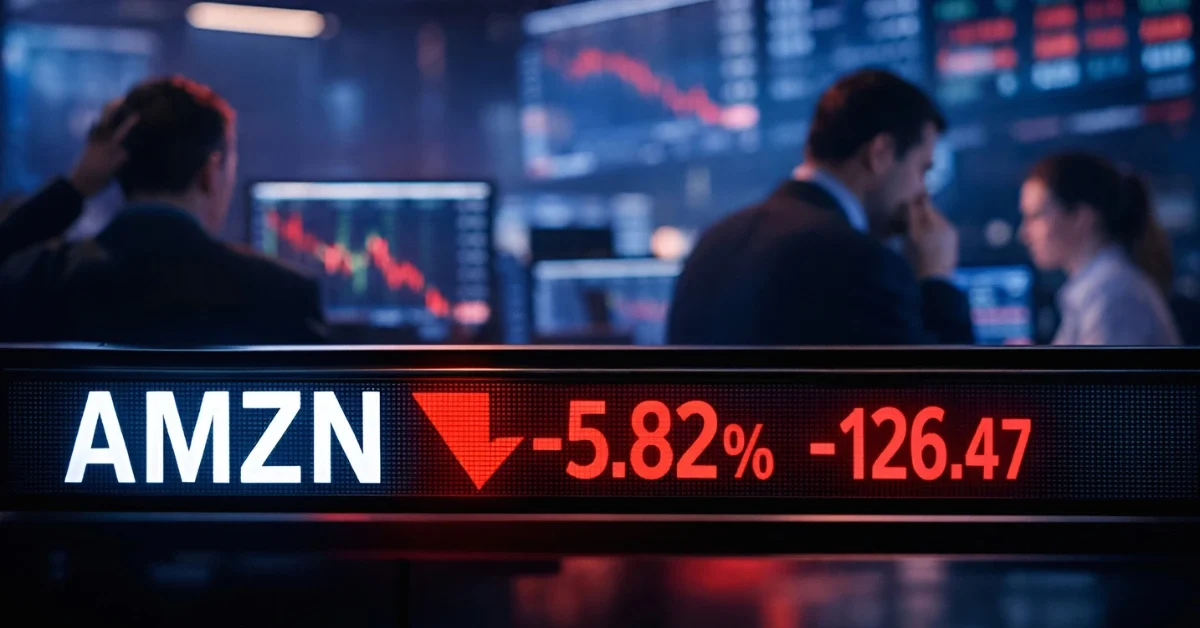
Amazon shares plummeted roughly 13% on Friday, erasing nearly $300 billion in market value, after the company revealed a staggering capital expenditure plan for the coming year. The e-commerce and cloud computing giant announced it expects to spend approximately $200 billion in 2026, a figure that far exceeded Wall Street estimates. This aggressive spending forecast is largely driven by the company’s race to build out infrastructure for artificial intelligence, signaling that the costs of competing in the AI era are rising much faster than many investors had anticipated.
The steep drop in Amazon’s stock price reflects growing unease across the financial markets regarding the profitability of generative AI. While major technology companies are pouring record sums into data centers and specialized chips, shareholders are becoming increasingly concerned about the timeline for returns on these massive investments. Amazon’s projection served as a harsh reality check, suggesting that the “build phase” of the AI revolution will be far more expensive and prolonged than previously thought.
The High Cost of the AI Arms Race
The central driver of the sell-off was the sheer scale of Amazon’s projected spending. By earmarking $200 billion for capital expenditures in a single year, Amazon is effectively doubling down on its conviction that AI will be a transformative technology worth almost any price. However, for investors focused on near-term margins and cash flow, this price tag was a shock. The spending plan suggests that free cash flow could remain under pressure as the company directs its resources toward constructing new data centers and securing the hardware necessary to train and run complex AI models.
This development has brought the “dark side” of the AI boom into focus for Wall Street. For over a year, the narrative around artificial intelligence has been overwhelmingly positive, driving stock indices to record highs. Now, the mood is shifting. The conversation is moving from the potential revenue AI might generate to the concrete and astronomical costs required to build it. Amazon’s announcement highlighted that even for the world’s wealthiest tech firms, the capital intensity of this technology is unprecedented.
Investors are now grappling with the realization that the payback period for this infrastructure build-out remains uncertain. While Amazon views this spending as essential to maintaining its dominance in cloud computing through Amazon Web Services (AWS), the market reacted with immediate skepticism, punishing the stock for what it perceives as excessive spending without guaranteed immediate returns.
Software Stocks Hit by Disruption Fears
The anxiety triggered by Amazon’s spending outlook was not confined to hardware and infrastructure builders. The broader software sector also faced significant downward pressure, driven by fears that artificial intelligence could fundamentally disrupt existing business models. Reports indicate that recent developments from AI competitors, specifically a “wake-up call” attributed to Anthropic, have rattled investors in software companies.
The concern is that advanced AI agents could eventually replace traditional software-as-a-service (SaaS) applications, rendering current recurring revenue models obsolete. This fear of displacement caused a slide in global software and data firms, compounding the jitters already present in the market. Companies like Oracle were caught in the sell-off as traders reassessed the long-term viability of legacy software providers in a world increasingly dominated by autonomous AI.
This sector-wide decline highlights a dual threat for technology investors. On one side, the companies building the AI infrastructure—like Amazon—are spending essentially all their available cash to do so, crushing their short-term profit outlooks. On the other side, the software companies that rely on traditional user interfaces and licensing models face an existential threat from the very technology being built.
Market Reaction and Future Outlook
Following the tech rout, markets attempted to stabilize, though the atmosphere remained tense. Futures markets showed signs of steadying after the initial shock, but the heavy losses sustained by Amazon and its peers left a mark on investor sentiment. The “AI capex lift”—finance jargon for the increase in capital expenditures—has become a central theme for the 2026 fiscal year.
The sell-off indicates a potential regime change in how the market values AI stocks. In the early stages of the boom, any company mentioning AI saw its stock price rise. Now, the market is demanding greater discipline and clearer paths to profitability. Amazon’s $200 billion gamble is a signal that the industry is entering a more mature, capital-intensive phase where the winners will be determined by who can sustain the highest levels of investment.
As the dust settles, all eyes will remain on Big Tech’s balance sheets. Amazon has made it clear that it is willing to endure short-term pain in its stock price to secure a long-term lead in artificial intelligence. Whether investors will regain their patience, or continue to punish companies for ballooning budgets, will likely define the market’s direction for the rest of the year.
