

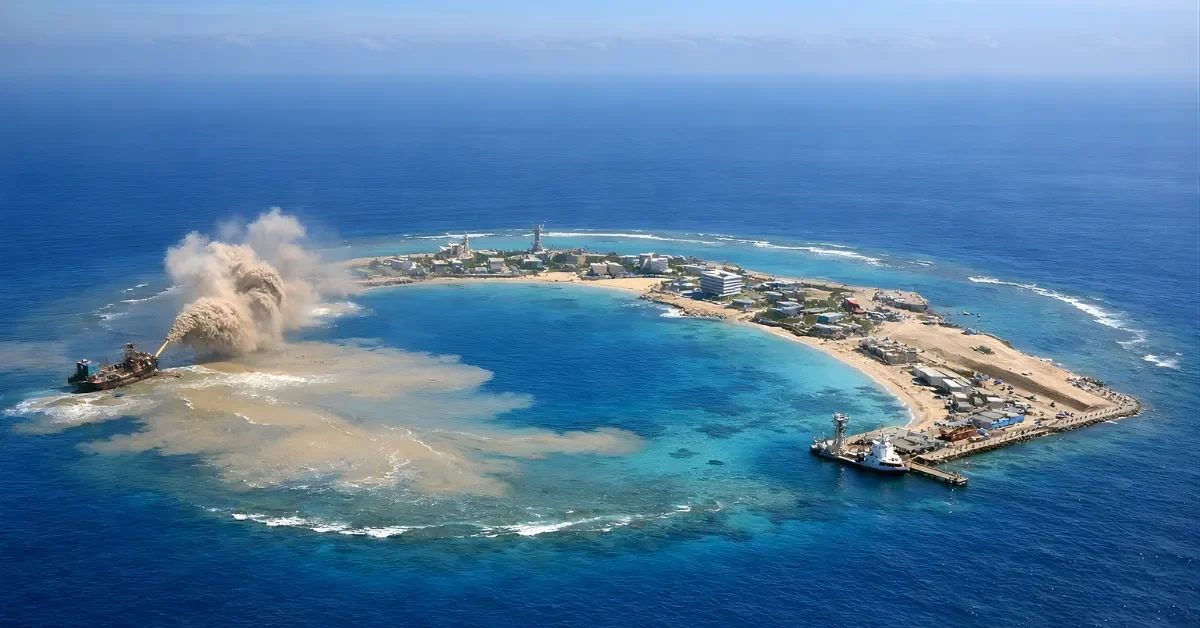
Fresh satellite imagery has fueled new attention on Antelope Reef in the South China Sea, where reports say China appears to be starting another round of land reclamation that could support a new military outpost.
The activity is being closely watched because Antelope Reef sits in the Paracel Islands, and analysts cited in recent reporting say a built-up outpost there could expand China’s footprint and operating options in the area.
Satellite images show new activity
Defense News reported that satellite imagery appears to show China is preparing to reclaim land at Antelope Reef for what could become another military base in the South China Sea.
The same report identified Antelope Reef’s location in the Paracel Islands and provided coordinates for the reef, while also describing it as a coral reef feature.
Newsweek separately reported that satellite imagery from the European Space Agency’s Sentinel-2 satellites indicates new sand dredging operations began after October 15 at Antelope Reef.
Newsweek said the dredging appeared to be concentrated at four sites along the eastern and southern edges of Antelope’s lagoon, with additional land reclamation visible on both sides of an existing outpost and a nearby port facility.
Defense News, citing AMTI and referencing Newsweek’s reporting, said the work could enable infrastructure such as access suited for roll-on/roll-off berths, which could support the movement of heavy equipment tied to dredging and land reclamation.
Why Antelope Reef matters
Defense News cited the Asia Maritime Transparency Initiative (AMTI) as saying China has military outposts in the Paracel Islands, including sophisticated bases such as Woody Island, and said Beijing seized the Paracel chain from Vietnam in 1974.
The same Defense News report said AMTI has described Antelope Island as “little more than a sandbar,” and noted that it previously had only a couple of buildings.
Defense News said that if Antelope Reef is turned into a military base, it could serve functions such as a helipad, a radar station, and an anchorage for Chinese warships and coast guard vessels.
Newsweek reported that Antelope Island, like the rest of the Paracels, is claimed by Vietnam and Taiwan as well as by China.
Wider South China Sea picture
Defense News reported that, beyond the Paracels, analysts say China has seven military outposts in the Spratly Island chain and has created 3,200 acres of new land there.
The same report added that China controls Scarborough Shoal, which it said Beijing seized from the Philippines in 2012.
Defense News also reported that Vietnam is strengthening its infrastructure in the Spratly Islands.
A separate write-up carried by Defcros said recent satellite analyses show China moving forward with land reclamation efforts at Antelope Reef as it seeks to establish another military facility in the South China Sea.
Fishing fleets and Taiwan focus
Alongside the Antelope Reef reporting, Defense News said China has demonstrated the use of large numbers of fishing boats in ways that could support future combat operations against Taiwan.
Defense News reported that the geospatial firm ingeniSPACE observed a formation in which 2,000 Chinese vessels created massive L-shaped “floating barriers” from Dec. 25–27 in waters northeast of Taiwan.
The same report said this activity occurred shortly before China announced a major exercise around Taiwan, which Defense News identified as “Justice Mission-2025” and described as designed to pressure Taiwan and rehearse a naval blockade.
Defense News also reported a separate event from Jan. 9–12 in which about 1,400 Chinese fishing boats formed a 200-mile-long “barrier” for more than 30 hours, based on automatic identification system data.
The report said these formations illustrate a higher level of coordination and linked the activity to China’s People’s Armed Forces Maritime Militia, also citing a U.S. Congressional Research Service report published in May 2025 about the militia’s role in defending China’s maritime claims.
UN dispute adds political heat
In a separate development at the United Nations, China’s permanent representative to the UN, Fu Cong, rejected what Xinhua described as a U.S. accusation involving “China’s expansive and unlawful maritime claims” in the South China Sea.
Fu said China has “indisputable sovereignty” over “Nanhai Zhudao and the adjacent waters,” and said China’s territorial sovereignty and maritime rights and interests in the South China Sea are grounded on what he called a solid historical and legal basis.
Fu also said the United States is not a party to the UN Convention on the Law of the Sea (UNCLOS) and therefore “has no right” to act as a judge of UNCLOS in criticizing other countries.
Xinhua reported that Fu accused the United States of stirring up trouble, sowing discord, deploying offensive weapons including land-based intermediate-range missiles in the South China Sea, and frequently sending ships and aircraft for military reconnaissance and drills while intruding into waters and airspace that he said surround China’s islands and reefs.
