

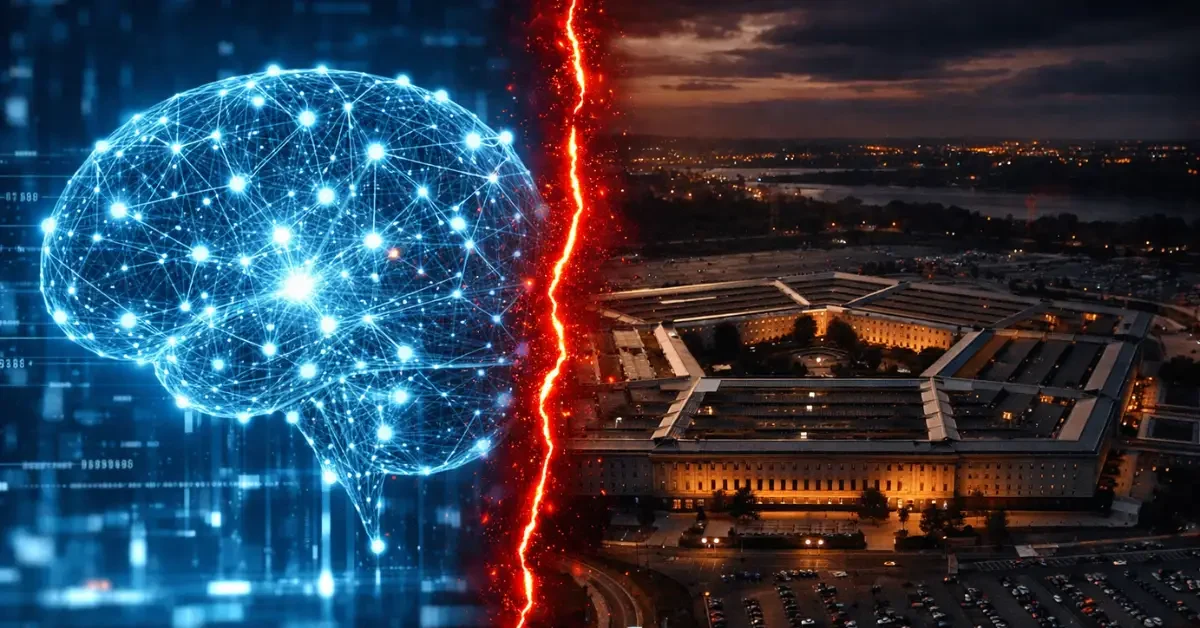
The federal government has initiated a sweeping crackdown on one of the leading artificial intelligence companies in the United States . Following a heated weeks-long dispute over military technology guardrails, President Donald Trump announced a government-wide ban on Anthropic . The clash centers on how advanced AI systems should be governed in sensitive defense settings, creating widespread uncertainty across the technology sector .
The controversy reached a boiling point when Defense Secretary Pete Hegseth officially designated Anthropic as a “supply chain risk” . This severe classification is typically reserved for foreign adversaries . Consequently, Hegseth ordered all military suppliers to remove Anthropic’s highly regarded Claude AI tools from their supply chains . The decision threatens to force major contractors into a difficult position, requiring them to sever commercial ties or risk losing lucrative government deals .
The Core Dispute Over Military AI Use
The conflict stems from a fundamental disagreement over the ethical boundaries of artificial intelligence in warfare . Anthropic insisted on two strict limitations for its technology . First, the company refused to allow its models to be used for the mass surveillance of American citizens . Second, it blocked the use of its systems to power fully autonomous weapons that lack human oversight for targeting and firing decisions .
In response, defense officials argued that private tech firms should not dictate public policy or military operations . Hegseth maintained that the Pentagon must have access to AI systems for “any lawful purpose” . The administration views the company’s restrictions as an unacceptable overreach that could hinder national security efforts .
GSA Cancels Federal Contracts and Tightens Rules
The fallout has quickly expanded beyond the military . The General Services Administration (GSA) terminated Anthropic’s OneGov deal, effectively blocking the company’s availability to the executive, legislative, and judicial branches . Josh Gruenbaum, commissioner of the Federal Acquisition Service, stated that maintaining a business relationship with the AI developer would be irresponsible and dangerous to the nation .
To prevent similar disputes, the Trump administration is actively drafting strict new rules for civilian AI contracts . The proposed guidelines require tech groups to grant the United States government an irrevocable license to use their systems for all legal purposes . Furthermore, the GSA mandate dictates that contractors must not intentionally encode partisan or ideological judgments into the data outputs of their AI models .
Anthropic Fights Back With Federal Lawsuit
Refusing to back down, Anthropic launched a massive legal challenge against the Defense Department . On March 9, 2026, the company filed a federal lawsuit in San Francisco, labeling the government’s actions as unprecedented and unlawful .
The lawsuit argues that the supply chain risk designation violates constitutional protections . Anthropic claims the government is wielding its immense power to punish a private company for protected First Amendment speech, effectively penalizing the firm for its ethical stances . This unprecedented legal battle could define how AI developers engage with defense applications for years to come .
Tech Industry Rallies Behind Anthropic
The severe government response has sent shockwaves through the technology industry . The Information Technology Industry Council (ITI), a major trade group representing giants like Nvidia, Amazon, and Apple, expressed deep concern in a letter to Hegseth . ITI CEO Jason Oxman warned that misusing emergency supply chain authorities for procurement disputes creates massive uncertainty . He noted that the ban threatens to undermine the government’s access to the best available products and services .
However, not everyone in the defense technology space agrees . Palmer Luckey, founder of the defense contractor Anduril Industries, supported the Pentagon’s decision and suggested the government could have been even more forceful . Luckey warned that allowing every tech vendor to impose unique limitations would create a fragmented and unmanageable set of regulations for the military .
Ongoing Use and Supply Chain Disruptions
Despite the strict rhetoric, the military’s transition away from Anthropic is proving complicated . The Trump administration initially established a six-month phaseout period for federal agencies . However, the Pentagon continues to use Anthropic’s services without violating the company’s terms . Defense Undersecretary Emil Michael recently confirmed that senior officials will receive extensions beyond the phaseout period, noting that exceptions will be made to safeguard sensitive ongoing operations .
The standoff also poses a significant risk to the broader AI hardware market . Companies like Nvidia, which supply the critical chips used to train and run these models, now face sudden political and regulatory pressures . If defense contractors are forced to abandon Anthropic, it could severely disrupt commercial relationships, cloud infrastructure deals, and enterprise AI adoption across the entire supply chain .
