

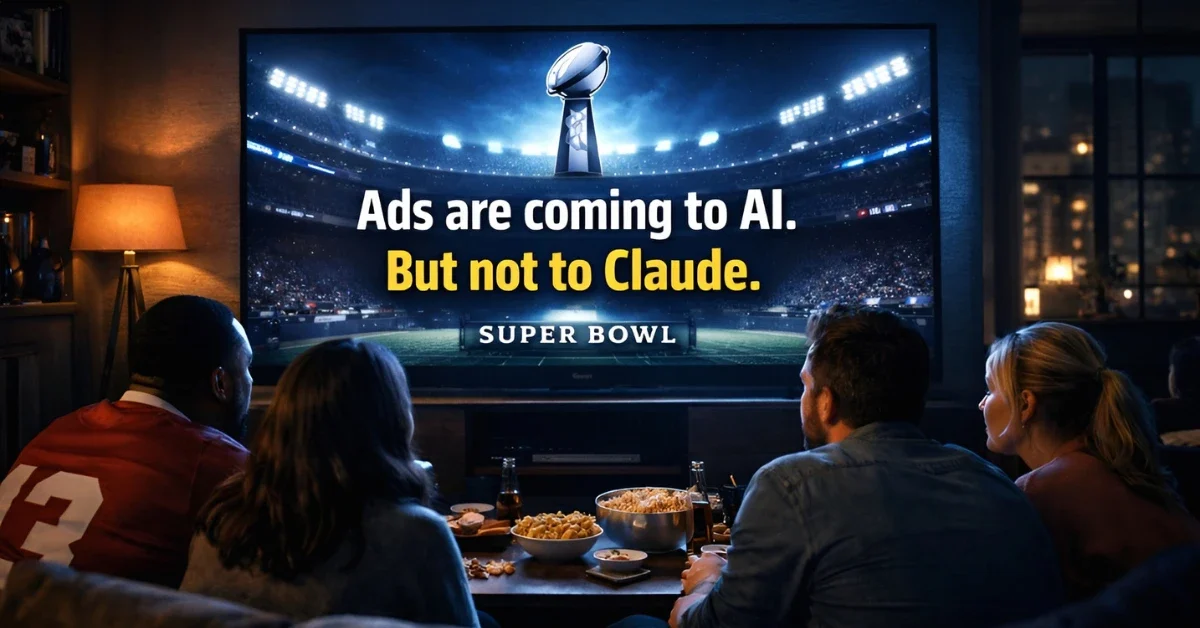
Anthropic has escalated its rivalry with OpenAI by purchasing millions of dollars in advertising time during Super Bowl LX to attack the maker of ChatGPT. The campaign, which is set to air during the National Football League championship game this Sunday night, focuses exclusively on OpenAI’s recent decision to introduce advertisements into its popular chatbot. Through a series of satirical spots, Anthropic positions its own Claude AI as the privacy-focused, ad-free alternative in a rapidly growing market.
The commercials mark a significant shift in the artificial intelligence sector, moving the competition from technical benchmarks to a public debate over business models. While OpenAI has defended its move to sell ads as a necessary step to support free access to costly computing power, Anthropic is using the massive platform of the Super Bowl to frame the decision as a betrayal of user trust. The campaign centers on the tagline, “Ads are coming to AI. But not to Claude,” explicitly drawing a line between the two companies.
A Public Spat on the Biggest Stage
The advertisements use humor to depict dystopian scenarios where AI assistants interrupt helpful interactions with unwanted sales pitches. One of the 30-second spots described by reports features a young man in a park attempting to do pull-ups. He asks a burly bystander, who represents a chatbot, for advice on how to get a “six-pack.” Instead of immediately providing a workout routine, the mechanical-sounding stranger first tries to sell him shoe inserts designed to help “short kings stand tall.” The young man is left bewildered by the sudden and irrelevant product placement before the advice finally begins.
Another commercial in the series, which includes titles such as “Betrayal,” “Deception,” “Treachery,” and “Violation,” takes a similar approach to personal advice. In this scene, a man asks an older woman—again serving as the personification of an AI—for help with communicating better with his mother. The interaction starts helpfully but quickly pivots into a pitch for “Golden Encounters,” a fictional “nature dating” service connecting “cubs with roaring cougars.” The stark contrast between the user’s sincere request and the absurdity of the ad placement drives home Anthropic’s critique of the ad-supported model.
OpenAI Executives Fire Back
The aggressive marketing push has provoked a sharp response from OpenAI’s leadership. Sam Altman, the CEO of OpenAI, took to social media platform X to label the advertisements as “misleading.” He further addressed the controversy during an interview on the TBPN podcast, rejecting the premise that his company would implement ads in such an intrusive manner. “We’re not foolish,” Altman stated. “We value our users, and we recognize that if we were to implement something akin to what those ads portray, people would justifiably cease utilizing our product.”
OpenAI’s Vice President of Global Affairs, Chris Lehane, also defended the company’s strategy. He argued that there is an underlying principle at stake regarding access to technology. According to Lehane, the immense cost of computing power required to run advanced AI models makes advertising a logical solution to keep services free for the general public. He pointed to successful models used by other tech giants, suggesting that ad revenue is essential for sustainability and broad accessibility.
The Battle for AI Users
This confrontation represents one of the most significant public disputes between leading artificial intelligence firms to date. By investing heavily in Super Bowl airtime, Anthropic is betting that users will prioritize an ad-free experience over the “free with ads” model that has dominated the internet era. The campaign aims to turn the presence of commercials in ChatGPT into a decisive wedge issue, categorizing the market into brands that become ad platforms and those that do not.
The rivalry highlights two diverging paths for the future of consumer AI. OpenAI appears to be following the trajectory of search engines and social media platforms, where user attention is monetized to subsidize free services. In contrast, Anthropic is marketing Claude as a premium utility that serves the user without split loyalties to advertisers. As the Super Bowl airs, millions of viewers will witness this philosophical debate play out in real-time, potentially influencing how the public perceives the integrity and utility of their AI assistants moving forward.
