

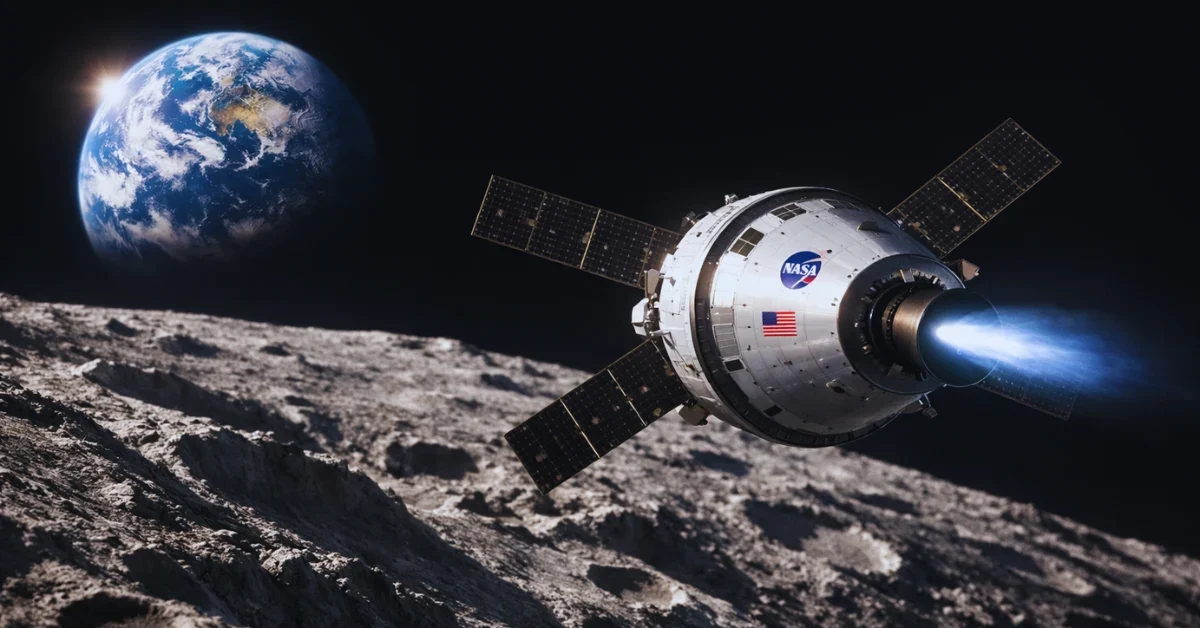
The Artemis II lunar flyby has officially marked a new era in space exploration, bringing humans back to the moon for the first time since the Apollo 17 mission in 1972. During the highly anticipated maneuver, a crew of four astronauts successfully navigated their spacecraft around the far side of the lunar surface. They captured stunning photographs of regions never before seen by human eyes, shared emotional milestones, and shattered a long-standing spaceflight distance record.
This historic Artemis II lunar flyby is part of a ten-day mission that launched from the Kennedy Space Center in Florida on April 1. The crew includes NASA astronauts Reid Wiseman, Victor Glover, and Christina Koch, alongside Canadian Space Agency astronaut Jeremy Hansen. Together, they have tested deep-space navigation systems and provided humanity with breathtaking new perspectives of our solar system, completely redefining modern spaceflight.
Shattering the Apollo 13 Distance Record
On the sixth day of their journey, the four astronauts officially traveled farther from Earth than any humans in history. Surpassing the previous benchmark of 248,655 miles set by the Apollo 13 mission decades ago, the Orion spacecraft reached a maximum distance of 252,756 miles from our home planet.
As the spacecraft soared through deep space, it utilized the moon’s gravitational pull to alter its trajectory. During the closest approach of the maneuver, the astronauts flew just 4,067 miles above the dusty, cratered lunar surface. This close encounter allowed them to deeply observe terrain features, ancient lava flows, and structural cracks that reveal how the celestial body evolved over billions of years.
First Human Glimpse of the Orientale Basin
One of the most significant highlights of the journey was the crew’s unhindered view of the moon’s perpetually hidden far side. For the first time, human eyes fully witnessed the Orientale Basin. This massive, dark, and heavily ringed impact crater stretches roughly 600 miles across the lunar surface. While robotic probes have photographed this rugged basin in the past, previous Apollo missions were unable to view it completely due to orbital and lighting limitations.
Beyond observing the rugged terrain, the astronauts experienced a rare astronomical event. As the spacecraft passed behind the moon and entered a forty-minute communications blackout with Earth, the crew flew directly into the lunar shadow. This positioned them perfectly to observe a total solar eclipse that lasted for fifty minutes. To their surprise, the shadow was not pitch black. The sun powerfully illuminated the entire perimeter of the moon, creating a brilliant, glowing outline against the deep blackness of space.
Capturing Earthrise and Emotional Milestones
As the Orion capsule emerged from the far side, the astronauts witnessed a spectacular “Earthrise,” watching our blue planet slowly ascend over the barren lunar horizon. This recreated the iconic perspective originally captured by the Apollo 8 crew. Earlier in the mission, Commander Reid Wiseman also photographed a stunning image titled “Hello, World.” Taken when the capsule was relatively equidistant between the two celestial bodies, the photograph showed the Sahara Desert, the Iberian Peninsula, and glowing auroras above a crescent Earth.
The magnitude of the journey sparked deeply emotional moments inside the capsule. While floating in microgravity, the astronauts gathered together in tears as Commander Wiseman named a newly observed lunar crater after his late wife, Carroll. The crew also dedicated a second crater, naming it “Integrity” in honor of their spacecraft. Astronaut Christina Koch reflected on the profound experience, noting that seeing the stark, unique body of the moon serves as a powerful reminder of Earth’s miraculous ability to provide everything humanity needs to survive.
Presidential Praise and the Journey Home
Shortly after concluding their extensive lunar observations, the astronauts received a direct transmission from Mission Control that included a live conversation with President Donald J. Trump. The president commended the crew for their bravery and the mission’s immense success. He praised their efforts, stating that they had made history and made all of America proud. He emphasized that humans had never seen anything quite like what the crew was accomplishing in a manned spacecraft.
With the critical flyby now complete, the astronauts are speeding back toward their home planet. The spacecraft is utilizing the momentum gained from the lunar gravity assist to carry them safely across the vast expanse of space. The historic mission is scheduled to conclude with a parachute-assisted splashdown in the Pacific Ocean off the coast of Baja California, bringing a successful end to humanity’s triumphant return to deep space.
