

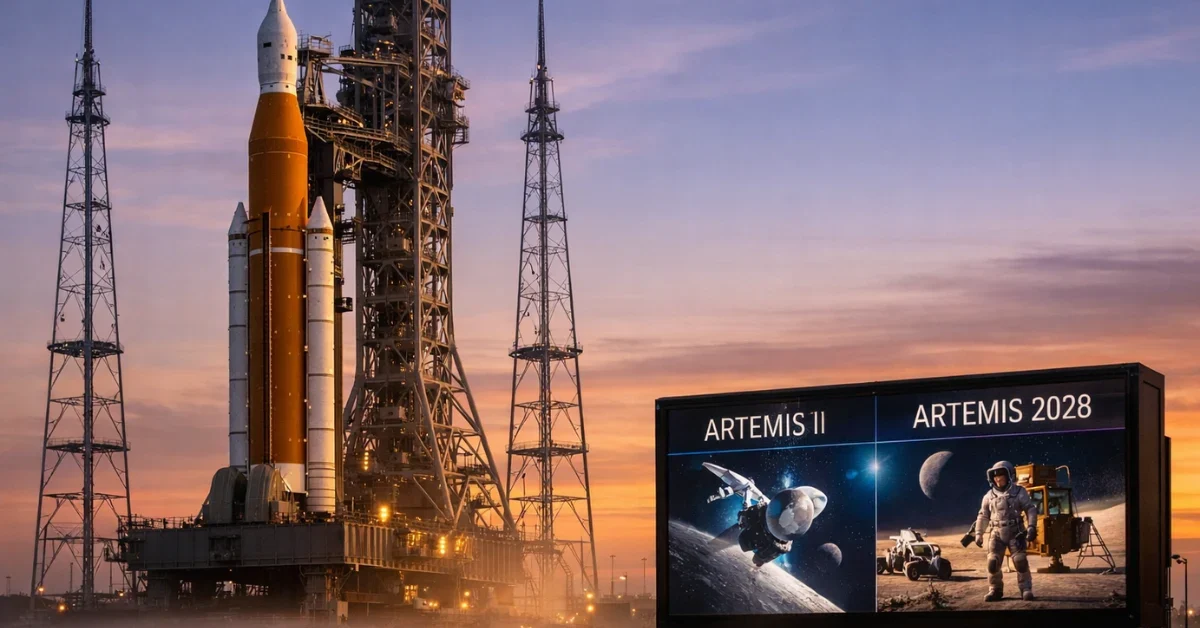
NASA has overhauled its Artemis schedule and mission design, pushing the first crewed lunar landing to 2028 and turning Artemis III into a crewed technology test flight in low Earth orbit in 2027.
The changes were announced by NASA Administrator Jared Isaacman, who said the agency needs to move in “steps” and reduce risk instead of attempting too many untested “firsts” at once.
Artemis II slips again
Before the newly redesigned Artemis III can fly, NASA is still working through delays on Artemis II, the mission planned to send four astronauts around the Moon without landing.
Spaceflight Now reported that Artemis II is on hold until at least April 1 after engineers worked to address a hydrogen leak and a helium pressurization problem in the rocket’s upper stage.
Newsbytes also said Artemis II was pushed back from a March 6 target to April 1 at the earliest, and described the rocket being moved back to the hangar at Kennedy Space Center after engineers found a blockage affecting helium flow.
Astronomy.com said Artemis II is currently set to launch in April if engineers can resolve the helium flow issue that emerged after the mission’s second dress rehearsal earlier in the month, and it described the trip as a 10-day journey around the Moon.
ScienceAlert noted that Artemis II includes Canadian astronaut Jeremy Hansen and said the earliest launch date is now April 1 following issues during wet dress rehearsals in February.
Artemis III becomes an Earth-orbit test
Under the new plan described across multiple reports, Artemis III will no longer attempt a Moon landing and will instead focus on systems tests in low Earth orbit.
Spaceflight Now said NASA plans a 2027 flight in which astronauts rendezvous and dock in low Earth orbit with one or both commercially developed lunar landers to test navigation, communications, propulsion, life support, and rendezvous procedures.
Astronomy.com similarly reported that Artemis III will be a low Earth orbit test flight, potentially docking with SpaceX’s Starship Human Landing System and Blue Origin’s Blue Moon lander, while the crew tests EVA suits, life support, and propulsion.
ScienceAlert said Orion astronauts are expected to conduct in-space testing of key systems such as life support, propulsion, and communications, and it said the crew may also test new spacesuits designed by Axiom Space.
Spaceflight Now added that the redesigned Artemis III could also give astronauts a chance to try the new commercially provided spacesuits in microgravity, even without a spacewalk.
Spaceflight Now compared the concept to Apollo 9, which tested a command module and lunar lander in Earth orbit in 1969 ahead of Apollo 11.
Two landings targeted for 2028
NASA’s revised architecture aims to follow the 2027 test mission with at least one—and possibly two—lunar landing missions in 2028.
Spaceflight Now said NASA is aiming for Artemis IV and Artemis V as lunar landing missions in 2028, using whichever commercial landers are ready, and it reported an official saying that if only one lander is available it would be used for both missions.
Newsbytes also said the plan could include a second Moon landing, Artemis V, in the same year, followed by annual attempts afterward, and it stated the longer-term goal is to land astronauts near the Moon’s south pole.
Astronomy.com reported that NASA is committing to annual lunar landings starting in 2028 as part of a more aggressive cadence than originally planned.
Why NASA is changing course
Spaceflight Now said the announcement came shortly after NASA’s independent Aerospace Safety Advisory Panel released a sharply worded report that considered the existing plans too risky and recommended the agency restructure Artemis to balance risk.
Newsbytes likewise reported that an independent space safety advisory panel criticized NASA’s plans as too risky and urged the agency to reconsider Artemis III’s demanding objectives.
Isaacman said NASA will “take down risk” and roll what it learns into subsequent designs, and Spaceflight Now reported him saying the agency needs to “get back to basics.”
A major part of the overhaul is simplifying how NASA flies the Space Launch System by standardizing configurations rather than repeatedly changing major elements between missions.
Spaceflight Now reported that NASA will halt work on the more powerful Exploration Upper Stage and instead move forward with a “standardized,” less powerful upper stage meant to reduce major changes between flights and use the same launch infrastructure.
Astronomy.com said NASA wants future landing missions to stay as close as possible to the existing Block 1 SLS setup, rather than shifting to heavier variants, and it linked that standardization to the drive for a faster flight rate.
ScienceAlert said NASA is also dealing with workforce pressure, reporting the loss of more than 4,000 employees—about 20% of its workforce—in 2025.
What’s still unclear
Astronomy.com said NASA has not fully detailed what the shift means for the development path of future SLS configurations beyond stating its intent to keep missions consistent with what has already flown.
ScienceAlert said NASA’s announcement did not mention the Lunar Gateway, and it noted the importance of the Gateway to Canada because it is planned to host Canadarm3, described as a $2-billion Canadian contribution to Artemis.
Astronomy.com also reported that NASA expects to announce specific objectives for the redesigned Artemis III in the near future.
