

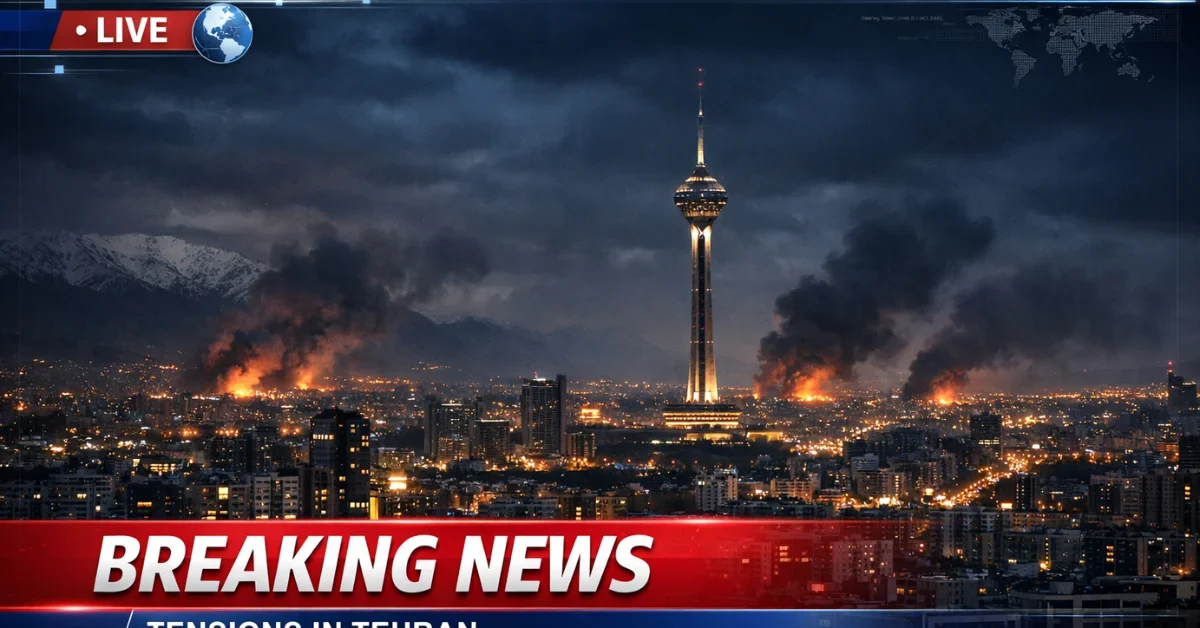
Iranian state media has officially confirmed the death of Supreme Leader Ayatollah Ali Khamenei following a coordinated military strike by the United States and Israel. The 86-year-old leader was killed in his Tehran compound during an attack that has immediately escalated tensions across the Middle East. The Ayatollah Ali Khamenei death announcement has triggered a 40-day period of public mourning across the nation.
The fatal airstrike took place on a Saturday, targeting Khamenei’s residence while he was reportedly holding a meeting with senior advisors. This joint US-Israeli operation aimed at top Iranian leadership facilities not only killed the Supreme Leader but also resulted in the deaths of several of his family members. Reports indicate that Khamenei’s daughter, son-in-law, and granddaughter lost their lives in the bombardment. The attack marks a major turning point in the region, prompting multiple Middle Eastern nations to close their airspace and issue safety advisories to their citizens.
US and Israeli Leaders Announce the Strike Results
Before Iranian state television formally broadcasted the news on Sunday, international leaders had already begun announcing the outcomes of the military operation. US President Donald Trump used social media to publicly declare that Khamenei had been killed, stating that the Iranian leader could not hide from American intelligence. Trump referred to the deceased ruler as one of history’s most evil figures, writing, “Khamenei, one of the most evil people in History, is dead.” He also encouraged the Iranian public to take control of their country.
In Israel, Prime Minister Benjamin Netanyahu confirmed that the military had eliminated senior figures within the Iranian regime, including Revolutionary Guard commanders and nuclear program officials. Netanyahu publicly stated, “There are many signs that this tyrant is no longer,” and warned that Israeli forces would continue to strike thousands of additional targets linked to what he described as a regime of terror.
Initial Denials and Iran’s Vow for Retaliation
In the immediate aftermath of the bombings, there was significant disagreement between international reports and Iranian officials regarding the leader’s status. Early on, Iranian authorities accused foreign enemies of engaging in “mental warfare.” Outlets such as Tasnim and Mehr initially claimed that Khamenei was still commanding the field, though they provided no evidence to support these assertions. This directly contradicted the firm statements from Washington and Jerusalem that the leader was dead.
Once the death was officially acknowledged, Iran’s rhetoric shifted to promises of severe retribution. The Islamic Revolutionary Guard Corps released a statement pledging a severe, decisive, and regrettable punishment for those responsible for the assassination. The group announced the launch of an intense offensive operation targeting American and Israeli assets in the Middle East. Iran’s cabinet echoed these sentiments, warning that the assassination was a great crime that would not go unanswered.
True to their warnings, Iranian forces quickly initiated retaliatory military actions. Tehran launched strikes against US military bases located in several Middle Eastern countries, including Jordan, Bahrain, Qatar, and the United Arab Emirates. Meanwhile, the streets of Tehran saw mixed reactions to the news, with reports noting that some residents openly celebrated the leader’s demise in public spaces.
The End of a 36-Year Rule
Ayatollah Ali Khamenei had served as Iran’s Supreme Leader since 1989, taking over after the death of the Islamic Republic’s founder, Ruhollah Khomeini. Over his 36 years in power, Khamenei directed the nation through numerous domestic and international crises. His administration was heavily criticized by human rights organizations for the violent suppression of domestic dissent, including the deaths of thousands of citizens during widespread protests in recent years.
Internationally, Khamenei was known for aggressively advancing Iran’s nuclear and ballistic missile programs. He also provided extensive financial and military support to a network of regional proxy groups. These militant organizations included Hezbollah in Lebanon, the Houthis in Yemen, and Hamas in Gaza. His backing of these groups frequently put Iran in direct conflict with Israel and the United States. Following the confirmation of his death, Australian Prime Minister Anthony Albanese commented on the leader’s legacy, stating that his passing will not be mourned due to his history of supporting violence and militant activities.
The fatal strike represents the climax of a prolonged period of severe regional conflict. Tensions skyrocketed following the October 7, 2023, attacks on Israel by Hamas, which led to a broader war involving Iranian-backed forces. Over the past few years, Israel systematically dismantled Iran’s air defenses and heavily weakened Hezbollah and Hamas. With the death of its longest-serving Supreme Leader and significant damage to its military infrastructure, Iran now faces a profound leadership vacuum and an uncertain future.
