

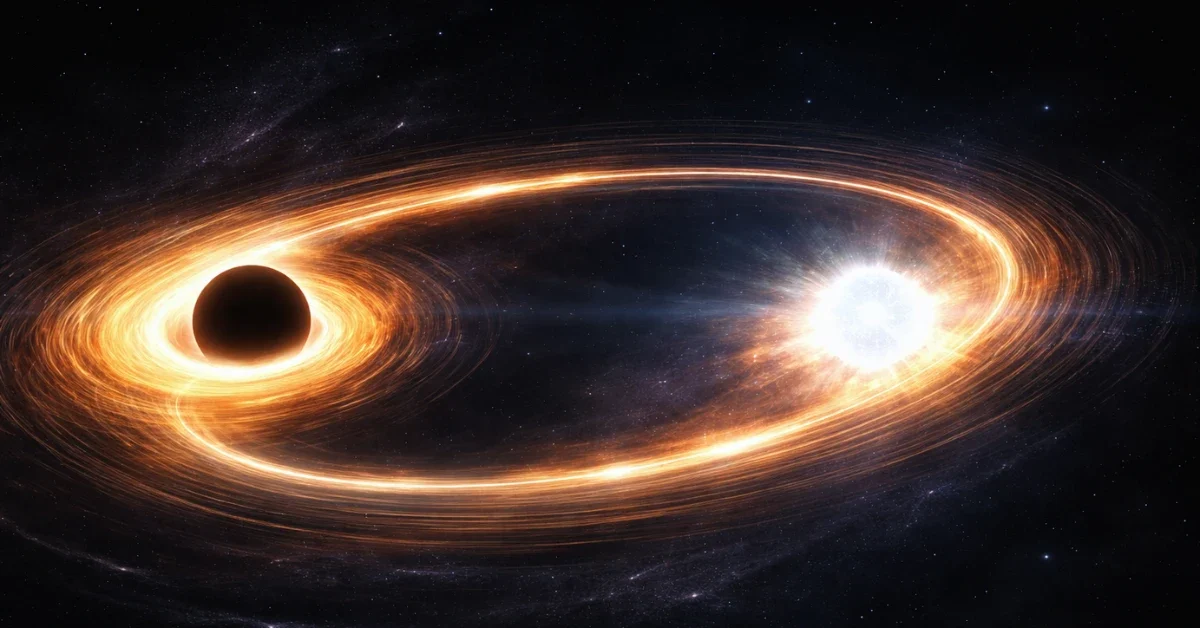
Scientists have uncovered the first robust evidence of an eccentric, oval-shaped orbit in a black hole and neutron star merger. This groundbreaking finding challenges long-held astronomical assumptions that these extreme cosmic pairs must adopt perfectly circular orbits before crashing together. Published in The Astrophysical Journal Letters on March 11, 2026, the research highlights a collision that forces physicists to rethink how mixed binary systems form and evolve in the universe. The discovery proves that our current theoretical models of these monstrous cosmic mergers are incomplete, introducing a new layer of complexity to the laws of physics.
The cosmic event, known as GW200105, was detected as gravitational waves—invisible ripples in the fabric of space-time originally predicted by Albert Einstein’s theory of relativity. These waves are released during the most extreme cosmic collisions. The specific merger occurred roughly 910 million light-years away from Earth. When the two dense stellar remnants finally crashed and combined, they birthed a newly formed black hole containing approximately 13 times the mass of our sun.
Researchers from the University of Birmingham, the Universidad Autónoma de Madrid, and the Max Planck Institute for Gravitational Physics collaborated to analyze the signals. They utilized precise measurements captured by the 1,900-mile-long Laser Interferometer Gravitational-Wave Observatory (LIGO) in the United States and the Virgo detector in Italy.
Measuring Eccentricity and Precession
To properly understand the final moments of this black hole and neutron star merger, the international research team relied on a new gravitational-wave model developed at the University of Birmingham’s Institute of Gravitational Wave Astronomy. For the first time in a mixed binary event, scientists simultaneously measured both the eccentricity of the orbit and its precession. Eccentricity refers to how oval-shaped the orbital path is, resembling the swirls of a Spirograph rather than a perfect ring. Precession describes the wobble or shift in the rotational axis of the objects over time.
By conducting a comprehensive Bayesian analysis that compared thousands of theoretical predictions against the real-world data, the researchers determined that a circular orbit was extremely unlikely. In fact, they officially ruled out a circular path with 99.5% confidence. The careful analysis also revealed no compelling evidence of precession leading up to the monumental crash.
Gravitational Interactions and Stellar Origins
Because the doomed system lacked noticeable spin-induced wobbling, scientists concluded that the oval shape was not caused by the rotation of the objects. Instead, the extreme eccentricity was most likely imprinted on the system long before its death.
Geraint Pratten, a Royal Society University Research Fellow at the University of Birmingham, noted that the elliptical shape of the orbit just before the merger gives away the system’s turbulent history. Rather than evolving quietly in isolated space, the binary pair was almost certainly shaped by chaotic gravitational interactions with other surrounding stars or a hidden third companion object.
Gonzalo Morras of the Universidad Autónoma de Madrid and the Max Planck Institute for Gravitational Physics explained that this highly eccentric orbit points to a birthplace in a dense environment where numerous stars interact gravitationally. This provides convincing proof that not all black hole and neutron star pairs share the exact same origin story, effectively dismantling the idea of a single dominant formation pathway.
Correcting Past Assumptions
Both black holes and neutron stars are created when massive stars run out of nuclear fuel and collapse into incredibly dense, dying remnants. Traditionally, astronomers believed that if two such remnants fell into a shared binary orbit, their path would naturally circularize over time long before they collided.
Because past analyses of the GW200105 event assumed a perfectly circular orbit, previous calculations produced fundamentally inaccurate mass estimates. Earlier models incorrectly estimated the black hole at around nine times the mass of the sun and the neutron star at about two solar masses. The new study officially corrects these values, underscoring the absolute necessity of accounting for orbital eccentricity in future observations.
Patricia Schmidt, an associate professor at the University of Birmingham, stated that the ongoing eccentricity at the end of the system’s life acts as a clear signal that formation pathways differ dramatically from standard predictions. Ultimately, this discovery opens a new window into the universe, helping explain the growing diversity observed among compact cosmic mergers.
