

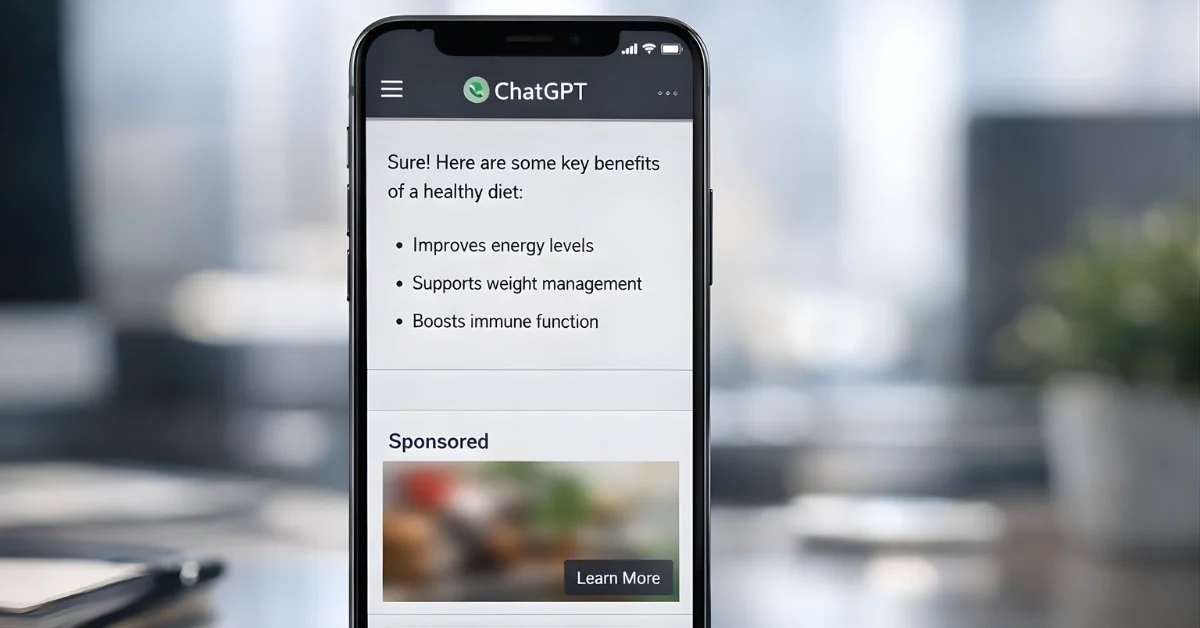
OpenAI says ChatGPT ads are about to appear for some users in the United States, marking a major shift in how the company plans to fund the popular AI chatbot. The company says it will begin testing ads in the coming weeks for people using ChatGPT’s free tier and its lower-cost Go plan.
The ads are expected to show up at the bottom of ChatGPT responses and will be clearly labeled and separated from the chatbot’s main answer. OpenAI says the ads will not influence what ChatGPT tells users, and it says it will not sell users’ information to advertisers.
Who will see the ads, and when
OpenAI says the early ad test will start in the U.S. and will focus on users who are not on the company’s higher-priced subscriptions. The test will apply to the free version of ChatGPT and to ChatGPT Go, a cheaper paid plan that costs $8 per month.
Multiple reports describe the rollout as beginning “in the coming weeks,” with the U.S. as the first location. Some reports also say OpenAI plans to expand the testing to other regions later.
OpenAI says users on higher-priced plans will not see ads. Reports name these ad-free tiers as Plus, Pro, Business, and Enterprise.
What the ads will look like in ChatGPT
OpenAI’s plan is to place ads at the bottom of ChatGPT’s responses, rather than mixing them into the main text of the answer. The company also says ads will be clearly labeled and kept separate from organic answers.
Some reports describe the ads as appearing when there is a relevant sponsored product or service tied to what the user is currently talking about. In other words, the ads may be targeted to the topic of the conversation, rather than appearing randomly.
Privacy, personalization, and sensitive topics
OpenAI says ads will not change ChatGPT’s answers, describing this as keeping “answer independence.” OpenAI also says user conversations will remain private from advertisers, and it will not sell users’ data to advertisers.
Reports say OpenAI plans to limit ads for certain groups and subjects. For example, some coverage says users under 18 will not be shown ads. Reports also say advertising will be restricted around sensitive topics, including politics, health, and mental health.
OpenAI also says users will have controls related to the ad experience. Some coverage says users will be able to see why a specific ad is being shown, dismiss ads, and give feedback. Reports also say users will be able to turn off ad personalization.
Why OpenAI is moving toward ads
OpenAI’s shift to advertising comes as AI services remain expensive to run. One report says OpenAI is trying to increase revenue to cover soaring costs, and it notes that only a small portion of the company’s large user base pays for subscriptions.
One report describes OpenAI as having nearly one billion users, with most using the product without paying. The same report also describes OpenAI’s valuation as reaching $500 billion in funding rounds and notes expectations that the company could go public in the future, with some speculation about a trillion-dollar valuation.
The move also places OpenAI closer to the business model of major consumer internet companies that rely heavily on ads. One report compares this shift to companies such as Google and Meta, which built large ad businesses around free-to-use services.
At the same time, OpenAI says it does not want ads to damage the experience people expect from a chatbot. In one report, OpenAI says it will not optimize for “time spent in ChatGPT,” distancing itself from engagement-driven ad strategies used by some social and video platforms.
A change from earlier messaging
The decision to test ads also highlights how OpenAI’s thinking has evolved. One report points to earlier comments from CEO Sam Altman, saying he previously described advertising in ChatGPT as a “last resort” and raised concerns about the risk to user trust.
OpenAI now says ads are part of a broader plan to support access to ChatGPT, especially for users who are not ready to pay for the company’s higher-priced subscriptions. Some coverage also suggests the company could see a secondary benefit if some users choose to pay for ad-free plans rather than use a version supported by ads.
