

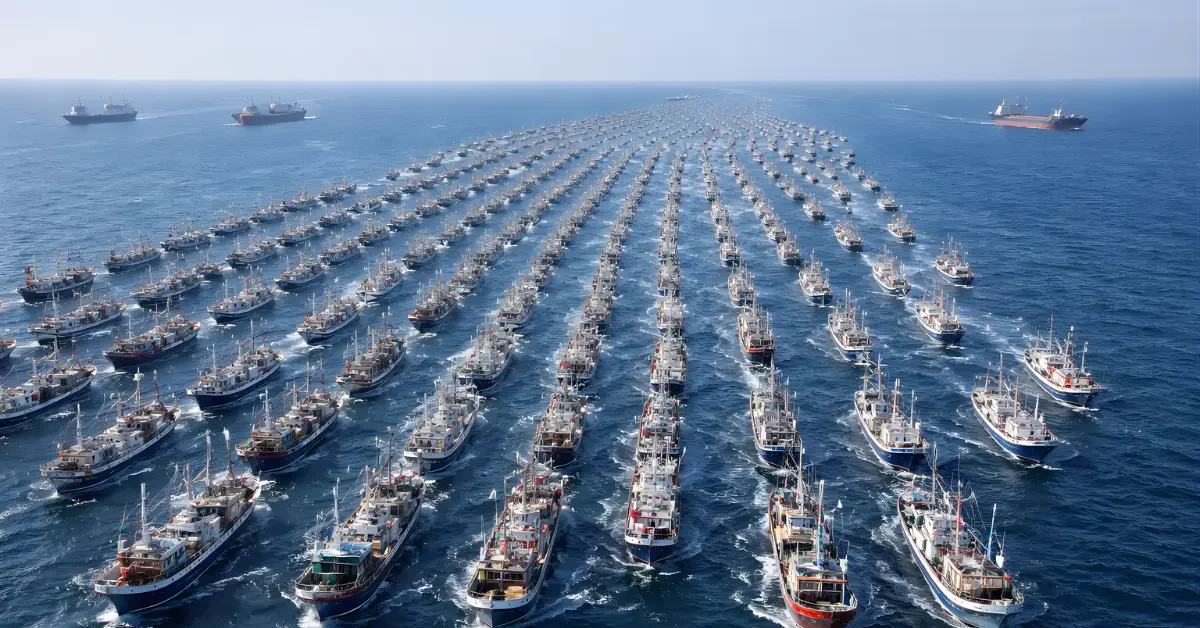
China has twice gathered unusually large groups of fishing boats in the East China Sea in recent weeks, forming tightly organized patterns that analysts say appear aimed at testing how civilian vessels could be used to restrict access to waters near Taiwan in a future confrontation. The formations were identified through ship-tracking data analysis, and multiple experts quoted in published reports said the behavior did not look like normal fishing activity.
The largest of the recent gatherings involved about 1,400 Chinese vessels that assembled by January 11 into a compact rectangular formation spanning roughly 200 miles, according to reporting that cited ship-tracking data. Another report described the same January formation as a rectangle stretching about 321 kilometers north to south.
Two large formations weeks apart
A similar operation occurred on Christmas Day, when roughly 2,000 boats assembled in the same area in an L-shaped configuration, according to accounts that cited ship-tracking analysis. One report described the Christmas formation as extending about 290 miles per line, creating a reverse L shape. Another report described the Christmas L-shaped “wall” as reaching up to 466 kilometers.
In both instances, the clusters were dense enough that nearby cargo ships changed course, either going around the mass of vessels or threading through it to stay on route. Analysts described the scale, discipline, and steadiness of the formations as unusual for fishing fleets, which typically spread out and move while working.
What ship-tracking firms found
The vessel movements were identified using ship-tracking data analyzed by ingeniSPACE, a U.S. geospatial intelligence company, according to published reports. The findings were also independently verified by Starboard Maritime Intelligence, according to those same accounts.
Analysts cited in the reports said there were no indications the tracking signals were falsified. The operations also went largely unnoticed until the tracking data was reviewed, according to one account.
Experts cite “maritime militia” concerns
Several maritime and military analysts said the patterns point to centralized coordination rather than spontaneous fishing activity. Gregory Poling, director of the Asia Maritime Transparency Initiative at the Center for Strategic and International Studies, was quoted as saying the vessels were almost certainly not fishing and that he could not readily explain the behavior without state direction.
Poling was also quoted as suggesting the gathering looked like an exercise to test how civilians would perform if told to muster at scale in a future contingency, potentially to support quarantine, blockade, or other pressure tactics against Taiwan. Another report said Western experts believe China is organizing a maritime militia that presents as civilian in peacetime but could be integrated into military operations during a crisis.
Why the timing is drawing attention
The two vessel concentrations occurred around the same period that China conducted military drills near Taiwan late last month, according to multiple accounts. The formations were reported to have been assembled near major shipping routes running from Shanghai, waterways described as carrying heavy commercial traffic.
One account described the repeated “maritime barrier” formations as being close to key maritime logistics routes, which experts viewed as relevant for crisis planning. Chinese authorities have not publicly commented on the reported fishing-vessel activity, according to one report.
How fishing boats could be used in a crisis
Specialists quoted in the reports said fishing boats alone would not be enough to impose a complete blockade of Taiwan. However, they also said large numbers of small vessels could congest sea lanes, limit the movement of warships and supply vessels, and complicate monitoring by creating too many contacts for radar and drone systems.
Lonnie Henley, described as a former U.S. intelligence officer who has studied China’s maritime militia, was quoted as saying smaller vessels could hinder the movement of American warships. Thomas Shugart, described as a former U.S. naval officer now with the Center for a New American Security, was quoted as saying masses of boats could act as missile and torpedo decoys by overwhelming radars or drone sensors with too many targets.
One report also described discussions of fishing vessels potentially acting as “bait” to draw missiles and torpedoes, which could force defenders to spread resources across many targets. Another account said experts viewed the repeated use of large, organized formations in the same waters as a sign that Beijing may be testing how civilian fleets could be rapidly mobilized as part of broader pressure tactics in contested seas.
Beijing claims Taiwan as its territory, according to one report, and the same account said China is also in a dispute with Japan over Japan’s support for the island.
