

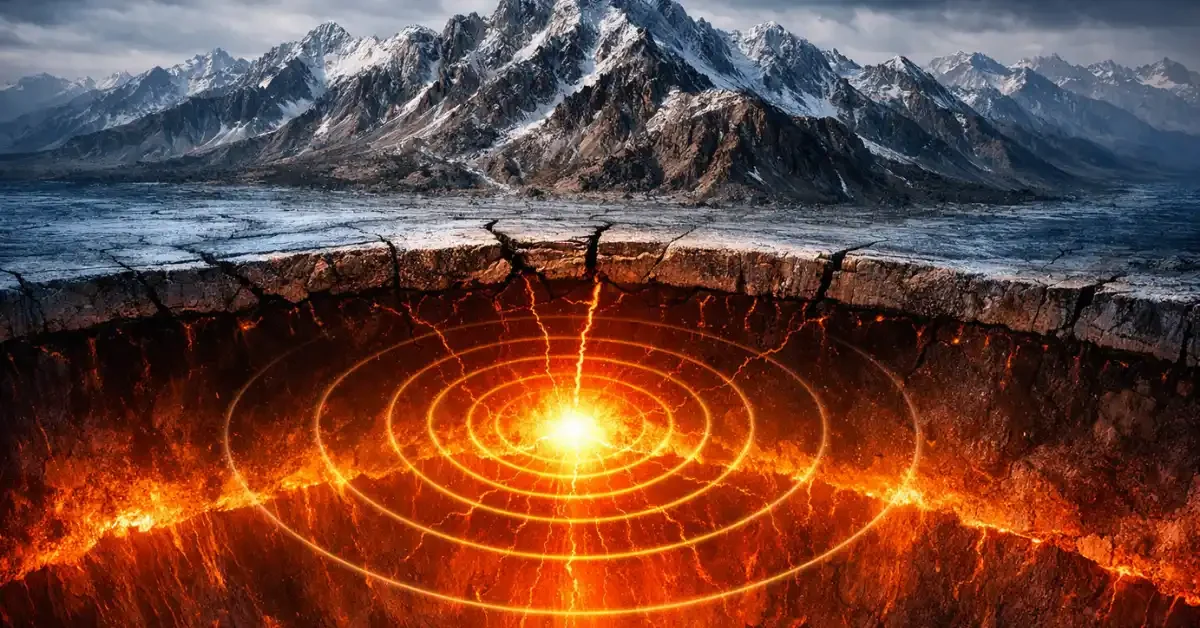
For decades, scientists believed that earthquakes almost exclusively rattled the Earth’s brittle outer crust . Now, researchers at Stanford University have proven that the ground shakes much deeper beneath our feet . A groundbreaking new study has produced the world’s first global map of continental mantle earthquakes . These rare tremors originate in the thick, semi-solid layer of rock located between the planet’s crust and its molten core . Published on February 5, 2026, in the journal Science, the research identifies 459 of these deep seismic events occurring since 1990 . By developing an innovative method to track seismic waves, scientists successfully pinpointed these elusive continental mantle earthquakes across the globe, offering critical clues about how our planet’s internal structures interact .
The Earth’s Mysterious Middle Layer
Most traditional earthquakes start in the Earth’s crust, which extends roughly six to eighteen miles below the surface . The crust is cold and fragile, causing it to crack and snap under intense stress . Beneath this brittle shell lies the mantle, a massive, 1,800-mile-thick zone of dense, warm rock that makes up the majority of the Earth’s interior . The boundary separating the crust from the mantle is known as the Mohorovičić discontinuity, or simply the “Moho” .
Because the mantle is hotter and more flexible than the crust, it typically stretches slowly like taffy rather than breaking abruptly . Consequently, many experts historically assumed it was impossible for significant seismic activity to occur there . While deep tremors happen in subduction zones—where heavy oceanic plates are forced downward—quakes under the main continental landmasses were highly debated . This new research definitively proves that these sub-Moho fractures occur far away from subduction zones, sometimes reaching depths fifty miles below the Moho .
A Game-Changing Detection Method
Tracking seismic activity that deep is a massive challenge. Because the Earth’s crust thickness varies wildly, traditional detection methods struggled to confirm whether a deep tremor started in the lower crust or the upper mantle . Furthermore, these deep events are generally too small to be felt by humans on the surface .
To solve this, Stanford geophysics professor Simon Klemperer and lead study author Shiqi Wang created a brand-new detection technique . Their approach analyzes the distinct patterns of seismic waves that echo through the Earth after a tremor occurs . They focused on two specific vibrations: Sn waves, or “lid” waves, which travel horizontally along the very top layer of the mantle, and Lg waves, which are high-frequency vibrations that bounce rapidly within the crust . By measuring the ratio of these wave types during an event, the team could confidently determine whether the fracture originated above or below the Moho .
Where Do These Deep Quakes Occur?
Armed with their new technique, the researchers evaluated over 46,000 quakes before confirming the 459 continental mantle earthquakes . When mapped out, these rare events were found to cluster in very specific regions rather than happening randomly .
A dense concentration stretches across a band from the Alps to the Himalayas, areas driven by massive continental collisions and active mountain-building . Another major cluster sits in East Africa, where the continental crust is actively tearing apart . Tremors were also recorded under the western United States, Baffin Bay in Canada, and near the Bering Strait . Some quakes even appeared in surprising locations like the Bering Sea, where deep seismic activity had never been previously documented . Researchers note that expanding sensor networks in remote areas will likely uncover many more of these events .
Why These Hidden Tremors Matter
While continental mantle earthquakes happen roughly a hundred times less frequently than normal crustal quakes, mapping them is a massive leap forward for earth science . Because these events occur so far underground, they pose absolutely no danger to human life or infrastructure on the surface .
However, their scientific value is immense. Studying the upper mantle is crucial because this region generates volcanic magma and plays a primary role in driving tectonic plate movement . By understanding the specific triggers for these deep quakes—whether they are aftershocks from crustal activity or the result of heat-driven convection—scientists can better understand the forces that cause all earthquakes . Ultimately, researchers believe these deep tremors are part of an interconnected cycle that links the crust and the mantle together, offering a clearer picture of how our planet functions as a complete system .
