

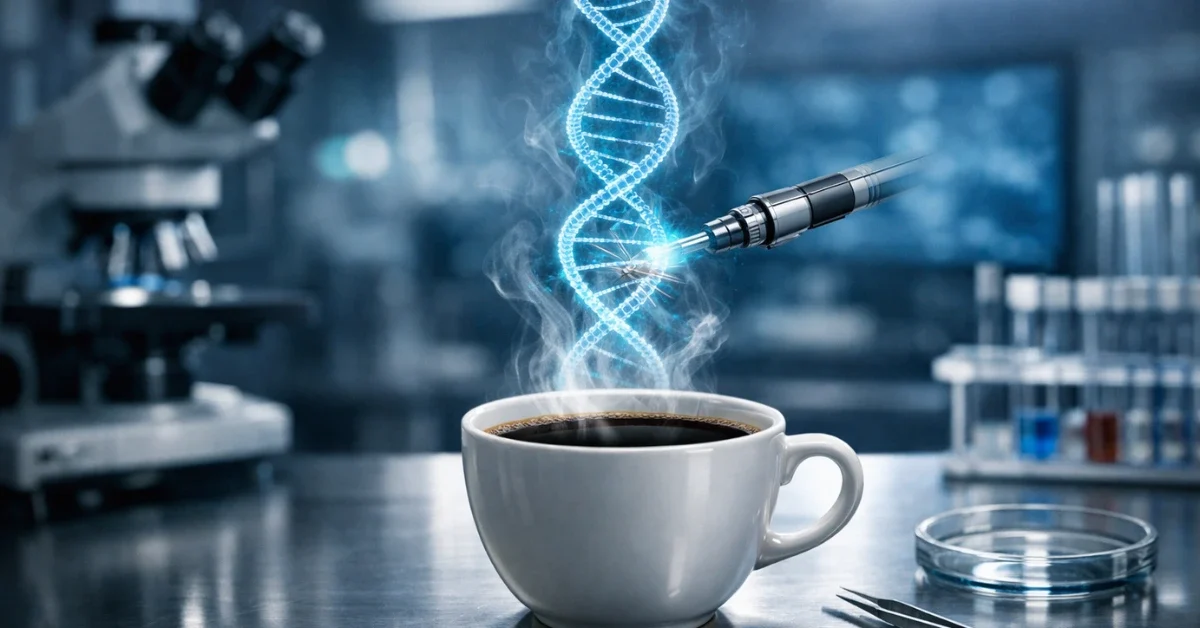
A simple cup of coffee could soon play a major role in treating severe medical conditions like cancer and diabetes. Researchers at the Texas A&M Health Institute of Biosciences and Technology have developed a novel method that uses caffeine to activate CRISPR gene editing tools inside the human body. By combining ordinary dietary compounds with advanced genetic engineering, scientists are paving the way for highly precise, controllable treatments for long-term diseases.
The innovative approach falls under the growing field of chemogenetics, which involves controlling cellular behavior through external molecules. Unlike traditional medications that impact multiple tissues throughout the body, chemogenetic therapies only target cells specifically programmed to respond. By introducing caffeine into this process, researchers have created an accessible way to switch targeted gene modifications on and off. The breakthrough findings were recently published in the journal Chemical Science.
Engineering the Cellular Switch
Yubin Zhou, director of the Center for Translational Cancer Research at the institute, led the effort to merge CRISPR technology with everyday compounds. The strategy requires preparing specific cells in advance using standard gene-transfer methods. Scientists equip these cells with the genetic instructions needed to produce a specialized nanobody, a matching target protein, and the necessary CRISPR components. Once this biological framework is established, the system remains dormant until it receives a specific outside signal.
That signal comes in the form of a small dose of caffeine. Consuming just 20 milligrams—an amount easily found in a standard cup of coffee, a soda, or a piece of chocolate—prompts the nanobody and its corresponding protein to bind together. This binding action effectively flips a molecular switch, initiating the CRISPR-driven gene editing process within the target cells. Researchers have dubbed these caffeine-activated nanobodies “caffebodies.”
Animal model lab studies have already demonstrated the effectiveness of this technique. The research team noted that both caffeine and its metabolic byproducts, such as theobromine found in cocoa, successfully trigger the desired genetic response. Because these triggers are well-understood and highly accessible, the experimental treatment presents fewer side effects than many existing medical interventions.
A Reversible Approach to Medicine
One of the most significant advantages of this new system is its reversibility. While other genetic modification methods activate changes permanently, the caffeine-driven model features a built-in off switch. The initial genetic activation lasts only for the duration of the caffeine’s metabolization time, which is typically a few hours.
To provide even greater control, researchers discovered that administering rapamycin can instantly halt the process. Rapamycin is a widely available immunosuppressant medication routinely given to organ transplant patients to prevent their white blood cells from attacking foreign tissue. When introduced into the new CRISPR system, rapamycin forces the bound proteins to separate.
This start-and-stop capability offers crucial benefits for patient safety. Doctors could temporarily pause a patient’s gene therapy to relieve treatment-related stress or manage unexpected side effects. Once the patient’s condition stabilizes, the therapy could be seamlessly restarted. Zhou noted that the system is entirely tunable, allowing medical professionals to engineer the cellular molecules to work in reverse—where caffeine causes the proteins to separate, and rapamycin brings them together.
Future Treatments for Cancer and Diabetes
The ability to manually direct the immune system opens up new possibilities for combating complex illnesses. Unlike older techniques, the chemogenetic model successfully activates T cells. These specialized cells function as the immune system’s memory bank, storing vital blueprints used to fight off future infections and diseases.
In the context of cancer therapy, scientists could integrate caffebodies directly into T cells, including chimeric antigen receptor T (CAR-T) cells. This would grant doctors precise chemogenetic control over exactly when, where, and with what intensity the patient’s immune system attacks cancerous tumors. By fine-tuning the body’s natural defenses, oncologists could deliver highly customized treatments.
Beyond cancer, the technology holds tremendous promise for metabolic disorders. Zhou envisions a future where patients with diabetes possess genetically engineered cells that automatically increase insulin production after consuming a caffeinated beverage. Because the underlying compounds are already familiar and widely consumed, the research team hopes to translate these preclinical findings into practical therapies that redefine precision medicine.
Moving forward, the research team plans to advance this work into broader preclinical studies. By exploring additional ways to pair caffebodies with CRISPR, they aim to expand the list of treatable medical conditions. The ultimate goal is to seamlessly repurpose familiar food ingredients as control signals for sophisticated cellular therapies, offering a highly practical path toward real-world medical applications.
