

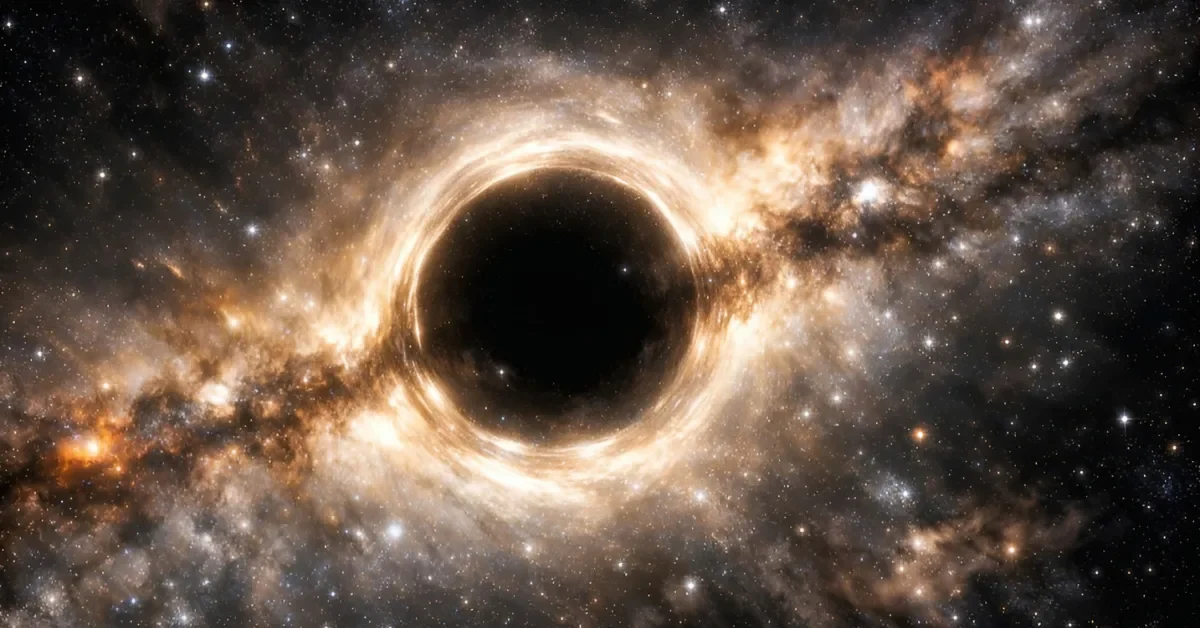
A new scientific study challenges the long-held belief that a supermassive black hole sits at the center of the Milky Way. Astronomers now propose that the galaxy’s heart might instead be powered by a dense core of dark matter. This theory suggests that the gravitational effects usually attributed to a black hole could actually be caused by a massive concentration of invisible particles known as fermions.
Published in the Monthly Notices of the Royal Astronomical Society, the research offers an alternative explanation for the movement of stars and gas within the galaxy. Instead of a singularity—a point of infinite density—the center may host a compact clump of dark matter that mimics the pull of a black hole. This model aims to resolve outstanding questions about the galaxy’s structure by treating the center and the surrounding halo as a single, unified system.
A Unified Body of Dark Matter
The researchers, led by the Institute of Astrophysics La Plata in Argentina, suggest that the Milky Way is governed by a continuous substance rather than separate components. According to the study, this “fermionic dark matter” forms a super-dense core at the galactic center, which is surrounded by a vast, diffuse halo that stretches to the galaxy’s edges.
Dr. Carlos Argüelles, a co-author of the study, explained that this model bridges the gap between the small-scale activity at the core and the large-scale rotation of the galaxy. “We are not just replacing the black hole with a dark object; we are proposing that the supermassive central object and the galaxy’s dark matter halo are two manifestations of the same, continuous substance,” Argüelles said.
Explaining Stellar Orbits and Galaxy Rotation
For years, astronomers have observed a group of stars, known as S-stars, speeding around the galactic center at thousands of kilometers per second. The traditional model attributes this speed to the immense gravity of Sagittarius A*, the proposed supermassive black hole. However, the new findings indicate that a dense core of fermions could exert the same gravitational influence, perfectly matching the observed orbits of these high-speed stars.
The study also relies on recent data from the European Space Agency’s Gaia mission. This mission mapped the rotation speed of stars and gas in the outer parts of the galaxy. The data revealed a “Keplerian decline,” or a slowdown in rotation at the galaxy’s edge. The researchers found that their dark matter model’s outer halo naturally explains this slowdown, whereas traditional models often struggle to fit this data without complex adjustments.
Mimicking the Black Hole Shadow
One of the biggest challenges for any new theory is accounting for the visual evidence captured by the Event Horizon Telescope (EHT), which famously imaged the “shadow” of the black hole at the Milky Way’s center. The research team asserts that their dark matter core can replicate this visual feature.
Dr. Valentina Crespi, another lead researcher, noted that the dense core bends light so intensely that it creates a central darkness surrounded by a bright ring. “Our model not only explains the orbits of stars and the galaxy’s rotation but is also consistent with the famous ‘black hole shadow’ image,” Crespi stated. This means the current visual proof does not definitively rule out the dark matter hypothesis.
Future Tests to Confirm the Theory
While the current data fits both the black hole and dark matter models, the study outlines specific ways to tell them apart. The key difference lies in a feature called the “photon ring,” a thin circle of light that is unique to black holes. The dark matter core scenario would not produce this specific ring.
Astronomers plan to use more precise instruments, such as the GRAVITY interferometer on the Very Large Telescope in Chile, to search for this signature. If future observations fail to find the photon ring, it could provide strong evidence that the Milky Way’s heart is indeed a giant ball of dark matter, fundamentally changing our understanding of the universe.
