

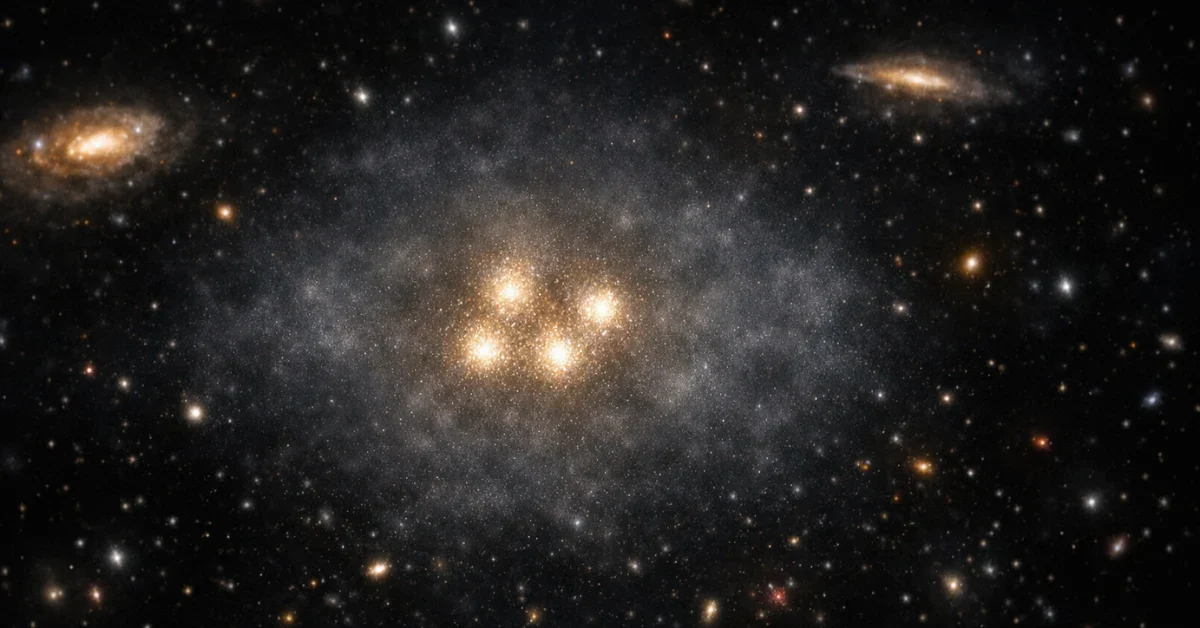
In the nearby universe, most galaxies are defined by the brilliant glow of billions of stars. However, astronomers have recently uncovered a rare cosmic ghost that challenges our understanding. Using NASA’s Hubble Space Telescope, scientists have identified an elusive object known as Candidate Dark Galaxy-2 (CDG-2). This low-surface-brightness galaxy is almost completely invisible to traditional observations. It is dominated by dark matter, containing only a sparse scattering of faint stars. This remarkable discovery provides an unprecedented glimpse into the hidden structures of our cosmos.
Located roughly 300 million light-years from Earth in the dense Perseus galaxy cluster, CDG-2 is unlike typical vibrant star systems. While our Milky Way boasts over 150 globular star clusters, this dark matter galaxy contains a mere four. These tightly packed clusters act like cosmic breadcrumbs, marking an otherwise unseen galactic structure. By following these subtle clues, researchers confirmed the existence of one of the darkest known galaxies ever observed.
A Collaborative Cosmic Discovery
Confirming the existence of such a faint object required the combined power of three major astronomical facilities. The initial clues came from NASA’s Hubble Space Telescope, which provided high-resolution imaging that revealed the four globular clusters traveling together through space. Because these clusters appeared to be bound by gravity, astronomers suspected an underlying invisible force was holding them in place.
To verify this theory, the team turned to the European Space Agency’s Euclid space observatory and the ground-based Subaru Telescope located in Hawaii. Follow-up observations from these powerful instruments uncovered an extremely faint, diffuse glow of starlight surrounding the four clusters. This nearly imperceptible halo provided the definitive physical evidence needed to prove that CDG-2 is indeed a true galaxy. Remarkably, this marks the first time a galaxy has been discovered purely by identifying its globular cluster population.
Measuring the Unseen
The sheer lack of visible material in CDG-2 is astounding. According to early calculations, the four globular clusters account for about 16 percent of all the visible light within the galaxy. The remaining mass of the galaxy is what makes it truly extraordinary. Researchers estimate that an astonishing 99 percent of the total mass of CDG-2 consists of dark matter. Dark matter is a mysterious, invisible substance that does not reflect, emit, or absorb light, making it detectable only through its gravitational influence on visible objects.
Conflicting Luminosity Estimates
While experts agree on the dark matter dominance of CDG-2, there is a discrepancy regarding its exact brightness. According to the European Space Agency, preliminary analysis suggests the galaxy dimly shines with a luminosity equivalent to roughly one million Sun-like stars. Conversely, data from NASA and the Space Telescope Science Institute state that CDG-2 shines with the light of about six million Sun-like stars. Both sides agree this brightness is incredibly low, but the exact value remains a point of differing scientific assessment.
The Mystery of the Missing Gas
How did a galaxy like CDG-2 become so devoid of normal matter? Most galaxies contain vast reservoirs of hydrogen gas, which serves as the essential fuel for creating new stars. Scientists suspect that CDG-2 likely contained more of this star-forming material in its distant past. However, its location within the Perseus cluster provides a crucial clue to its current ghostly appearance.
The Perseus galaxy cluster is a crowded cosmic neighborhood. Astronomers theorize that intense gravitational interactions with other galaxies inside this dense cluster likely stripped away the vast majority of CDG-2’s normal matter. With its hydrogen gas forcefully pulled away by neighboring galaxies, CDG-2 lost its ability to ignite new stars. All that was left behind was a ghostly structure held together almost entirely by the gravitational glue of dark matter.
Shaping Our Understanding of the Universe
The ability to detect such faint objects represents a massive leap forward in astronomical technology. Francine Marleau from the Institute for Astro- and Particle Physics at the University of Innsbruck in Austria highlighted the importance of these new observing capabilities. “The Euclid data clearly confirm the presence of the extremely faint, diffuse light of CDG-2, revealing the galaxy behind the globular clusters for the first time,” Marleau stated.
She further noted, “The Euclid images of the Perseus cluster demonstrate the mission’s unique capability to detect new low-surface-brightness galaxies, including extremely faint ones, while also revealing their globular clusters, nuclear star clusters, internal structures, and surrounding environments.” Discoveries like Candidate Dark Galaxy-2 are vital for the scientific community. They help astronomers better understand how galaxies form, how they evolve over billions of years, and how unseen forces continuously shape the universe we inhabit.
