

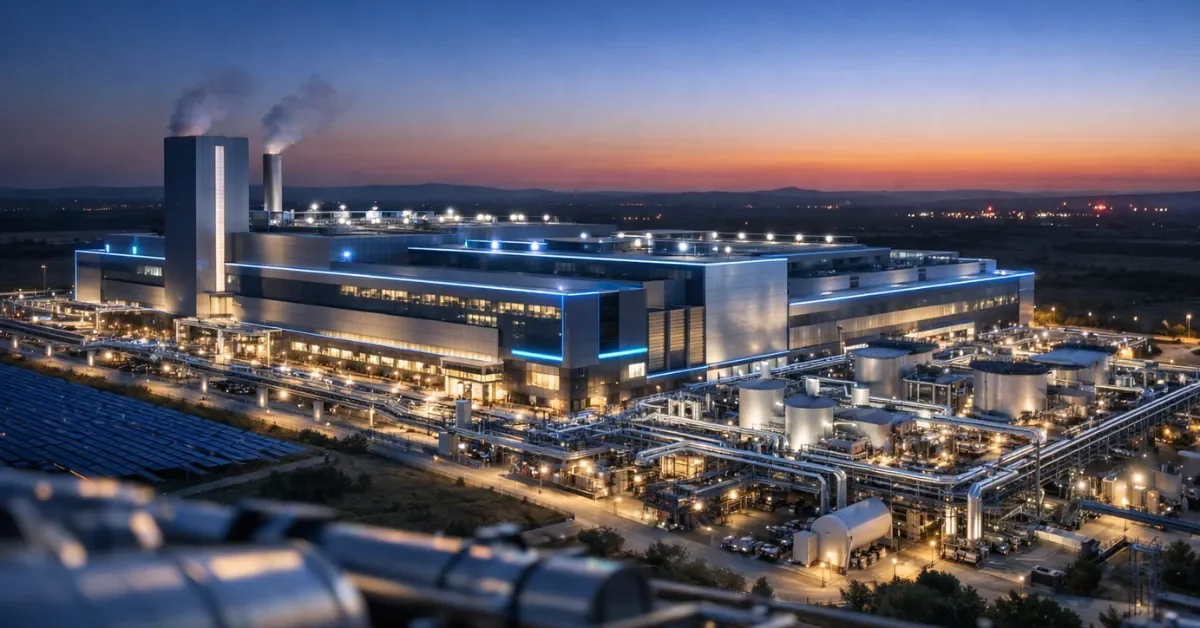
Billionaire entrepreneur Elon Musk formally announced the Elon Musk Terafab chip plant late Saturday, an ambitious semiconductor manufacturing project estimated to cost between $20 billion and $25 billion. Speaking to a crowd at the defunct Seaholm Power Plant in downtown Austin, Texas, the chief executive officer of Tesla and SpaceX revealed plans to build the massive facility on the existing Tesla campus in eastern Travis County.
This ends a week of speculation after Musk teased the project on his social media platform X. The new facility will unite Tesla, SpaceX, and the artificial intelligence venture xAI to create what Musk described to the audience as the most epic chip-building exercise in history by far.
Shifting Toward Vertical Integration
The primary objective of the factory is to produce one terawatt of computing power annually. To put this scale into perspective, one terawatt equals one trillion watts, an amount slightly less than the total electricity generation capacity of the United States. The project aims to meet escalating demands for artificial intelligence hardware across Musk’s portfolio.
The launch signals a major shift toward vertical integration. By manufacturing his own semiconductors, Musk aims to control a crucial component of his companies’ future. This move represents the most ambitious infrastructure bet the CEO has made since Gigafactory 1 in Sparks, Nevada, fusing three distinct companies into a single vertically integrated hardware machine.
Manufacturing Focus and Chip Types
The Austin complex will consist of two main manufacturing branches. The first area focuses on edge and inference computing tailored specifically for Tesla products. This side of the facility will produce Tesla’s fifth-generation semiconductor, officially known as the AI5 chip.
The AI5 hardware is designed to power the automaker’s autonomous driving systems. This includes running the company’s Full Self-Driving software, managing future robotaxis, and providing processing power for the Optimus humanoid robots.
A second manufacturing focus will be dedicated to producing high-performance artificial intelligence chips for SpaceX and xAI. Musk anticipates that xAI will consume the vast majority of these advanced semiconductors. The corporate relationship between the entities carries varying descriptions in recent reports; while most sources classify the Terafab initiative as a joint venture, one report states xAI acquired SpaceX in February as a wholly owned subsidiary. Regardless of the exact corporate structure, the operational goal remains uniting their hardware supply chains.
Space Computing and Galactic Ambitions
Beyond Earth-based applications, the Terafab project is tied deeply to future space infrastructure. Musk argues that scaling human civilization requires moving energy-intensive computing operations directly into orbit. By utilizing constant solar power in space and benefiting from reduced structural costs, extraterrestrial data centers could offer a more sustainable path for technological expansion.
The plan involves designing future satellites that can scale from 100 kilowatts to megawatt-level power, supporting complex artificial intelligence workloads far above the planet. SpaceX’s Starship rocket will be utilized to transport millions of tons of necessary payload into orbit.
Musk envisions using this new space-based computing infrastructure to eventually help build a galactic civilization on the Moon and Mars. He suggested that harnessing the Sun’s massive energy output could lead to a future of absolute abundance, where advanced AI and robotics eliminate resource scarcity for humanity.
A Phased Approach to Production
Despite the grand vision, the Terafab project will follow a phased construction approach. The initiative will begin with an advanced technology fab in Austin. This initial facility will be equipped with the necessary machinery to manufacture and test various types of semiconductor chips.
Musk has previously stated that starting with a smaller-scale operation is essential before transitioning to a much larger footprint. He ultimately described the final iteration of the Terafab concept as being like a gigafactory, but way bigger.
Observers note that the CEO currently lacks a background in semiconductor production and has a documented history of over-promising on project goals and timelines. However, the decision to build the facility stems directly from projected supply chain shortages.
During Tesla’s Annual General Meeting last year, Musk warned that relying on external suppliers would not yield enough hardware to support rapid growth. He stated that even when extrapolating the best-case scenario for chip production from outside suppliers, it was still not enough, adding that the company might have to do a Tesla terafab. Now, that predicted facility is officially moving forward in Texas.
