

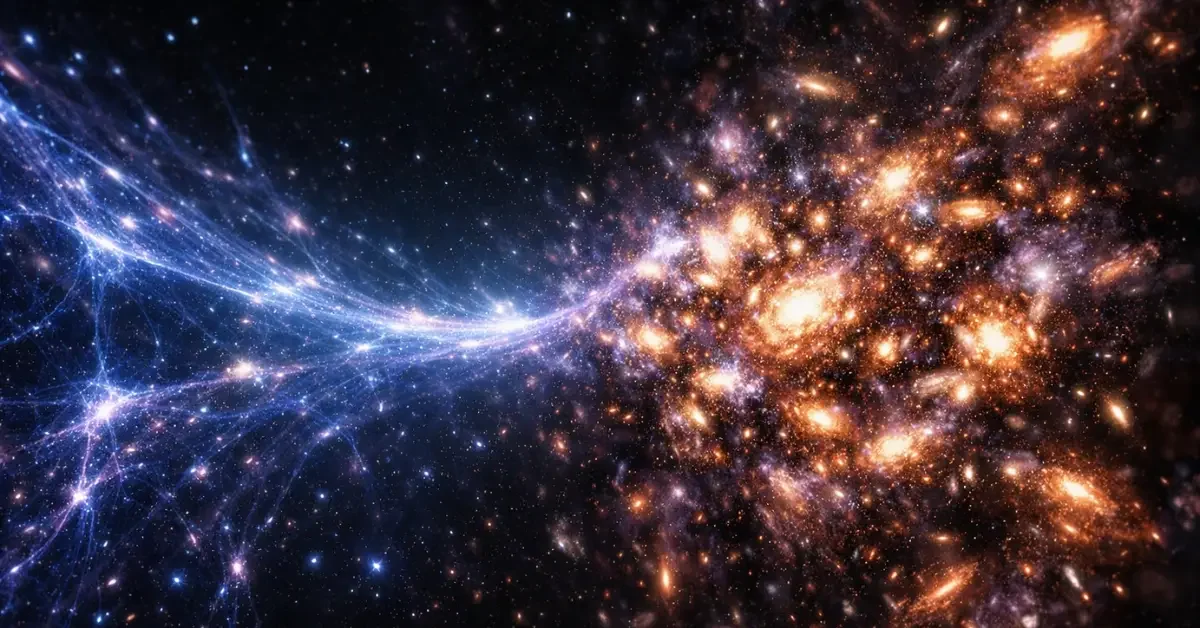
For decades, astronomers believed that the mysterious force driving the accelerated expansion of the universe was a constant, unchanging presence. However, recent observations suggest we might be witnessing evolving dark energy. Data from two major international astronomical projects indicate that this cosmic force could be weakening over time, challenging the widely accepted standard model of cosmology.
If evolving dark energy is indeed losing its strength, the ultimate fate of the universe could look vastly different than previously thought. Instead of expanding infinitely or tearing apart in a massive cosmic rip, the universe might eventually reverse its expansion. The latest calculations based on this changing energy even point toward a potential “big crunch,” where the cosmos collapses back in on itself billions of years from now.
Clues from the Largest Cosmic Maps
The current scientific debate centers on newly released findings from the Dark Energy Spectroscopic Instrument (DESI) in Arizona and the Dark Energy Survey (DES) in Chile. In March 2025, the DESI collaboration presented an analysis of its first three years of observations. The team tracked nearly 15 million galaxies and quasars to map how the universe has expanded over the past 11 billion years.
Taken on its own, the DESI data completely aligns with the standard cosmological model, known as Lambda CDM, which treats dark energy as a constant. However, when researchers combined the DESI map with other measurements—such as exploding supernovae, weak gravitational lensing, and the cosmic microwave background—cracks in the standard model emerged. The combined data showed a preference for dark energy that weakens over time. The statistical confidence for this behavior ranges from 2.8 to 4.2 sigma, approaching but not yet reaching the 5-sigma standard required to declare a definitive physics discovery.
In January 2026, the DES collaboration released a combined analysis of its own six-year survey. Using multiple cosmological probes, DES found that while their measurements mostly fit the standard model, they also fit an evolving dark energy model just as well. Furthermore, a persistent gap between predictions for the early universe and the actual clustering of galaxies in the modern universe widened, indicating that neither model is completely perfect.
A Reversal in the Expansion
These subtle shifts in dark energy have massive implications for the future. In February 2026, Cornell University physicist Henry Tye published calculations suggesting that the universe may only be halfway through its total lifespan of 33 billion years.
Using the combined data from DES and DESI, Tye proposed that dark energy is not a pure cosmological constant. Instead, he theorizes that its behavior is influenced by an extremely low-mass hypothetical particle whose effects change over time, pushing the underlying cosmological constant into negative territory. According to this model, the universe will continue to expand for another 11 billion years before reaching its maximum size. After that, the expansion will reverse, causing everything to shrink and ultimately end in a big crunch roughly 20 billion years from now.
Measurement Errors or New Physics?
While the prospect of a collapsing universe is dramatic, not all astrophysicists agree that dark energy is actually changing. Some experts caution that the apparent evolution might simply be the result of messy data or inaccurate measurements.
Dr. Slava Turyshev recently published a preprint paper arguing that extraordinary claims require extraordinary evidence. He suggests that slight inaccuracies in how scientists measure the brightness of distant supernovae could entirely explain the disconnect between the DESI data and the cosmic microwave background. Turyshev also points to potential errors in measuring the “sound horizon,” a cosmic ruler based on sound waves from the early universe known as baryon acoustic oscillations. He proposes using alternative mathematical diagnostics that do not rely on these specific early-universe measurements.
Independent researchers have also voiced caution. Andy Taylor, an astronomer not involved with the DESI research, noted that the statistical significance of the dynamic dark energy claim is still relatively low. He emphasized that the disagreement could be a statistical fluke or the result of hidden biases in the data.
However, if future diagnostics confirm that the fluctuations are real, physicists will have to rethink how the universe operates. Turyshev noted that true evolving dark energy could require entirely new physics models, such as the late-transition interacting thawer model or a transition to “phantom” energy, neither of which fit the current standard model.
More Data on the Horizon
Scientists will not have to wait long to test these competing theories. The DESI project is currently in its fourth year of a five-year mission and plans to ultimately map roughly 50 million celestial objects. Meanwhile, the European Euclid space telescope recently released its first data set, and the upcoming Vera C. Rubin Observatory is preparing to conduct its own high-precision surveys. Over the next decade, these combined efforts will likely reveal whether dark energy is truly evolving or if the standard model of cosmology remains intact.
