

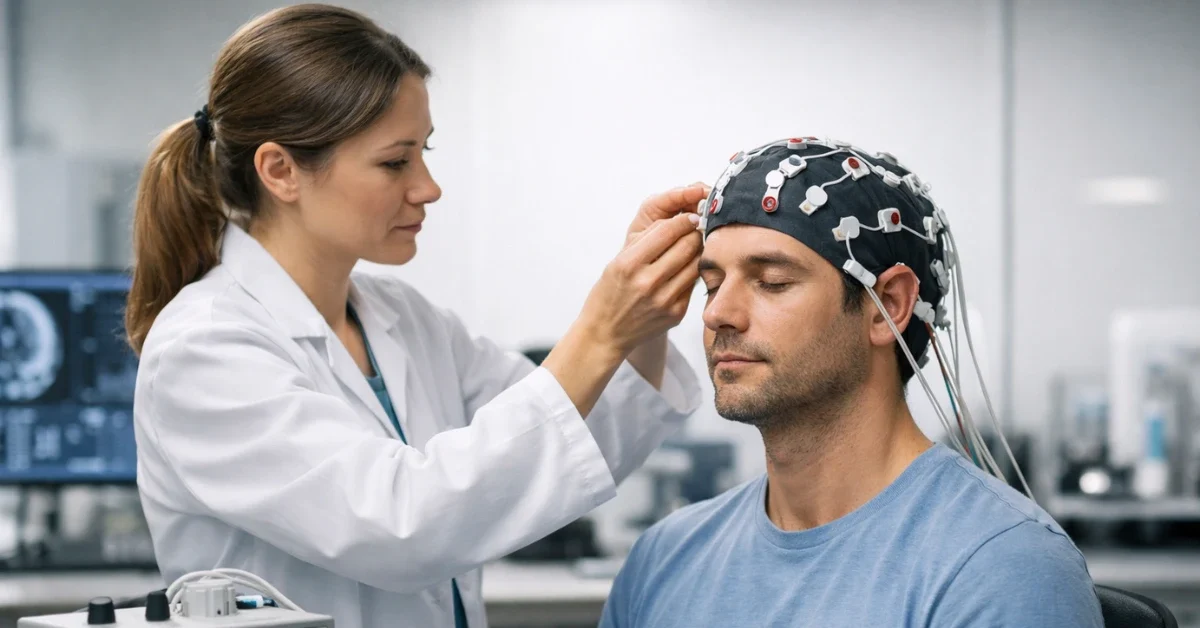
A study in PLOS Biology reports that synchronizing “gamma-band” activity between frontal and parietal brain regions using noninvasive electrical stimulation led people to make slightly more altruistic money-sharing decisions in a lab task.
Researchers say the effect appeared most clearly in situations where participants would otherwise end up with less than the other person, suggesting the targeted brain-network “communication” may matter when altruistic choices feel personally costly.
What the experiment tested
The research team, led by Jie Hu of East China Normal University with colleagues from the University of Zurich, examined why people differ in altruism and whether a targeted brain intervention can shift sharing behavior.
To measure altruism, the study used a modified “Dictator Game,” where participants decided how to split money between themselves and another person.
Medical Xpress reports that 44 participants completed 540 decisions in the game, facing offers where they could end up with more or less money than their partner depending on their choice.
The PLOS Biology paper describes two main inequality contexts in the task: “advantageous” inequality (participants had more than the partner in both options) and “disadvantageous” inequality (participants had less than the partner in both options).
How the stimulation worked
During the decision-making task, researchers used transcranial alternating current stimulation (tACS) aimed at two areas—one in frontal cortex and one in parietal cortex—intended to influence how strongly these regions synchronize.
The PLOS Biology study says the stimulation was designed to enhance frontoparietal phase coupling, based on earlier EEG findings linking stronger gamma-band coherence between frontal regions and parietal regions to more altruistic choices during disadvantageous inequality.
Participants received three stimulation conditions: gamma-band entrainment, alpha-band entrainment as an active control, and sham stimulation.
In the PLOS Biology protocol, gamma stimulation used alternating currents at 72 Hz with a 6 Hz envelope, while alpha stimulation used 12 Hz with a 6 Hz envelope, with stimulation delivered in-phase across the two targeted sites.
What changed during gamma stimulation
Both the journal article and Medical Xpress report that gamma-synchronized stimulation made participants more likely to choose the more altruistic option compared with alpha or sham stimulation.
In the PLOS Biology results, the probability of choosing the altruistic option was higher during gamma entrainment (0.16 ± 0.02) than during alpha entrainment (0.14 ± 0.02) or sham stimulation (0.15 ± 0.02), and alpha did not differ from sham.
The researchers also modeled the decision process and concluded the stimulation did not simply add randomness; instead, it increased the weight people gave to “other-regarding” concerns when evaluating the offers.
Medical Xpress describes this as a shift in how participants balanced their own payoff against the other person’s payoff, making them consider their partner more during choices.
Co-author Christian Ruff said the team identified “a pattern of communication between brain regions that is tied to altruistic choices,” framing the work as a step toward understanding how the brain supports social decisions and cooperation.
When the effect was strongest
A key claim in the PLOS Biology paper is that the increase in altruism was specific to disadvantageous inequality, aligning with the study’s hypothesis drawn from the earlier EEG link between frontoparietal gamma coherence and altruism in that context.
In the reported breakdown, the PLOS Biology paper shows the disadvantageous-inequality altruistic choice probability during gamma (0.12 ± 0.02) exceeded sham (0.10 ± 0.02) and alpha (0.10 ± 0.02), while in advantageous inequality the probabilities were similar across gamma, alpha, and sham.
The paper also notes that, overall, people were more likely to choose the altruistic option in advantageous inequality than in disadvantageous inequality, consistent with the idea that people weigh others’ interests more when they have more than the other person.
Limits and next steps
Medical Xpress notes the researchers did not directly record brain activity during the stimulation sessions, and it points to future studies combining stimulation with electroencephalography to directly test how neural activity changes.
Even with that limitation, the PLOS Biology authors argue their results provide causal evidence that enhancing gamma-band synchronization between frontal and parietal regions can increase altruistic behavior by strengthening other-regarding preferences.
The paper was published in PLOS Biology on February 10, 2026, with the journal listing receipt on June 4, 2025, and acceptance on January 6, 2026.
