

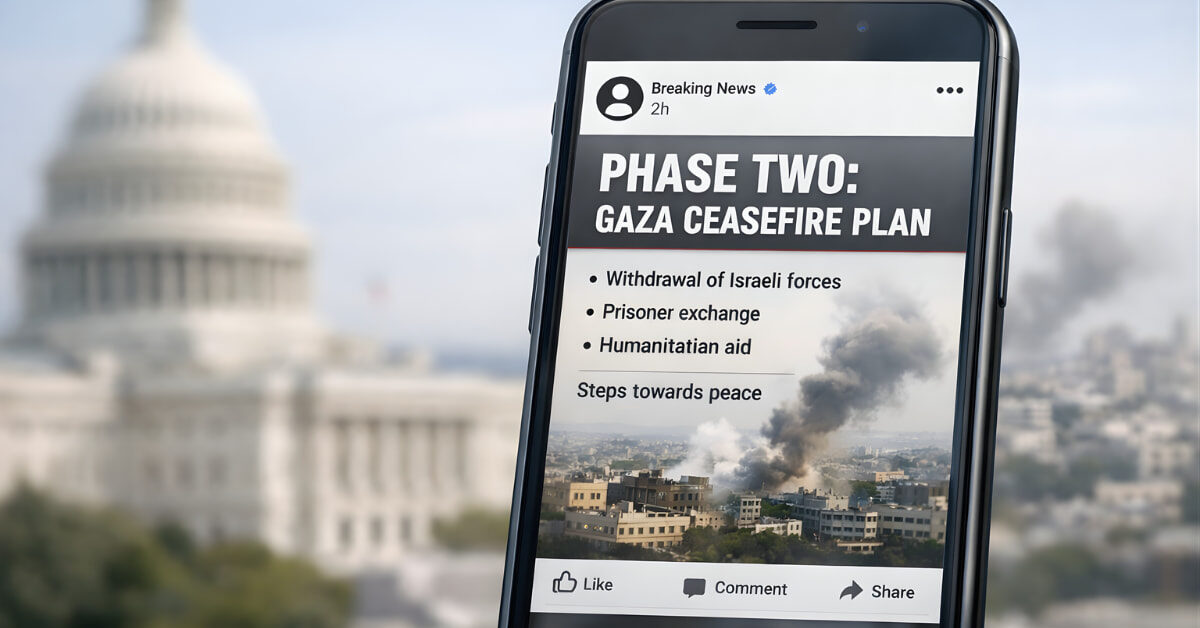
The United States has launched phase two of President Donald Trump’s Gaza peace plan, shifting from a ceasefire framework toward demilitarization, technocratic governance, and reconstruction, according to a statement from US envoy Steve Witkoff. Witkoff said the new phase includes setting up a technocratic Palestinian administration to manage day-to-day affairs in Gaza under the plan.
Witkoff announced the phase two launch in a post on X, describing it as part of Trump’s 20-point plan to end the Gaza conflict. He wrote that the US expects Hamas to meet its obligations, including “the immediate return of the final deceased hostage,” and warned: “Failure to do so will bring serious consequences.”
What phase two includes
Witkoff said phase two moves the plan “from ceasefire to demilitarization, technocratic governance, and reconstruction.” Multiple reports describe the next steps as establishing a transitional or technocratic Palestinian administration in Gaza alongside demilitarization and rebuilding.
DW reported that the transitional technocratic Palestinian administration would administer daily affairs in Gaza and that no Hamas members would be allowed. CNBC and Euronews said the technocratic committee is expected to deliver public services to Gaza’s population, while also facing major operational and funding questions.
Governance details remain unclear
Several outlets reported that Witkoff did not provide details on who would serve in the new transitional Palestinian administration. The Washington Post also described the phase two launch as including a committee of Palestinian experts to manage the territory, alongside demilitarization and rebuilding efforts.
Al Jazeera reported that mediators from Qatar, Turkey, and Egypt welcomed the formation of a Palestinian technocratic body and said it would be led by Ali Abdel Hamid Shaath. At the same time, Al Jazeera said questions remain about the structure and authority of the provisional administration.
Ceasefire and hostages under phase one
Euronews reported that the ceasefire reached under Trump’s 20-point plan took effect in October and stopped much of the fighting. Euronews and CNBC reported that, under the first phase of the three-phase deal, Hamas released all but one hostage it was holding in exchange for hundreds of Palestinians held in Israeli prisons.
Witkoff’s phase two message tied Hamas obligations to the return of the final deceased hostage, with a warning of serious consequences if it does not comply. Reuters also framed the phase two launch around establishing a technocratic Palestinian administration in Gaza.
Security, reconstruction, and aid concerns
Al Jazeera reported that the phase two plan aims to establish a transitional authority and pursue the “full disarmament and reconstruction” of Gaza. Al Jazeera also said the broader proposal includes a Trump-led “Board of Peace” and an “international stabilization force” intended to ensure security in Gaza.
Humanitarian access remains a major issue highlighted alongside the diplomatic announcements. Al Jazeera reported that the UN and major humanitarian organizations have urged Israel to allow unhindered aid into Gaza, including food, shelter supplies, and equipment for debris removal and rebuilding. Al Jazeera also reported that the US-negotiated ceasefire agreement required Israel to allow 600 aid trucks into Gaza daily.
How the plan is being presented now
Across outlets, the phase two rollout is being described as a pivot from maintaining a ceasefire to trying to shape Gaza’s governance and security arrangements while reconstruction begins. But multiple reports also emphasize that key details—especially the makeup of the technocratic leadership—have not been publicly spelled out in Witkoff’s announcement.
