

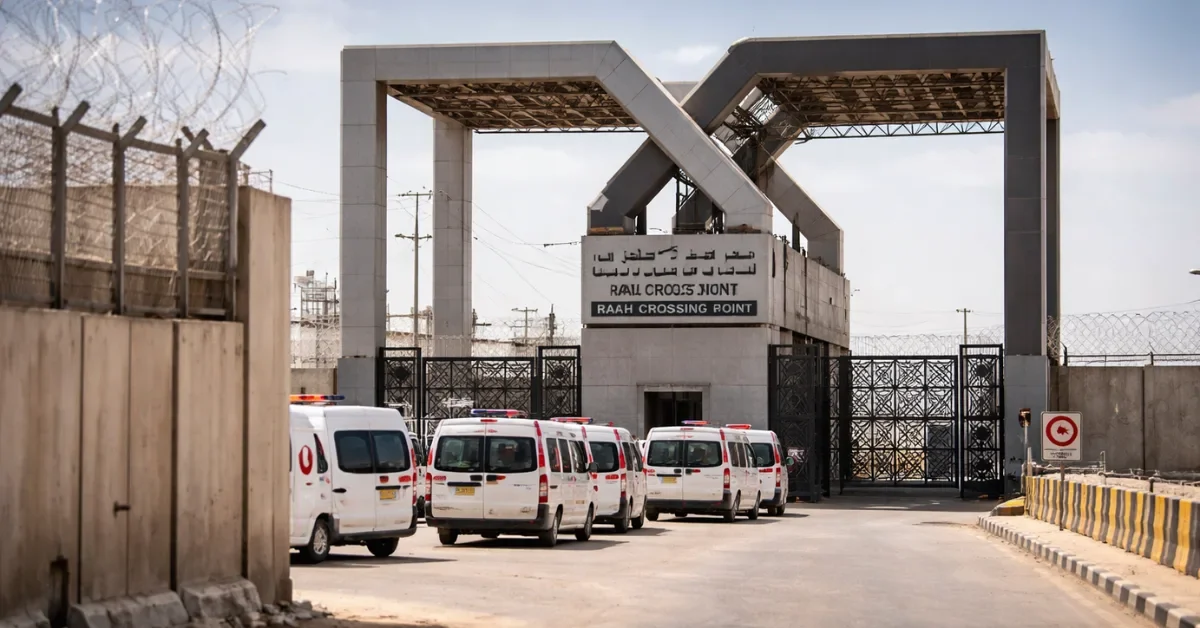
The U.S.-backed Gaza peace plan is encountering significant challenges as Hamas tightens its grip on the territory and Israel expands its military footprint. While the initial phases of the ceasefire agreement have led to the limited reopening of the Rafah border crossing, ongoing violence and governance disputes threaten to derail the transition.
Hamas Tightens Control Ahead of Transition
As Gaza prepares for a promised transfer of governance, Hamas is actively solidifying its authority from the ground up. According to an Israeli military assessment presented to Prime Minister Benjamin Netanyahu in late January, the militant group is embedding its loyalists into government offices, local authorities, and security apparatuses. Hamas continues to manage tax collection and disburse salaries across the territory.
This control has fueled skepticism regarding President Donald Trump’s peace plan, which requires Hamas to disarm in exchange for an Israeli military withdrawal. To advance the initiative, Trump’s international Board of Peace convened its inaugural meeting in Washington to discuss subsequent steps and supervise Gaza’s transitional governance.
Hamas has stated it is prepared to dissolve its existing government and hand over administration to a U.S.-backed committee of Palestinian technocrats led by Ali Shaath, a former Palestinian Authority official. However, the group claims that Israel has not yet permitted the committee members to enter Gaza to assume their duties.
Rafah Crossing Reopens Under Strict Rules
A key component of the peace plan’s first phase is the reopening of the Rafah border crossing between Gaza and Egypt, which had been closed since Israeli forces seized the Palestinian side in May 2024. Pedestrian traffic resumed recently, but access remains highly restricted.
According to COGAT, the Israeli defense ministry body coordinating civilian affairs, the crossing is open only for residents. A daily quota allows just 50 Palestinians to cross in each direction, while commercial goods and humanitarian supplies remain strictly prohibited. On the first day of operations, only 12 Palestinians successfully entered Gaza on a bus, highlighting the rigorous security protocols in place.
The Israeli military maintains strict oversight on the Gaza side, establishing a checkpoint named “Regavim” to verify identities against intelligence lists and search belongings. Meanwhile, ambulances have lined up on the Egyptian side to receive the first medical evacuees. Approximately 20,000 Palestinian patients urgently need medical care outside the territory, and 100,000 Palestinians who fled early in the conflict are waiting to return.
Expanding Buffer Zones and Military Action
Despite the U.S.-brokered ceasefire, military operations and boundary shifts continue. The Israeli military currently controls a buffer zone covering more than half of the Gaza Strip.
In December, Israel relocated its Yellow Line ceasefire boundary approximately 200 meters deeper into Gaza City’s Al-Tuffah neighborhood. Satellite imagery analysis reveals that the military subsequently razed the area, destroying at least 40 buildings. This expansion contradicts the U.S.-supported ceasefire agreement, leaving the once-historic district desolate after two years of airstrikes.
Clashes also persist along the ceasefire lines. An Israeli drone strike recently killed three Palestinians near the Morag corridor in central Gaza. The Israeli military stated the individuals posed an immediate threat and possessed weapons and intelligence-gathering equipment. Furthermore, Israel has supported anti-Hamas armed groups during the conflict, including a faction in southern Gaza that claimed responsibility for killing a senior Hamas police officer in Khan Younis.
US Unveils New Gaza Development Master Plan
As political and military tensions persist, the United States has introduced a comprehensive redevelopment vision. At a gathering in Switzerland, Jared Kushner presented a master plan for a “New Gaza.”
The proposal features a color-coded map designating zones for residential skyscrapers, data centers, industrial facilities, and beachfront resorts reminiscent of Dubai or Singapore. According to the presentation, the ambitious reconstruction efforts are slated to begin in Rafah, an area that remains under strict Israeli military oversight.
Controversies Over US Aid Security Firm
Humanitarian aid operations in the territory remain fraught with security challenges. UG Solutions, a U.S. firm employing armed contractors to secure aid sites, is currently in discussions for a new role with the Board of Peace.
The firm previously faced UN criticism after Palestinians were killed attempting to reach aid distribution points. The Israeli military stated its soldiers fired to quell crowds and address threats in those areas.
Amjad al-Shawa, head of the Palestinian NGOs Network, declared that the firm has “Palestinian blood on their hands” and is not welcome to return to Gaza. In response, UG Solutions maintained that its contractors only secured the immediate perimeters of aid sites and had no control over the actions of the Israeli military or Palestinian militant groups. The firm noted that humanitarian and commercial entities are actively seeking its services to prevent shipments from being looted or diverted.
