

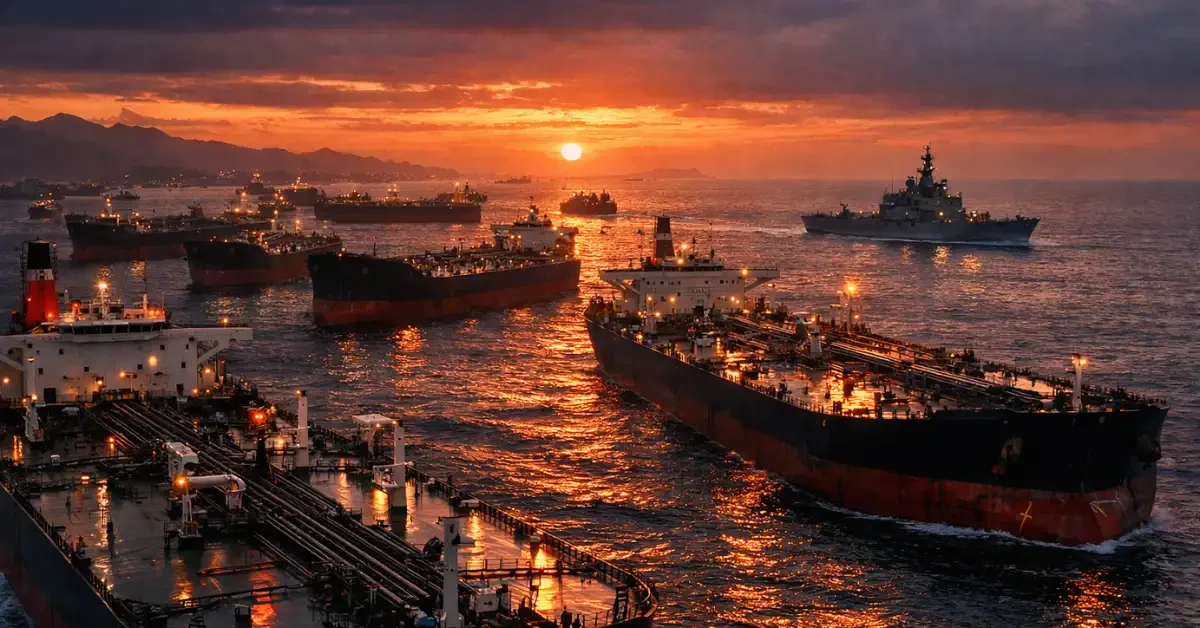
The escalating Strait of Hormuz conflict involving the United States, Israel, and Iran has brought shipping through the critical waterway to a near halt, sparking fears of a severe global energy crisis. The crisis began after joint US and Israeli military operations killed high-ranking Iranian officials, including Supreme Leader Ayatollah Ali Khamenei. In immediate retaliation, Iran launched missile strikes against US military and diplomatic sites. Consequently, maritime traffic in the narrow passage—which carries about one-fifth of the world’s daily oil consumption—has been suspended, sending energy prices surging.
To secure global energy flows amidst the Strait of Hormuz conflict, US President Donald Trump announced that the United States is actively exploring protective measures for vessels navigating the volatile region. Trump stated the US International Development Finance Corporation could provide political risk insurance to shipping lines, while the US Navy is prepared to escort tankers. Despite these protective proposals, the immediate impact on global trade and energy markets remains severe.
Stranded Tankers and Rising Maritime Risks
The effective closure of the waterway has created a massive bottleneck of maritime traffic, though sources disagree on the exact scale of the disruption. Anadolu news agency reports that over 700 non-Iranian tankers are currently piled up on either side of the strait, including 334 crude oil carriers. In contrast, marine tracking platforms indicate that at least 150 vessels, including oil and liquefied natural gas tankers, have dropped anchor in surrounding waters.
Safety in the region has deteriorated rapidly, leading the United Kingdom Maritime Trade Operations to raise the maritime security level for the strait to its highest risk category, “critical.” Iran’s Islamic Revolutionary Guard Corps warned that vessels could face drone and missile attacks, claiming over 10 tankers were already targeted. Several vessels have been caught in the crossfire. The US-flagged Stena Imperative was damaged by aerial impacts, killing a shipyard worker. A projectile also struck the Marshall Islands-flagged MKD VYOM, killing a crew member, while the Gibraltar-flagged Hercules Star was hit off the United Arab Emirates. Furthermore, debris from an intercepted missile sparked a fire at Dubai’s Jebel Ali Port, and US missiles reportedly sank several Iranian warships in the Gulf of Oman.
Due to these dangers, major shipping companies like Hapag-Lloyd and CMA CGM have suspended transit. Marine insurers, including Gard, Skuld, and the American Club, are also canceling war risk coverage for vessels operating in the Gulf. Consequently, the cost of shipping oil from the Middle East to Asia has skyrocketed, with spot shipping rates nearly tripling since the beginning of 2026.
Global Markets React to Imminent Supply Threats
The geopolitical turmoil has sent shockwaves through global energy markets, offset only slightly by reports of US crude stockpiles rising by 5.7 million barrels last week. Oil prices experienced their biggest gain in four years, with West Texas Intermediate crude climbing above $75 a barrel—an 11% surge. Meanwhile, reports differ slightly on the exact performance of Brent crude; some data indicates it settled near $81 a barrel, while other sources note it rose 7.1% to $78.15 before testing a 15-month high of $80.80 in early Asian trading.
Supply chain disruptions are compounding the crisis across the Middle East. Iraq has started shutting down operations at major oil fields, including Rumaila and West Qurna 2, which could effectively halt a majority of the country’s output. Qatar has also paused its liquefied natural gas production. In response, Indian companies reduced natural gas supplies to industrial sectors, and India’s petroleum minister reviewed the situation to ensure domestic availability.
Major Asian markets, which heavily rely on long-term contracts for oil transiting through Hormuz, are feeling intense pressure. Refiners in China, India, South Korea, and Japan are considering reducing their operating rates by 20% to 30% as dozens of loaded tankers remain stuck. While Saudi Arabia and the United Arab Emirates possess alternative pipelines that can bypass the strait, these routes only offer a spare capacity of 2.6 million barrels per day—a mere fraction of the 20 million barrels that normally pass through the chokepoint. To help stabilize markets, OPEC has agreed to modestly boost oil output, though options remain limited.
The economic fallout threatens to extend well beyond energy markets. One-third of the world’s fertilizer trade also passes through the Strait of Hormuz, raising grave concerns about agricultural supply chains already destabilized by the Ukraine war. With limited alternatives and ongoing hostilities, the global economy faces structural damage if this vital shipping lane remains paralyzed.
