

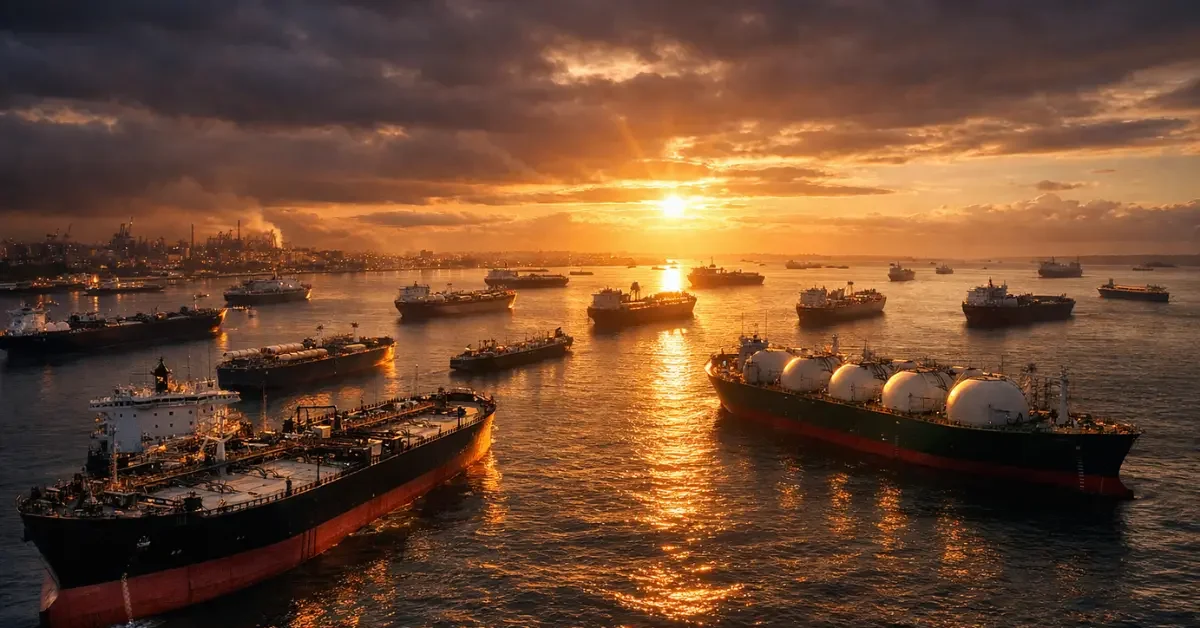
Global energy prices have surged following a severe escalation in the Middle East conflict. The recent military clashes, initiated by United States and Israeli airstrikes against Iran, have heavily disrupted international oil and natural gas markets. As the conflict broadens, the immediate fallout includes widespread shipping halts, targeted attacks on energy infrastructure, and plummeting global stock markets.
The turmoil has ignited fears of renewed inflation and economic instability across Europe, Asia, and the United States. With the Middle East responsible for nearly one-third of global oil production and a fifth of natural gas supplies, the sudden interruption in exports has sent shockwaves through the global economy. Brent crude jumped as much as 13 percent to reach $82.37 per barrel, recovering from a previous close under $73. Meanwhile, European natural gas prices soared by over 40 percent, and UK wholesale gas prices spiked by more than 46 percent to hit a three-year high.
Shipping Hubs Paralyzed and Supply Routes Cut
The most immediate cause of the price shock is the complete shutdown of the Strait of Hormuz. Traffic through this critical maritime choke point has been halted for four consecutive days following Iranian attacks on five vessels. This closure effectively cuts off a route that facilitates roughly 20 percent of the world’s oil and gas supply.
With the strait blocked, shipping rates have skyrocketed to unprecedented levels. Hundreds of oil and liquefied natural gas (LNG) tankers remain stranded near major regional hubs, including the United Arab Emirates’ Fujairah port. These vessels are currently unable to deliver their vital cargoes to customers across Europe and Asia. As maritime freight companies seek to avoid the conflict zone, many are diverting ships around the Cape of Good Hope. This diversion significantly increases transit times and drives up demand for bunker fuel.
Qatar Halts LNG Exports Amid European Storage Crisis
The energy crisis deepened over the weekend when Iran launched drone strikes on Qatar’s main LNG export facility. In response to the military attacks, state-owned QatarEnergy suspended its LNG production. Qatar is the world’s third-largest LNG producer and accounted for 19 percent of global LNG exports last year.
This sudden halt presents a massive challenge for European utilities and industrial sectors. Europe entered this crisis with historically low gas inventories due to new storage regulations, previously high prices, a warm winter, and sluggish economic activity. In the Netherlands, which hosts Europe’s primary gas trading hub, stockpiles are hovering around just 10 percent full. This is far below the historical average of 48 percent for early March. Italy is faring slightly better with inventories at approximately 50 percent, though still below its 60 percent seasonal average.
The disruption in storage refilling threatens to drastically increase industrial energy costs. Energy analysts are now urging the European Union to accelerate its green energy transition to reduce its heavy reliance on imported fossil fuels traded on volatile global markets.
Asian Markets Face Tightening LNG Supplies
The shutdown of Qatar’s export facilities will also have a profound impact on Asian markets. Any extended outage will heavily disrupt global trade flows, particularly for major importers that rely heavily on Qatari gas. Last year, China sourced 29 percent of its LNG imports from Qatar, while India relied on the nation for about 45 percent of its supplies.
To prevent impending shortages, countries including China, India, Japan, and South Korea are expected to quickly increase their orders from alternative vendors. This sudden rush for replacement fuel will likely lead to much tighter overall LNG availability and aggressively drive up prices for all destinations.
Financial Markets Slide on Inflation Fears
The dramatic spike in global energy prices has immediately bled into global financial markets. In the United States, the Dow Jones Industrial Average plunged by nearly 900 points at the opening bell. This led a broad retreat from risk assets that also dragged down the S&P 500 and the Nasdaq Composite. European markets closed sharply lower as part of a coordinated global selloff.
Traders are increasingly anxious that prolonged instability could trigger a fresh bout of inflation or even stagflation. The bond market reflects this shifting sentiment, with European bonds extending a heavy selloff. In a dramatic reversal, traders are now pricing in a greater than 60 percent chance of an interest rate hike by the European Central Bank this year. Just days prior, markets had factored in a 40 percent probability of a rate cut.
Exploring Alternative Egress Routes
While the situation remains volatile, Middle East producers do possess some alternative export routes that could partially mitigate a prolonged closure of the Strait of Hormuz. Saudi Arabia has the capability to increase exports via its East-West pipeline to the Red Sea, which holds between one and two million barrels per day of spare capacity. Furthermore, additional oil volumes could potentially be routed into the Mediterranean from Iraq. Meanwhile, the OPEC+ alliance agreed to resume unwinding its voluntary production cuts, though whether these measures can offset the massive supply risks remains uncertain.
