

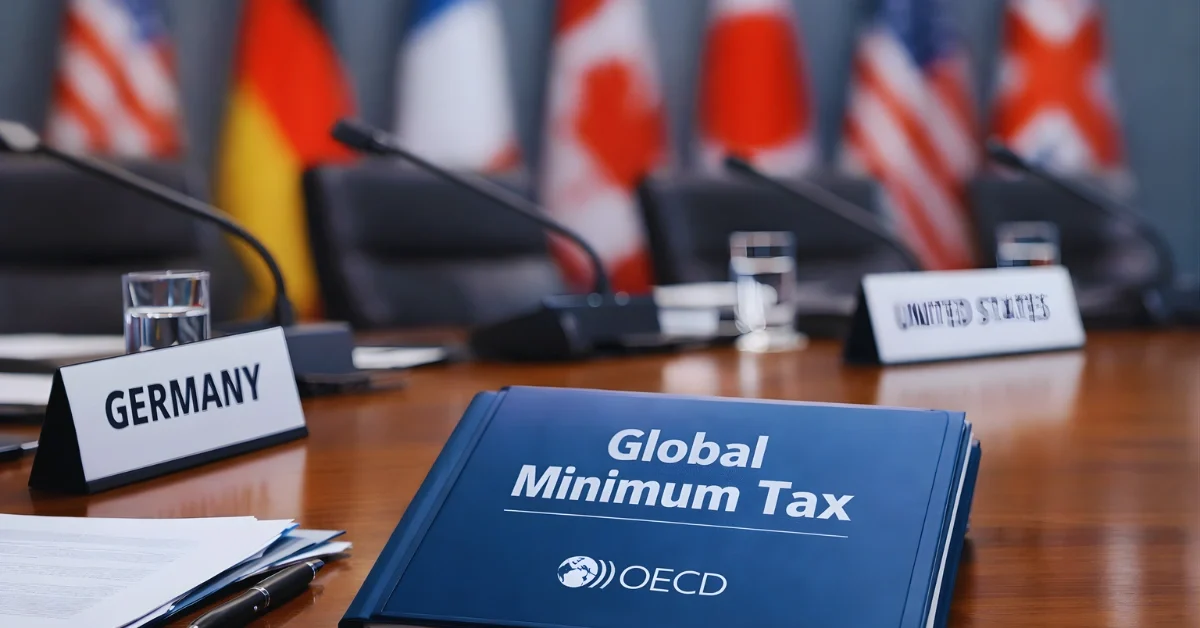
International negotiators at the OECD agreed to exempt US companies from key parts of the global minimum tax framework, a move described as a major win for the Trump administration and US multinationals. Treasury Secretary Scott Bessent called the outcome a “historic victory in preserving U.S. sovereignty and protecting American workers and businesses from extraterritorial overreach.”
The agreement centers on a “side-by-side” approach that sets out how the US tax system can operate alongside the global minimum tax rules without triggering certain provisions that the US opposed. The OECD released a document detailing the terms, and the package also includes simplification measures aimed at cutting compliance burdens for multinational companies.
What changed in the global minimum tax
The global minimum tax is also known as Pillar Two, part of a 2021 international tax pact designed to limit profit shifting and reduce harmful tax competition among countries. Under Pillar Two, the aim is to impose a 15% minimum levy on multinational companies in every country where they operate.
According to the report, the Trump administration pushed for US-parented groups to be carved out of two core Pillar Two rules: the income inclusion rule (IIR) and the undertaxed profits rule (UTPR). The same report says key Republicans in Congress also warned of retaliation against foreign companies if the US demand was not met.
How the carve-out works
The side-by-side system is built around two safe harbors: an “ultimate parent entity safe harbor” and a “side-by-side safe harbor,” according to the OECD’s document as described in the report. These safe harbors apply to multinationals in jurisdictions that the OECD Inclusive Framework recognizes as “having an eligible tax regime,” and a list released under the agreement currently includes only the US.
The report explains that the IIR lets a multinational’s parent country collect tax when a subsidiary is taxed below 15% in its local jurisdiction. It also explains that the UTPR allows a country to collect tax from a company if both the parent jurisdiction and the local country are not charging at least a 15% rate.
Under the side-by-side safe harbor, multinationals can elect the safe harbor if their headquarters country meets conditions that include having eligible domestic and worldwide tax systems and enacting those systems before Jan. 1, 2026, among other requirements listed in the report. A company that can elect this safe harbor is insulated from the IIR and UTPR, though the report notes the safe harbor does not affect the application of qualified domestic minimum top-up taxes (QDMTTs).
Simplification and incentive treatment
The report says the OECD document outlines a set of safe harbors to support the side-by-side system and to reduce compliance costs for multinational groups. It also says the package provides more favorable treatment of certain “expenditure-based” and “production-based” tax incentives, described as “substance-based” incentives that are strongly connected to real activity in a jurisdiction.
One element described is a substance-based tax incentives safe harbor that can eliminate top-up tax that would otherwise be attributable to certain incentives, according to the report’s description of the OECD text. The report adds that businesses can claim incentives under this safe harbor “equal to the greater of 5.5% of the payroll costs or depreciation of tangible assets in the jurisdiction,” as stated in the OECD material cited in the report.
The OECD package also introduced an effective tax rate (ETR) safe harbor that uses a simplified income calculation based on financial accounting data for businesses that can show they do not have top-up tax liabilities in Pillar Two jurisdictions. The report says this simplified ETR safe harbor will be in place for multinationals in all jurisdictions starting in 2027, and that the transitional country-by-country reporting safe harbor is extended through the end of 2027.
US reaction and implementation timeline
Bessent said Treasury will keep engaging at the OECD to support full implementation of the side-by-side agreement, according to the report. The same report says lawmakers and Treasury officials have acknowledged it will take time for countries to adopt the new arrangement into local law, especially when countries introduce tax measures through annual budget proposals.
OECD Secretary-General Mathias Cormann described the outcome as “a landmark decision in international tax co-operation,” according to an OECD press release cited in the report. The report also notes that multinationals have complained the compliance costs tied to the complex rules can outweigh the tax itself, a criticism the package’s simplification steps are meant to address.
