

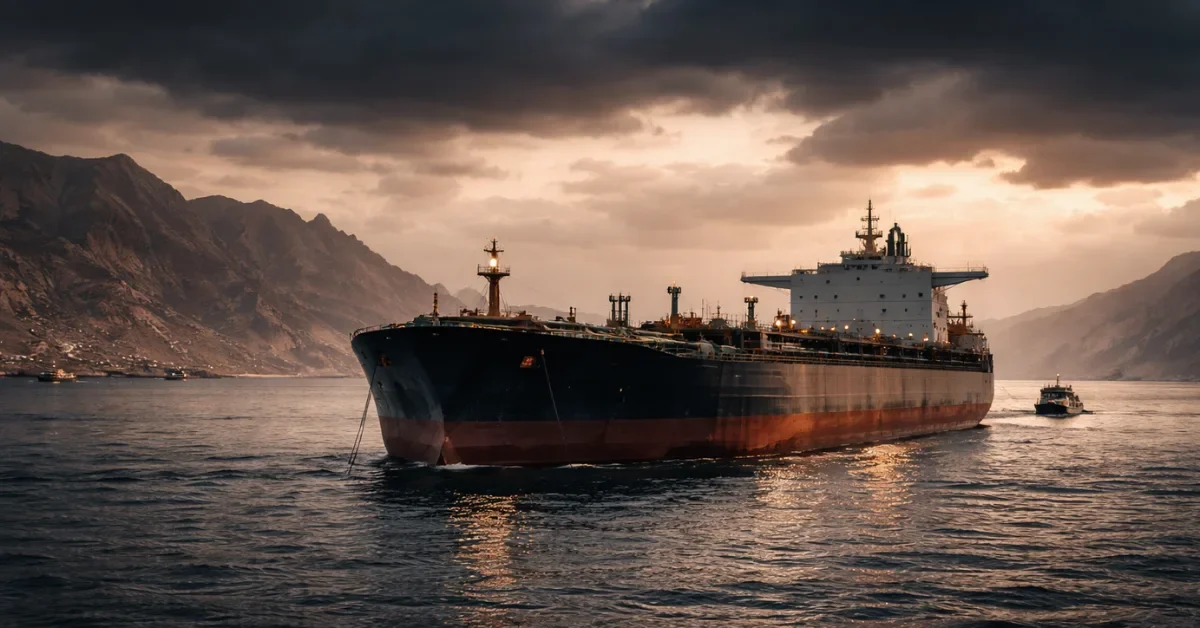
Global oil prices have surged above $100 a barrel for the first time since 2022 as the ongoing war between the United States, Israel, and Iran disrupts critical energy markets. The conflict, which began on February 28, 2026, has effectively closed the Strait of Hormuz, a vital shipping route for international trade. The shutdown of this key waterway has choked off major supply lines, sending shockwaves through the global economy and forcing shippers to halt operations or reroute their vessels.
The sudden spike in global oil prices reflects growing fears over long-term energy shortages. According to Euronews, both Brent crude and West Texas Intermediate eclipsed $114 a barrel. In contrast, Gulf News reported that Brent traded near $103 after briefly approaching $120 earlier in the session. Regardless of the exact figures, the rapid increase is driving up costs for consumers at the gas pump and putting immense pressure on worldwide logistics and supply chains.
Strait of Hormuz Shipping Halted
The Strait of Hormuz is the only sea passage connecting the Persian Gulf to the open ocean. Before the conflict escalated, between 14 million and 15 million barrels of crude oil passed through the strait every day, accounting for roughly one-fifth of the world’s oil supply. Now, the waterway has seen commercial transit grind to a near-complete standstill.
Iran has threatened to fire on ships attempting to navigate the strait. In response, international shipping companies have largely avoided the area. Over the weekend, the only commercial vessels to pass through the region were linked to Iran, with the last non-Iranian ship being a Chinese-owned bulk carrier that transited on Saturday morning. The situation marks an unprecedented disruption; analysts note that the strait has never been entirely closed in its written history.
To bypass the bottleneck, Saudi Arabia has diverted record levels of oil shipments to the Red Sea. However, this alternative route carries its own risks due to the presence of Houthi forces in Yemen, who have targeted vessels in that area since 2023. Saudi Arabia has also attempted to keep its oil flowing by offering crude cargoes through unusual spot tenders routed outside the Persian Gulf.
Energy Facilities Attacked and Output Reduced
The fighting has directly impacted energy infrastructure across the Middle East. Over the past week, oil refineries in Saudi Arabia, Qatar, Bahrain, and Kuwait have suffered strikes, and those affected nations have blamed Iran for the attacks. Additionally, Iranian state media reported that Israel carried out strikes on four Iranian oil storage facilities and a transfer center. In a further escalation, Bahrain accused Iran of hitting a plant vital to its drinking water supplies.
With tankers unable to move product through the Persian Gulf, storage facilities in neighboring countries are rapidly filling to capacity. This backlog has forced Kuwait, the United Arab Emirates, and Iraq to actively reduce their crude oil output. The reduction in production compounds the supply crisis, pushing energy markets into panic mode.
The strain on trade contracts is already showing. Following the announcement of Iran’s new Supreme Leader, Bahrain’s state oil company declared force majeure, legally releasing it from contractual obligations due to extraordinary circumstances. Qatar’s Minister of Energy, Saad al-Kaabi, predicted that other Gulf producers will be forced to take similar measures and stop exports within days if the crisis continues.
Global Response and Economic Impact
Political leaders and international bodies are scrambling to address the fallout. Group of Seven (G7) finance ministers scheduled an emergency meeting for March 9 to discuss a coordinated release of emergency petroleum reserves. This effort would potentially be coordinated by the International Energy Agency to help stabilize the market.
In the United States, President Donald Trump dismissed the rising crude costs as a temporary issue. On his Truth Social platform, Trump called the short-term price increases a “very small price to pay” for world safety and the destruction of the Iranian nuclear threat. U.S. Energy Secretary Chris Wright echoed this sentiment, assuring the public that energy would flow soon and downplaying the likelihood of a drawn-out crisis.
Despite these assurances, Iran’s Islamic Revolutionary Guard Corps issued a stern warning. The group threatened further retaliatory attacks on regional energy sites and challenged the U.S. and Israel to continue the conflict if they could tolerate oil prices exceeding $200 per barrel.
The ripple effects are expanding globally. China has ordered its oil refiners to pause fuel exports to prioritize its domestic needs. Meanwhile, the automotive logistics sector is facing steep cost increases for vehicle and component distribution. The Association of European Vehicle Logistics warned that transport companies are being forced to absorb these sudden fuel expenses, placing heavy pressure on their cash flow. Financial markets have also slumped, with major Asian indices like the Nikkei and Kospi sliding sharply as investors react to the prolonged volatility.
