

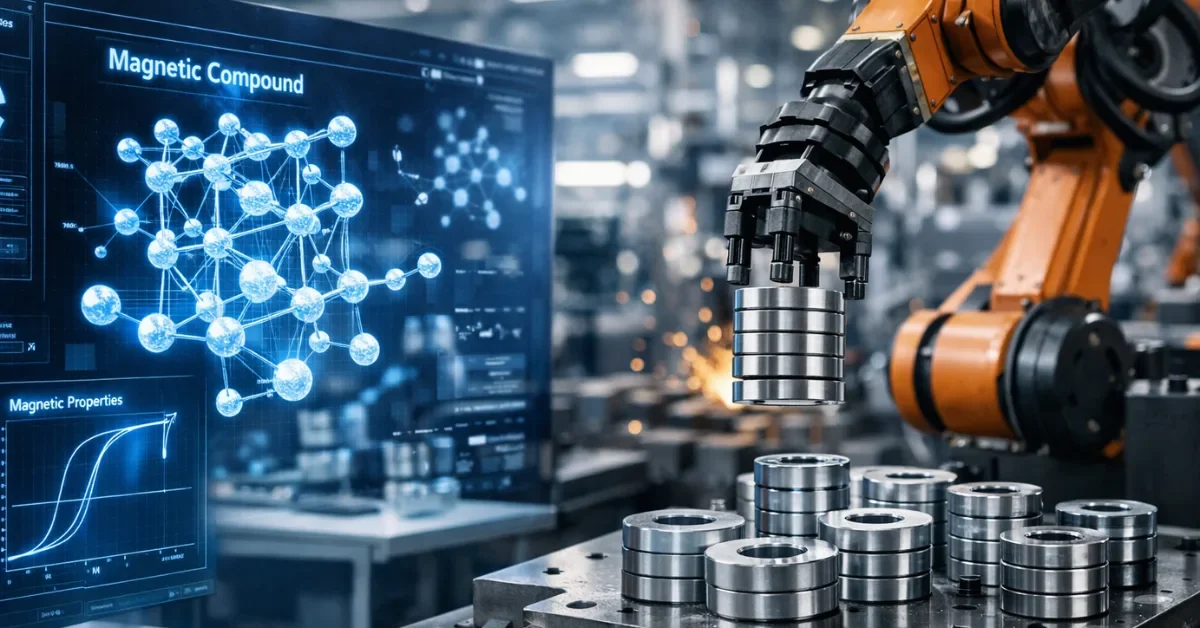
The global race to secure supply chains for rare earth permanent magnets intensified this week with two major developments: a scientific breakthrough in the United States and a massive industrial commitment from India. Researchers at the University of New Hampshire have utilized artificial intelligence to identify 25 previously unknown magnetic materials, potentially offering alternatives to scarce resources. Simultaneously, the Indian government announced a definitive target to commence domestic production of these critical components by the end of 2026.
These parallel advancements mark a significant shift in the materials sector, aiming to reduce reliance on costly imports and geopolitically sensitive supply chains. With rare earth permanent magnets being essential for electric vehicles (EVs), wind turbines, and defense technologies, these efforts represent a coordinated stride toward energy independence and manufacturing resilience.
AI Unlocks Hidden Magnetic Potential
In a landmark study released Wednesday, scientists at the University of New Hampshire revealed they have successfully used artificial intelligence to speed up the discovery of next-generation magnetic materials. By analyzing decades of existing scientific literature, the team created a comprehensive database of 67,573 magnetic compounds.
This AI-driven approach identified 25 materials that were previously documented but never recognized as magnetic. According to the findings, these newly identified compounds remain stable and magnetic even at high temperatures, a critical requirement for engines and renewable energy systems. Suman Itani, the study’s lead author and a doctoral student in physics, noted that accelerating the discovery of sustainable magnetic materials is key to lowering the costs of electric vehicles and strengthening the manufacturing base.
The team’s tool did not generate new materials from scratch but instead found hidden patterns in real data that human researchers had overlooked. This method allows scientists to bypass years of slow trial-and-error lab testing, opening the door to cheaper, more sustainable technologies that could eventually replace traditional rare earth permanent magnets.
India Targets Domestic Manufacturing by Year-End
While scientists explore new materials, India is moving to secure its industrial capabilities using existing resources. On Thursday, Federal Mining Minister G. Kishan Reddy announced that the country aims to start producing rare earth permanent magnets by the end of this year. This initiative is part of a broader strategy to reduce imports of critical industrial inputs.
To support this ambitious timeline, New Delhi approved a 73 billion rupee ($802 million) manufacturing program in November. The government plans to establish four critical mineral processing plants across four different states. The technology for these plants was developed by the mining ministry in collaboration with a state-run body.
Despite holding the world’s third-largest reserves of rare earths—estimated at 6.9 million tons by the U.S. Geological Survey—India currently mines only a fraction of its potential due to limited private investment. This new push, in partnership with the private sector, aims to leverage those reserves to supply the growing aerospace, defense, and renewable energy sectors.
Accelerating Development Cycles
The role of artificial intelligence in the magnet sector extends beyond academic discovery into commercial application. U.K.-based company Materials Nexus recently demonstrated the power of this technology by developing a new magnet, MagNex, without using rare earth elements.
Working with the Henry Royce Institute and the University of Sheffield, the company used an AI platform to design, synthesize, and test the new magnet in just three months. This process was approximately 200 times faster than traditional methods, which typically require decades of research. The AI system analyzed over 100 million compositions to balance performance, supply chain security, cost, and environmental impact.
These rapid advancements suggest a future where the supply of rare earth permanent magnets is no longer a bottleneck for green technology, driven by both smarter discovery tools and robust national production strategies.
