

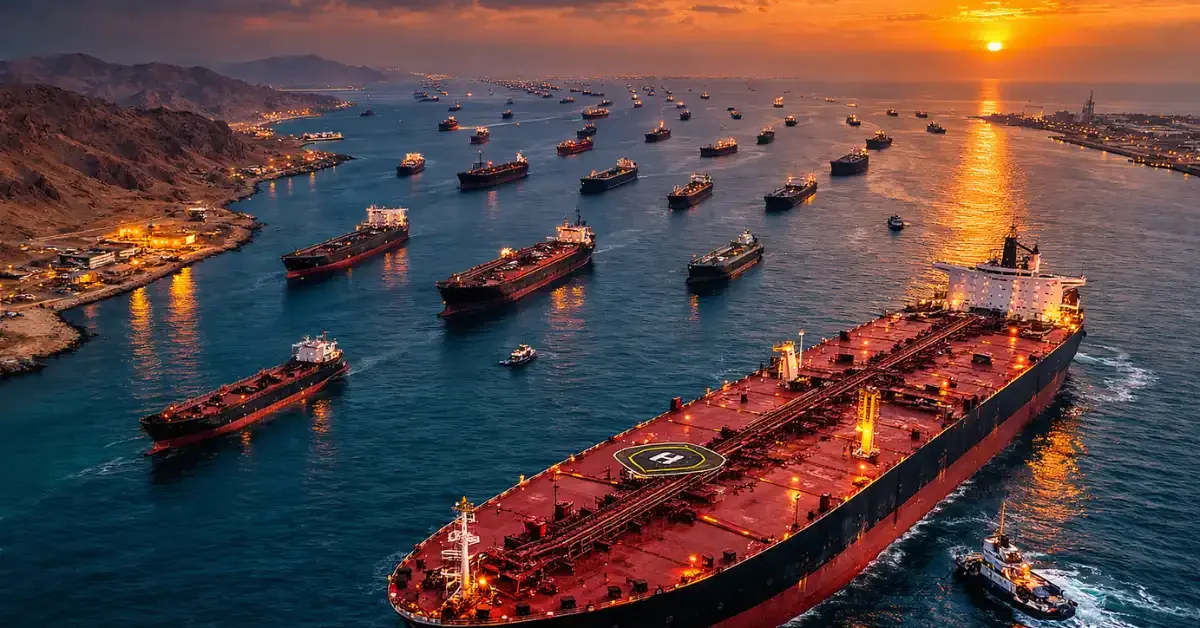
The ongoing war between the United States, Israel, and Iran has paralyzed one of the world’s most critical maritime routes. Following intense military escalations, Iran has effectively shut down the crucial waterway, resulting in a severe Strait of Hormuz blockade. The sudden closure has stranded thousands of commercial ships, rattled global energy markets, and pushed oil prices above $100 per barrel.
The Strait of Hormuz is a vital energy corridor, normally handling about 20 million barrels of oil shipments daily and roughly 20 percent of the global liquefied natural gas trade. With the Strait of Hormuz blockade in full effect, the International Maritime Organization (IMO) reports that at least 3,000 vessels and 20,000 seafarers are currently stranded in the Middle East. The situation worsened dramatically after a tugboat assisting another ship in the strait was struck, killing four seafarers.
Iran Defends Closure While U.S. Scrambles to Respond
Iran’s newly appointed Supreme Leader, Mojtaba Khamenei, announced in his first public address that the strait must remain closed as leverage against the United States. He emphasized that the strategy is part of an effective deterrent defense, warning that regional attacks will continue. The Iranian military has also stated it would welcome the presence of U.S. Navy escorts, signaling a readiness for direct confrontation in the narrow passage.
Despite the growing economic fallout, American officials have provided contrasting messages regarding their ability to secure the waterway. Defense Secretary Pete Hegseth downplayed the crisis, telling reporters that the military is actively dealing with the situation and the public does not need to worry. He asserted that the United States will not allow the strait to remain contested and noted there is no clear evidence that Iran has placed naval mines in the area.
However, U.S. Energy Secretary Chris Wright offered a starkly different assessment. He stated that the U.S. military is simply not ready to escort commercial oil ships through the strait. According to Wright, American military resources are fully concentrated on destroying Iran’s offensive capabilities, production facilities, and nuclear program, rather than securing maritime trade routes.
Economic Impact and Soaring Energy Costs
The disruption has sent shockwaves through the global economy. Oil prices recently surged past $100 per barrel, and stock markets have slid despite a massive release of strategic crude reserves by the International Energy Agency. Investors remain deeply concerned about the choked supply chain and the broader implications for international trade.
While Ebrahim Zolfaqari, a spokesman for Tehran’s central joint military command, threatened that oil could skyrocket to $200 a barrel, Wright dismissed this scenario as unlikely. He characterized the current economic strain as short-term discomfort necessary for the long-term goal of permanently dismantling Iran’s ability to manufacture missiles and maintain its nuclear ambitions.
Rare Exemptions for Turkish and Indian Vessels
Although the waterway is largely impassable for most international shipping, Iranian authorities have granted a few rare exemptions. Turkey’s Transport and Infrastructure Minister Abdulkadir Uraloglu confirmed that a Turkish-owned ship named Rozana was allowed to pass through the strait after receiving permission from Tehran. Out of 15 Turkish-owned vessels recently in the area, several remain anchored, including six cruise ships. The remaining vessels collectively have 171 personnel on board, and Turkish officials are maintaining contact with the stranded crews.
India has also secured safe passage for critical energy supplies. Iran permitted two Indian-flagged liquefied petroleum gas carriers to navigate the strait. The Shivalik proceeded under the protection of the Indian Navy, while the Nanda Devi is expected to follow. Additionally, a Liberia-flagged tanker, Smyrni, carrying Saudi Arabian oil for India’s state-owned Hindustan Petroleum Corporation, managed to transit the waterway.
These exemptions come as India faces a severe gas crisis that has forced the government to restrict supplies to industries to protect household cooking gas reserves. In a related diplomatic move, India recently provided refuge to 183 Iranian sailors whose vessel docked following the outbreak of hostilities. This follows reports that another Iranian vessel was sunk by a U.S. torpedo near Sri Lanka.
Emergency International Meetings Convened
As the maritime crisis deepens, the international community is rushing to coordinate a response. The IMO has called an extraordinary session of its governing council in London for March 18 and 19. Chaired by Victor Jiménez of Spain, the 40-member council will assess the escalating security environment and discuss potential measures to safeguard seafarers and stabilize international trade flows.
Until a coordinated international response or a military breakthrough occurs, the narrow shipping corridor remains a dangerous flashpoint. With commercial traffic slowed to a crawl and insurance conditions fundamentally altered, the ongoing crisis continues to threaten the stability of the global energy market and the safety of thousands of maritime workers.
