

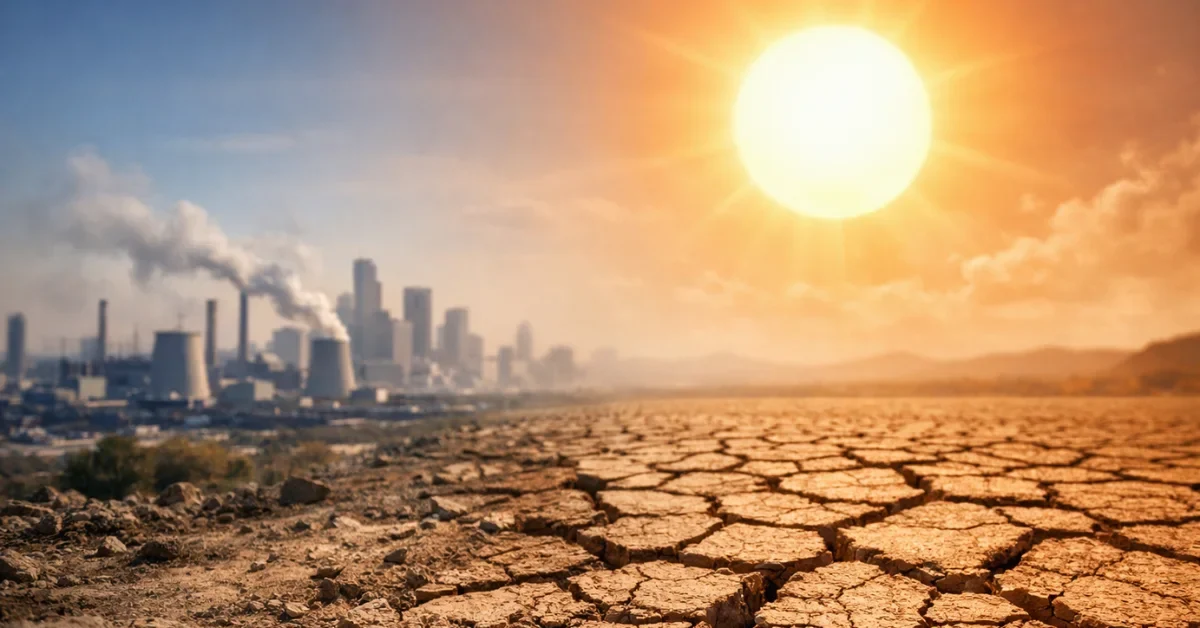
A new scientific study has identified a statistically significant global warming acceleration since 2015, revealing that the planet is heating up faster than at any point since records began in 1880. Published recently in the journal Geophysical Research Letters, the research indicates that the rate of temperature increase has nearly doubled over the past decade.
Between 1970 and 2015, the Earth warmed at a relatively steady pace of just under 0.2 degrees Celsius (0.36 degrees Fahrenheit) per decade. However, researchers found that over the last ten years, this warming rate surged to between 0.35 and 0.4 degrees Celsius (0.63 and 0.72 degrees Fahrenheit) per decade. This sudden spike means humanity is pushing the climate system to its limits. All ten years since 2015 rank as the warmest ever recorded, with the last three years taking the top three spots.
Filtering Out Natural Climate Noise
To understand whether this global warming acceleration was a true long-term trend or just a temporary anomaly, scientists needed to remove natural climate fluctuations from the data. Study co-authors Stefan Rahmstorf, a professor at the Potsdam Institute for Climate Impact Research, and Grant Foster, a statistician, analyzed five major global temperature datasets. These included historical records from NASA, the National Oceanic and Atmospheric Administration, and Berkeley Earth.
The researchers used statistical methods to filter out three primary natural factors that influence global temperatures: the El Niño-Southern Oscillation cycle, volcanic eruptions, and solar variations. By removing this environmental background noise, the underlying human-caused warming signal became much clearer. Rahmstorf stated that the certainty rate for this acceleration is 98 percent, showing consistent results across all the datasets and analysis methods used in the study.
Why the Warming Trend is Speeding Up
While the study itself focused on confirming the data trend rather than determining the exact cause, scientists have a leading hypothesis for the sudden surge. The most likely explanation involves recent changes to international shipping emissions.
Historically, ocean-going vessels released large amounts of pollutants that contributed to poor air quality and hundreds of thousands of premature deaths annually. However, these same emissions helped form clouds over the oceans, which reflected sunlight back into space and provided a modest cooling effect on the planet. Stricter shipping regulations introduced in 2020 drastically reduced these pollutants. While this change improved global air quality and saved lives, the sudden drop in reflective cloud cover likely contributed to the sharp increase in global temperatures. Because this is a one-time reduction in aerosols, researchers believe this specific high warming rate might be temporary rather than a permanent new baseline.
Scientific Disagreement on the Findings
Not all experts agree that a definitive global warming acceleration is currently measurable. Zeke Hausfather, a research scientist at Berkeley Earth, noted that while there is widespread agreement on recent rapid warming, it remains unclear how much of the past decade’s increase is a forced response to human activity versus unforced natural variability. Hausfather suggested that the methods used to remove natural variables in the new study might be imperfect and could leave residual effects in the data.
Similarly, statistician Robert Lund from the University of California, Santa Cruz, urged caution. Lund, who co-authored a 2024 paper arguing that a recent surge in warming was not yet detectable, stated that there is no statistical evidence that the Earth is suddenly getting warmer at an accelerated rate. He pointed out that current models struggle to fully capture the complex interactions between the atmosphere and the ocean, making it difficult to properly account for the uncertainties caused by events like El Niño.
Approaching the Climate Limit
Despite the debate over the exact rate of acceleration, researchers agree that the Earth is rapidly approaching critical climate thresholds. The Paris Agreement established a goal to limit the global temperature increase to 1.5 degrees Celsius (2.7 degrees Fahrenheit) above preindustrial levels. If the current warming pace continues, the new study warns that humanity will cross this 1.5-degree limit by the year 2030.
Looking further ahead, an unchecked continuation of this accelerated trend could lead to roughly 4 degrees Celsius (7.2 degrees Fahrenheit) of additional warming by the end of the century. Such an extreme temperature rise would bring catastrophic consequences, including dramatic sea level rise, severe ocean acidification, mass extinctions, and more frequent extreme weather events.
Ultimately, the future climate depends entirely on human activity. The primary driver of this crisis remains the burning of fossil fuels like coal, oil, and gas for electricity and heat. Global fossil fuel consumption has more than doubled in the last fifty years, pushing greenhouse gas emissions to record highs. To stabilize the planet’s temperature, scientists emphasize the urgent need to rapidly reduce global carbon dioxide emissions to zero.
