

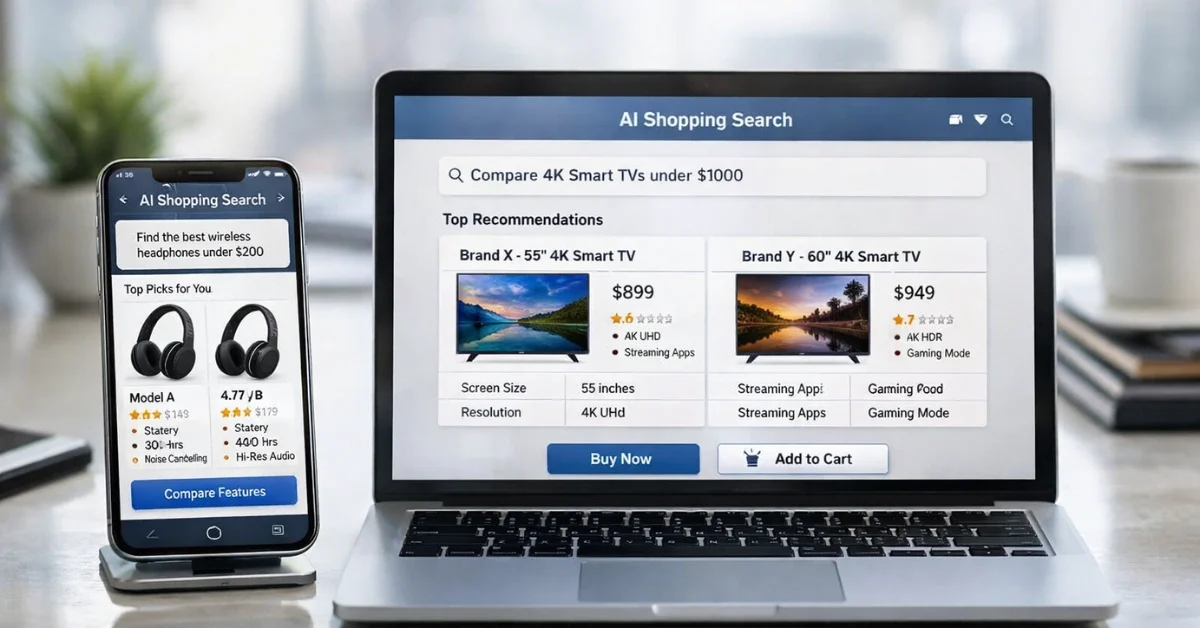
Google is widening its AI commerce push with new shopping tools in AI Mode, a checkout system designed to let people buy products without leaving Google’s interface, and a broader push to connect search, ads and transactions more tightly together. Alphabet has also told investors it plans to spend between $175 billion and $185 billion on capital expenditures in 2026, underscoring the scale of its AI investment.
At the center of the strategy is AI Mode in Search, which moves beyond standard keyword searches and instead uses conversational prompts, visual inputs and AI-generated comparisons. Google says the goal is to help shoppers move from discovery to purchase inside its own platforms rather than being sent elsewhere to complete the process.
Search Becomes Transactional
Google is testing sponsored product formats inside AI Mode that highlight retailers offering items tied to a shopper’s query while keeping those listings inside the conversational experience. The company is also rolling out “Direct Offers,” a feature that lets brands show shoppers tailored promotions such as loyalty perks, bundles and other value-based incentives alongside price discounts.
Google has said its own late-2025 user research showed AI Mode was more helpful when people could compare multiple brands and stores more easily. That shift puts more pressure on retailers to provide structured product data, real-time availability and pricing feeds that can be surfaced accurately inside AI-driven search results.
Checkout Inside Google
A major part of the plan is what Google calls “agentic commerce,” which refers to AI systems that assist with or complete transactions for users. After launching its Agent Payments Protocol in 2025, Google introduced the Universal Commerce Protocol, or UCP, to standardize how merchants connect with AI agents across the shopping journey, including digital identity and payment authorization.
Google says UCP-powered checkout is rolling out in the United States, allowing shoppers to buy products from Etsy and Wayfair directly inside AI Mode in Search and the Gemini app. The company has also said integrations with Shopify, Target and Walmart are planned, while merchants continue to fulfill the orders themselves.
That commerce push now includes Walmart through a separate partnership with Google Gemini. Walmart said the integration will help customers discover and purchase products from Walmart and Sam’s Club, with the feature launching first in the United States before expanding internationally.
Walmart and Google announced that partnership at the National Retail Federation’s Big Show in New York City, and the companies did not disclose financial terms or a launch date. According to the report, Walmart’s incoming CEO John Furner and Google CEO Sundar Pichai made the announcement as Walmart looked to keep pace with growing consumer use of AI chatbots for convenience and inspiration.
Ads, Video and Creative Tools
Google is also linking its commerce effort more closely with advertising and creator content on YouTube. The company said it plans to use AI to better match brands with creator audiences by analyzing video content and audience signals so that viewer engagement can turn into measurable sales.
Google described YouTube as the most-watched streaming platform in the United States for three years, citing Nielsen’s Gauge report as of January 2026. It also said its ad products are increasingly being powered by Gemini 3, which it identified as its latest AI model.
The company said advertiser use of generative creative tools accelerated in 2025, including a threefold increase in Gemini-generated assets. In the fourth quarter alone, Google said 70 million creative assets were generated using Gemini within AI Max and Performance Max campaigns.
Google also said AI Max is designed to expand Search campaign reach by identifying additional queries and placements, and it cited internal October 2025 data saying the system is unlocking billions of additional searches that advertisers were not previously reaching. At the same time, Google said it is reworking measurement tools to unify reporting and attribution across channels.
Bigger Stakes for Retailers
The broader message from Google’s updates is that online shopping is becoming more conversational, more automated and more closely tied to the platforms where people search, watch videos and compare products. Google executive Vidhya Srinivasan said the company’s objective is to remove the usual trade-off between speed and certainty in online shopping.
For retailers and brands, that means visibility may depend more on compatibility with Google’s AI systems, from product feeds to payment protocols and in-platform checkout. Combined with Alphabet’s planned 2026 capital spending, the latest moves show a company investing heavily as it tries to make AI central to how people search, shop and buy.
