

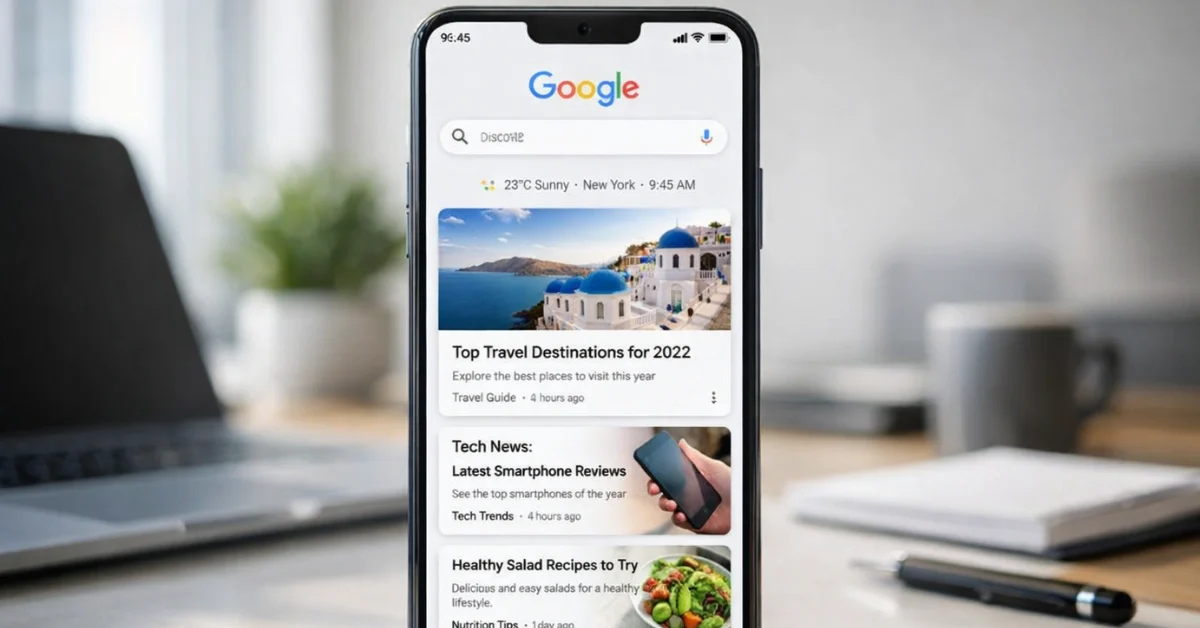
Google released the February 2026 Discover core update on Thursday, February 5, 2026, marking the first time the company has announced an update focused exclusively on its Discover feed. The broad update affects how articles surface in Google Discover, the personalized content feed available on Google’s iOS and Android apps. According to Google, testing shows that people find the Discover experience more useful and worthwhile with this update.
The rollout is expected to take up to two weeks to complete and is currently limited to English-language users in the United States. Google stated it will expand the update to all countries and languages in the months ahead. This phased approach differs from typical core updates that roll out globally.
What Changes the Update Brings
The February 2026 Discover core update improves the user experience in three key ways. First, it shows users more locally relevant content from websites based in their country. Second, it reduces sensational content and clickbait in Discover. Third, it highlights more in-depth, original, and timely content from websites with expertise in a given area, based on Google’s understanding of a site’s content.
Because the update prioritizes locally relevant content, it may reduce traffic for non-US websites that publish news for a US audience. However, over time, this update will elevate those websites’ content in their locally relevant regions as it expands globally.
How Google Evaluates Expertise
Google’s systems are designed to identify expertise on a topic-by-topic basis, meaning sites can demonstrate deep knowledge across multiple subjects or maintain a deep focus on a single topic with equal opportunity to appear in Discover. The company provided a specific example to illustrate this approach. A local news site with a dedicated gardening section could have established expertise in gardening, even though it covers other topics. In contrast, a movie review site that wrote a single article about gardening would likely not demonstrate that same level of expertise.
Google confirmed it will continue showing content that’s personalized based on people’s creator and source preferences, ensuring that individual user interests remain a factor in content delivery.
Expected Impact on Publishers
As with all core updates, this change may lead to fluctuations in Discover traffic. Some sites might see increases or decreases, while many sites may see no change at all. Website owners who noticed changes in Google Discover visibility should monitor several key metrics. Discover impressions serve as the clearest indicator of whether the update has affected a site, with a clear, sustained drop suggesting content is being shown less often in the feed.
Publishers should also track Discover clicks to confirm whether changes in impressions actually affect traffic. If impressions fall and clicks drop at a similar rate, visibility in Google Discover has likely declined across the board. Click-through rate shows how appealing content is within the Discover feed, with a falling rate indicating that headlines or images may no longer resonate with users.
Updated Guidelines for Publishers
Google updated its Discover documentation with new recommendations for content creators. The updated guidance advises publishers to avoid clickbait and similar tactics that artificially inflate engagement by using misleading or exaggerated details in preview content, including titles, snippets, or images, or by withholding crucial information required to understand what the content is about.
Publishers should use page titles and headlines that capture the essence of the content and avoid sensationalism tactics that manipulate appeal by catering to morbid curiosity, titillation, or outrage. Google recommends providing content that’s timely for current interests, tells a story well, or provides unique insights.
The documentation also emphasizes including compelling, high-quality images in content, especially large images that are more likely to generate visits from Discover. Large images need to be at least 1200 pixels wide and enabled by the max-image-preview:large setting or by using AMP. Additionally, publishers should provide an overall great page experience, which includes avoiding overloading pages with annoying ads and auto-playing content.
Early Signs of Volatility
Reports of ranking volatility emerged almost immediately after Google announced the February 2026 Discover core update. Major publishers and content-driven websites noticed changes in content impressions from Google’s Discover feed. According to Semrush’s Sensor Tool, which measures ranking volatility, desktop rankings peaked on February 5 and remained in the high range afterward. Interestingly, while the update focuses on the mobile-based Discover feed, mobile ranking volatility measured lower than desktop.
Website owners experiencing declines should understand that reduced visibility doesn’t indicate a penalty. Instead, it means content may not align with Google’s changes to the Discover feed as much as other pages and websites do. Google recommends waiting for the update to complete its rollout before making significant changes to content, as some fluctuations are only temporary while the system adjusts.
Guidance for Site Owners
For site owners seeking guidance, Google’s general guidance about core updates applies, as does the company’s Get on Discover help page. The update follows the same general principle Google has emphasized in recent years: creating helpful, relevant content written for real people rather than solely to rank in search engines.
Content that clearly answers a question or addresses a need will perform more consistently in search results and remain mostly unaffected by major updates. Google Discover favors content that adds something new to a topic through original insight, expert commentary, or practical examples that go beyond surface-level coverage.
Since Google Discover is a mobile content feed, mobile usability remains crucial. Pages should load quickly, display correctly, and avoid visually disruptive layouts or excessive ads. Strong mobile usability supports user engagement and can maintain content visibility in Discover, while poor user engagement signals can damage organic performance.
