

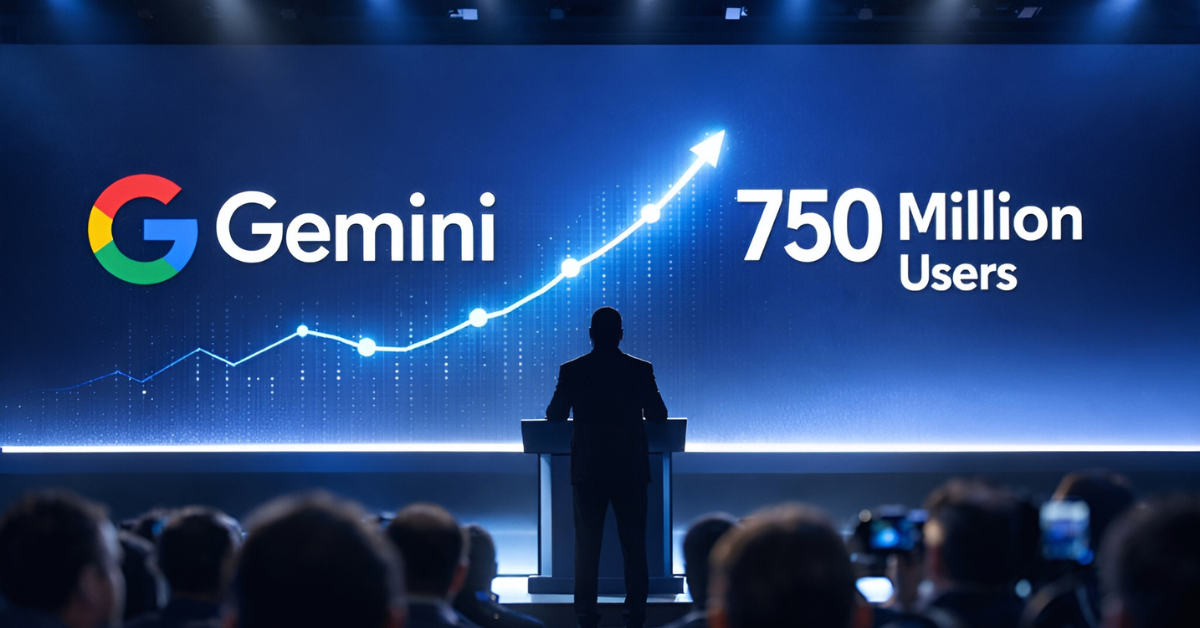
Google has officially solidified its position as a dominant force in the artificial intelligence landscape, announcing that its Gemini app has surpassed 750 million monthly active users. This major milestone was revealed alongside Alphabet’s fourth-quarter 2025 earnings report, which highlighted a historic financial year for the tech giant. The company reported that its annual revenues exceeded $400 billion for the first time, driven largely by aggressive investments and rapid growth in its AI capabilities.
The surge in user numbers marks a significant turnaround for Google, which had previously faced criticism for appearing slower than competitors in the AI race. With Gemini now reaching three-quarters of a billion users each month, the company has effectively reset the narrative, positioning itself as a leader rather than a laggard. This growth signals widespread consumer adoption of Google’s AI tools, which are now deeply integrated into the company’s vast ecosystem of products.
From Laggard to Leader in the AI Race
The trajectory of the Gemini app illustrates how quickly the competitive dynamics of the technology sector can shift. Just a year prior, industry observers were closely watching how Google would respond to the early dominance of OpenAI and its ChatGPT platform. The latest figures suggest that Google has not only caught up but is pulling ahead with stellar growth momentum.
According to recent reports analyzing the market, Google’s strategic pivot to prioritize AI across its operations is paying off. The transition from being perceived as behind the curve to establishing a massive user base of 750 million indicates that the company’s foundational models and consumer applications are resonating globally. This rapid expansion is narrowing the gap with early movers in the generative AI space, as Google leverages its extensive infrastructure to deploy these tools at scale.
CEO Sundar Pichai emphasized this strong AI-led growth in his message regarding the company’s performance. The integration of advanced models into search, workspace, and mobile devices has lowered the barrier to entry for hundreds of millions of people, allowing them to access powerful AI assistance directly through the interfaces they already use daily.
Record-Breaking Financial Performance
The operational success of Gemini was mirrored by Alphabet’s financial results for the fiscal year 2025. Surpassing the $400 billion revenue mark represents a watershed moment for the company, underscoring the lucrative potential of its diversified business model even as it pivots toward new technologies.
The fourth-quarter earnings call provided a platform for executives to discuss how artificial intelligence is beginning to contribute meaningfully to the bottom line. While specific breakdowns of AI-only revenue remain complex, the broader signal is clear: the technology is enhancing core products like Search and Cloud, driving higher engagement and commercial activity.
Pichai flagged this performance as evidence of the company’s enduring strength and its ability to innovate while maintaining substantial profitability. The financial achievements of 2025 provide the necessary capital to sustain the incredibly high costs associated with training and running next-generation AI models, a cycle that is expected to intensify in the coming year.
Ramping Up Infrastructure Spending for 2026
Looking ahead, Alphabet has signaled that it will not be slowing down its investment pace. The company forecasts a sharp surge in capital spending for 2026, aimed specifically at bolstering the infrastructure required to support its AI ambitions. This includes the construction of data centers, the acquisition of specialized chips, and the energy resources needed to power them.
During the earnings discussion, the company indicated that it is effectively resetting the bar for AI infrastructure spending. This aggressive capital expenditure strategy is designed to ensure that Google possesses the computational capacity to train even larger models and serve its rapidly growing user base without latency or capacity bottlenecks.
The decision to increase spending comes as the demand for AI compute power outstrips supply across the industry. By committing to these heavy investments now, Google aims to secure its long-term advantage, ensuring that the 750 million users currently on the Gemini app can be supported as the service evolves and expands.
A New Era of AI-Native Computing
The dual announcements of the Gemini user milestone and the $400 billion revenue record paint a picture of a company in full transformation. The focus is no longer just on organizing the world’s information but on generating and synthesizing it through intelligent agents.
Observers note that while the costs are rising, the user engagement metrics provide validation for the strategy. As the company prepares for 2026, the focus remains on maintaining this momentum, ensuring that the Gemini app continues to evolve from a novelty into an essential utility for its massive global audience. With the financial wind at its back and a clear infrastructure roadmap, Google is firmly entrenched in the next phase of the digital revolution.
