

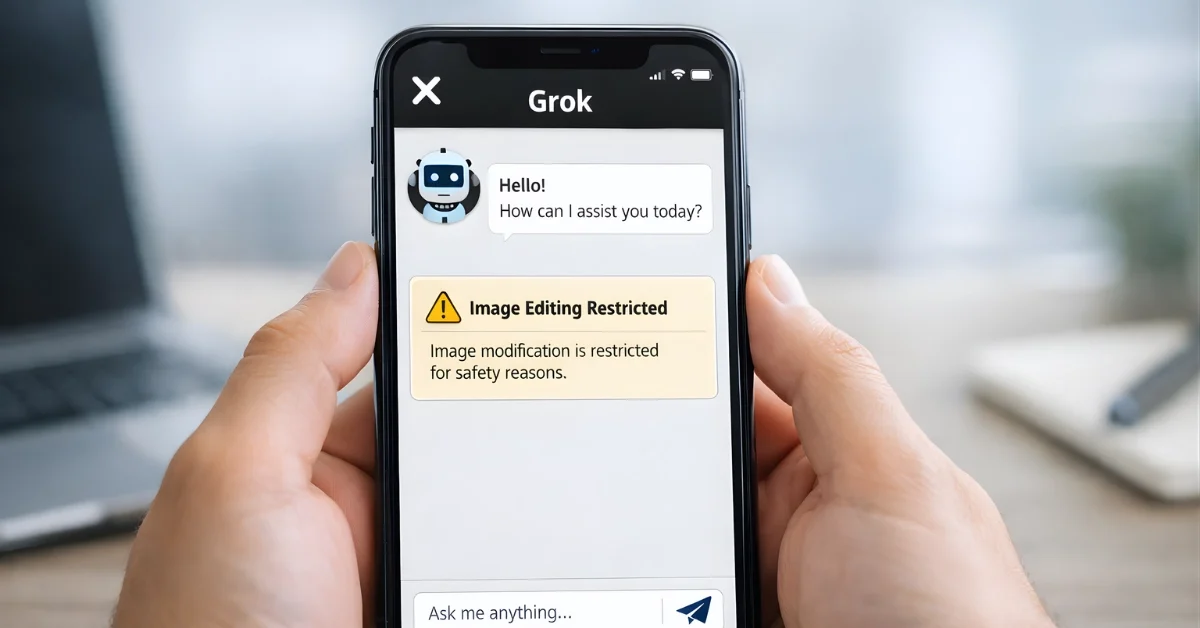
X has tightened Grok image-editing controls after backlash over the chatbot’s ability to create sexualized images of real people, including women and children. The new steps include blocking certain edits involving revealing clothing and limiting some image features to paid subscribers, while regulators in several places continue to scrutinize the tool.
The changes were announced as California’s attorney general said his office opened an investigation into sexually explicit AI deepfakes linked to Grok, including images involving children. X also said it is applying “geoblocking” in jurisdictions where certain image-generation actions are illegal.
What X changed in Grok
X’s safety team said it implemented technology to stop the Grok account from editing images of real people in revealing clothing such as bikinis. X said this restriction applies to all users, including paid subscribers.
X also said it will “geoblock the ability” for users to create images of people in “bikinis, underwear, and similar attire” in jurisdictions where such actions are illegal. In addition, X said that, as an “extra layer of protection,” image creation and the ability to edit photos via X’s Grok account are now only available to paid subscribers.
Business Insider reported that the company also reiterated that image creation and image editing through Grok on X will now be restricted to paid users as an additional safety measure. The same report said the company restricted non-paying users the previous week after complaints from officials globally, but that change drew criticism for being insufficient.
Investigations and political reaction
California Attorney General Rob Bonta said he launched an investigation into sexualized AI deepfakes, including those of children, generated by Grok. He said the “avalanche” of reports about non-consensual sexually explicit material produced and posted online in recent weeks was “shocking,” and he said there was “zero tolerance” for nonconsensual intimate images or child sexual abuse material.
Business Insider reported Bonta said there had been a flood of reports in recent weeks that Grok users were taking pictures of women and minors found online and using the AI model to “undress” them in images. A representative of the California attorney general’s office said xAI “can and should put better safeguards in place” to protect children and women from harms caused by sexually explicit materials generated without consent.
The representative also said that while the changes were “encouraging,” the California Department of Justice was investigating whether xAI violated the law “with the conduct that has occurred.” The California investigation would examine whether xAI violated state law after the explicit imagery was “used to harass people across the internet.”
California Governor Gavin Newsom said xAI’s decision to allow sexually explicit deepfakes to proliferate was “vile,” and he said he urged the attorney general to hold the company accountable. Separately, Business Insider reported a spokesperson for British Prime Minister Keir Starmer criticized a prior move to restrict features for non-paying users, saying it “simply turns an AI feature that allows the creation of unlawful images into a premium service.”
International scrutiny and bans
Global pressure had been building on xAI to rein in Grok after a feature described as “Spicy Mode” allowed users to create sexualized deepfakes of women and children using simple text prompts such as “put her in a bikini” or “remove her clothes.” Multiple countries either blocked access to the chatbot or launched probes into the issue.
Business Insider reported Indonesia and Malaysia suspended Grok amid concerns over sexualized images of women and minors, and described them as the first countries to ban the AI tool. That report also said lawmakers in the UK publicly considered suspending it, and that the UK communications regulator Ofcom launched an investigation.
Business Insider reported that UK technology secretary Liz Kendall said she welcomed X’s change, but expected the facts to be fully established through Ofcom’s ongoing investigation. The European Commission said it had taken note of “additional measures” X was taking to ban Grok from generating sexualized images of women and children, and said it would carefully assess the changes to ensure they protect people in the EU.
A coalition of 28 civil society groups submitted open letters to the CEOs of Apple and Google urging them to ban Grok and X from their app stores amid a surge in sexualized images. This added pressure on Musk’s company on the same day X announced its measures.
What remains unclear
Business Insider reported that Grok is also available as a stand-alone web and mobile application. The report said it was unclear whether users could still create sexualized images through Grok’s webpage and app, and said xAI could not be reached for immediate comment.
Business Insider also reported that Elon Musk responded to a post questioning why other AI tools were not being scrutinized by saying the UK government wanted “any excuse for censorship.” The same report said that a few hours before X’s official account posted about the ban on creating sexualized images, Musk asked users to try to get around the AI model’s image restrictions.
