

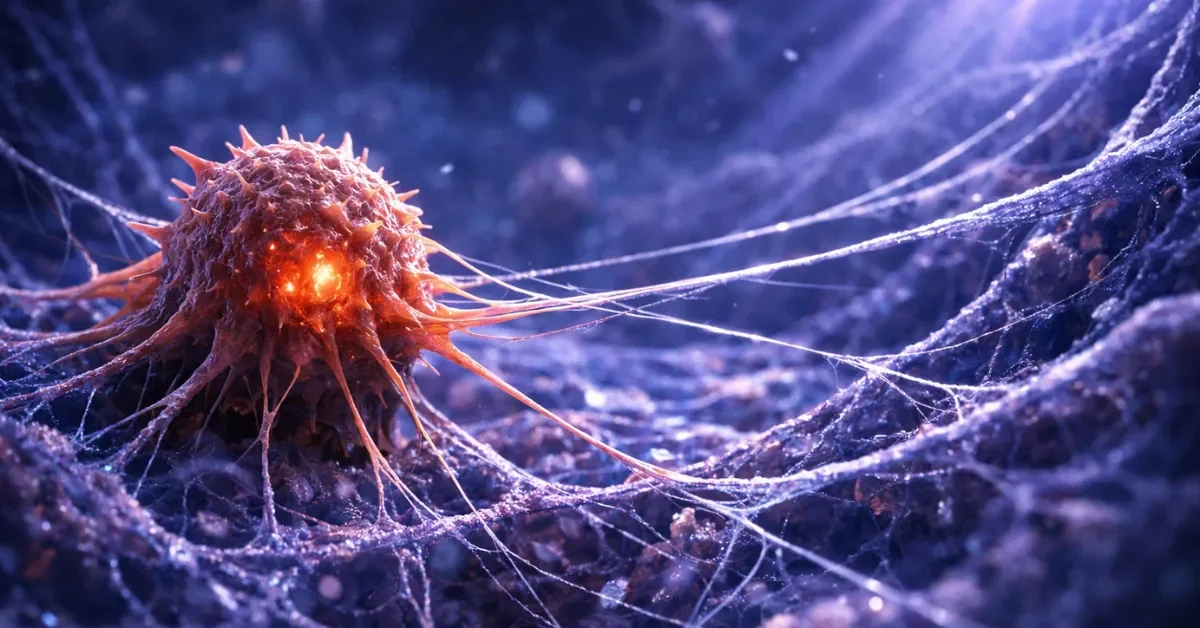
In the fairy tale of the princess and the pea, a young royal is so sensitive she can detect a tiny vegetable beneath many mattresses. In biology, something remarkably similar happens when a single cell senses conditions far beyond what it directly touches. For a long time, scientists believed this unique ability was limited to unusual cells found in tumors. However, groundbreaking new research shows that ordinary cells can achieve an even greater feat when they work together.
Engineers at Washington University in St. Louis recently published these exciting findings in the journal Proceedings of the National Academy of Sciences. Their work sheds light on how cells detect and respond to their environment well beyond the surface they are attached to. Understanding this complex process could help researchers learn how cancer cells spread through the human body, eventually revealing innovative ways to slow or prevent that dangerous progression.
The Mechanics of Depth Mechano-Sensing
To understand this biological breakthrough, it helps to look at the physical forces at play. Amit Pathak, a professor of mechanical engineering and materials science at Washington University, focuses his research on how cells interact with the physical properties of their surroundings. He explained that a process called “depth mechano-sensing” allows cells to detect structural features hidden beyond the surface they are currently resting on.
In earlier studies, Pathak and his team discovered that abnormal cells equipped with a “high front-rear polarity” have an especially strong ability to sense their physical environment. This polarity is highly indicative of actively migrating cells. These solitary, abnormal cells can detect subtle physical cues up to ten microns away. This impressive sensing distance stretches well beyond the immediate area where the cell is physically attached.
This sensing ability relies on how a cell pulls and actively reshapes the fibrous collagen around it. By deforming these tiny fibers, the cell effectively extends its reach deep into the extracellular matrix. Through this physical manipulation, the cell can “feel” what lies hidden in the next anatomical layer. That upcoming layer could be incredibly stiff, such as a dense tumor, or it could be softer tissue or even nearby bone. By detecting the stiffness of the extracellular matrix, a single abnormal cell determines the most effective direction to move.
Teamwork Extends Cellular Reach
While individual abnormal cells possess impressive abilities, normal cells perform even better under the right conditions. The newly published research shows that tight groups of epithelial cells can achieve a much greater sensing range. Epithelial cells are ordinary cells that form the skin surface and carefully line the various cavities throughout the body.
When these epithelial cells act together in a coordinated group, they generate enough physical force to probe aggressively through the fibrous collagen. In doing so, they can detect environmental layers located as far as one hundred microns away. This collective effort gives them a sensing range ten times farther than what a single migrating cell achieves alone.
As Professor Pathak noted during the study, the secret lies entirely in teamwork. Because the cells operate as a unified collective, they are capable of generating significantly higher mechanical forces than they ever could individually. Pathak conducted this revealing research alongside his PhD student, Hongsheng Yu.
To further understand this phenomenon, the research team utilized advanced computer models. These models suggest that the collective sensing process unfolds in two distinct stages as the cells cluster tightly together and begin migrating as a unit. During these active phases, the physical information the cells gather about their hidden surroundings directly influences exactly how they move and ultimately spread.
Implications for Cancer Progression
The implications of this enhanced sensing ability are particularly significant for understanding diseases. Cancer cells appear to deeply benefit from this extraordinary long-range sensing capability. Their natural capacity to detect what lies ahead helps them successfully escape the harsh tumor environment. Once free, they can easily move through the surrounding healthy tissue while actively avoiding detection. This depth mechano-sensing ability allows dangerous cells to migrate much more easily, even when navigating through softer biological environments.
Moving forward, researchers urgently want to determine exactly how this impressive sensing range is biologically controlled. They are searching to see whether specific internal regulators determine just how far these cells can detect their surroundings. Identifying those hidden regulators could open the door to highly effective new cancer treatments. If medical scientists can disrupt a cancer cell’s ability to “feel” its path forward, they may successfully limit how far the terrible disease spreads throughout the patient’s body.
Crucial funding for this research was provided by the National Institutes of Health and the National Science Foundation’s Civil, Mechanical and Manufacturing Innovation division.
