

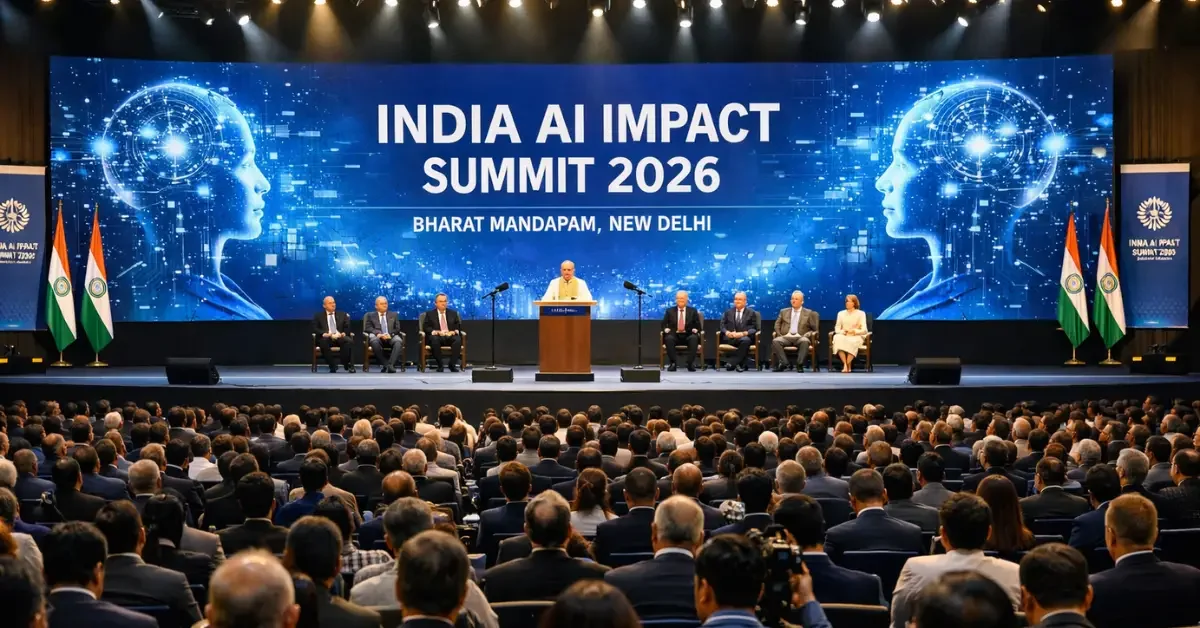
India marked a historic milestone this week by hosting the India AI Impact Summit 2026 at Bharat Mandapam in New Delhi, running from February 16 to 20. Billed as the largest AI gathering in the world, the five-day event is the first major AI summit held in the Global South, drawing over 20 heads of state, 60 ministers, and 500 global AI leaders to the Indian capital.
Prime Minister Narendra Modi officially welcomed participants and shared his vision for the summit on social media. “The AI Impact Summit will enrich global discourse on diverse aspects of AI, such as innovation, collaboration, responsible use and more,” Modi posted on X. The summit’s theme — Sarvajan Hitaya, Sarvajan Sukhaya, meaning “Welfare for All, Happiness of All” — captures the inclusive spirit India is projecting as a rising AI power.
Ambani’s Record-Breaking $110 Billion Pledge
The single biggest announcement at the summit came on February 19, when Reliance Industries chairman Mukesh Ambani revealed that his conglomerate and telecom arm Jio will invest $109.8 billion over the next seven years to build AI and data infrastructure. Ambani described the commitment as a long-term “nation-building” investment, focused on developing sovereign AI computing capabilities and addressing the high costs and scarcity of compute resources that currently limit India’s AI progress.
On the same day, American AI company OpenAI announced it would become the first customer of a data center operated by Tata Consultancy Services — another significant partnership born from this summit.
India Scales Up Its Compute Power
On day two of the summit, Union Minister for Electronics and Information Technology Ashwini Vaishnaw announced that India would add 20,000 Graphics Processing Units (GPUs) in the coming weeks, taking total national compute capacity from 38,000 to more than 58,000. The expansion is a concrete step toward building the hardware foundation India needs to compete at the top tier of global AI development.
These resources are made available to startups, researchers, students, and public institutions at just ₹65 per hour through India’s ₹10,300 crore IndiaAI Mission. Keeping compute affordable sits at the core of the government’s vision to democratize AI access rather than concentrate it within large corporations.
Vaishnaw also expressed strong optimism that more than $200 billion in AI and deep-tech investments could flow into India’s ecosystem over the next two years, driven by growing interest from venture capital firms across all five layers of the AI stack.
Sutras and Chakras: India’s Guiding Framework
The summit’s intellectual structure rests on three foundational principles called “Sutras” — a Sanskrit term for guiding threads — centred on People, Planet, and Progress. These define how AI must serve all of humanity, respect environmental limits, and ensure benefits reach communities equitably. Working sessions are then organized into seven “Chakras” covering areas from human capital development and social inclusion to AI safety governance, sustainability, scientific discovery, and economic growth.
On February 17, the government launched six sectoral AI Impact Casebooks documenting over 170 deployed and scalable AI innovations across health, energy, education, agriculture, gender empowerment, and accessibility. These are not pilot proposals — they are solutions already delivering real results, made available as reference models for replication at scale.
Youth, Rankings, and a Shifting Global Stage
On the summit’s opening day, over 2.5 lakh students across India collectively pledged to use AI responsibly. The initiative has been submitted for recognition by Guinness World Records, reflecting the government’s push to embed a culture of responsible innovation in the next generation.
Stanford University has ranked India among the top three AI nations in the world, according to information shared at the summit. The world’s leading technology figures took note. Top executives expected to participate included tech CEOs such as Sundar Pichai, OpenAI’s Sam Altman, Anthropic’s Dario Amodei, and Bill Gates, alongside Indian business leaders Mukesh Ambani and Nandan Nilekani. Demand for space in the city was so intense that luxury hotel rates in central New Delhi climbed above $20,000 per night.
“Hosting the summit in India, the first in the Global South, highlights a shift toward solutions shaped by emerging economies,” said Jules Polonetsky, CEO of think-tank Future of Privacy Forum, who flew in from Washington D.C. to speak at the event. For decades, the frameworks governing emerging technologies were shaped largely within advanced economies. This summit represents a deliberate effort to widen that circle.
India held close to 500 pre-summit events over the past six months, received more than 700 proposals for main summit sessions, and drew over 4,650 applications from 60-plus countries for its three flagship Global Impact Challenges — AI for ALL, AI by HER, and YUVAi — with 70 finalists selected to showcase their innovations at the Grand Finale and Awards Ceremony.
