

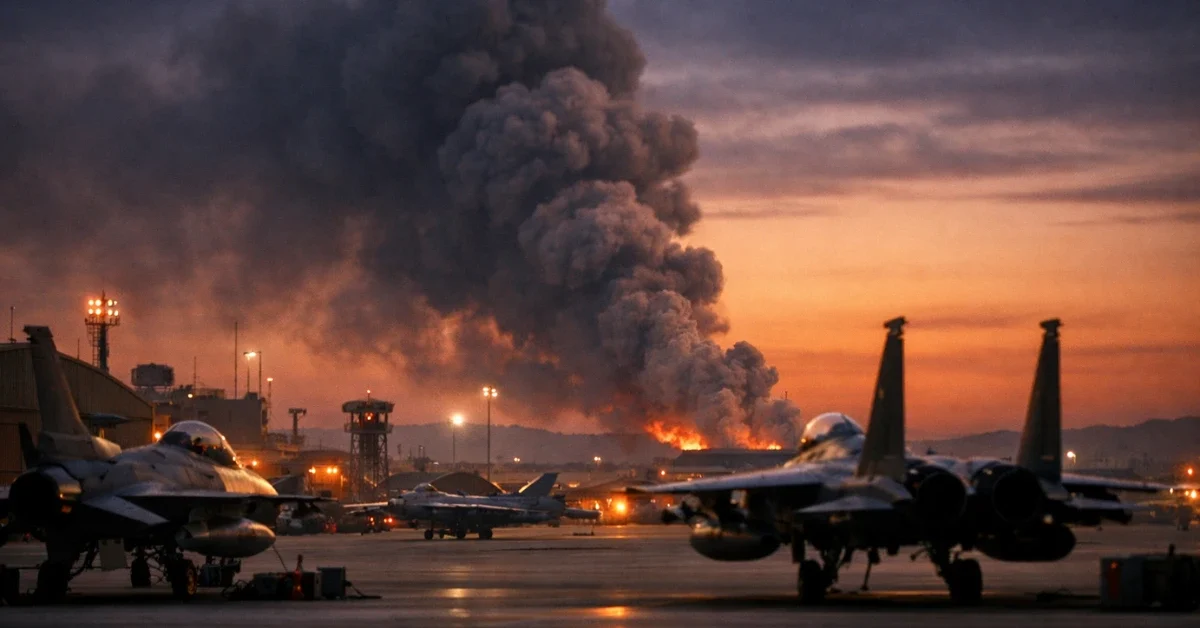
Iran launched a wave of retaliatory drone and missile strikes against United States military installations and Israeli targets across several Gulf Arab states on Saturday. The attacks followed coordinated U.S. and Israeli airstrikes on Iranian territory, which U.S. President Donald Trump described as the start of “major combat operations.” The escalating conflict has disrupted the stability of the Middle East and triggered international alarm.
State-run media in the United Arab Emirates reported that the missile strikes resulted in one death in Abu Dhabi, though officials have not released further details about the fatality. The Iranian strikes targeted numerous military facilities hosting U.S. personnel throughout the region.
Military Bases Targeted Across the Region
The Iranian military confirmed the deployment of drones and short-range missiles aimed at key installations. Targeted locations included the al-Udeid air base in Qatar, the Ali al-Salem base in Kuwait, the al-Dhafra air base in the United Arab Emirates, and the Muwaffaq Salti base in Jordan. Additional strikes were directed at the Prince Sultan air base in Riyadh, Saudi Arabia, a U.S. base in Erbil, Iraq, and the U.S. Fifth Fleet base in Bahrain.
Witnesses across the Gulf region reported hearing loud explosions and emergency sirens as regional missile defense systems activated. In Bahrain, observers saw a column of gray smoke rising near the coast after a service center utilized by the U.S. Fifth Fleet was attacked.
There are conflicting accounts regarding the success of the Iranian offensive. Government officials in Kuwait, Qatar, the United Arab Emirates, and Jordan stated that their defense systems successfully intercepted the incoming Iranian missiles. In contrast, Iran’s Revolutionary Guards released a statement claiming that their formidable strikes delivered “powerful blows” to the U.S. bases. The Guards declared that their military operations would continue relentlessly until their enemies face a decisive defeat.
Regional leaders quickly condemned the Iranian missile launches. Saudi Arabia and the United Arab Emirates issued formal statements denouncing the attacks as unacceptable infringements on their national sovereignty. Both nations asserted their legal right to retaliate against the aggression.
In response to the regional backlash, Iranian Foreign Minister Abbas Araghchi contacted his counterparts in the Gulf states to defend Tehran’s actions. Araghchi argued that these nations shared responsibility for the conflict because they failed to prevent the United States from using their local military bases to conduct illegal operations against Iran.
US and Israel Launch Operation Epic Fury
The Iranian missile strikes were a direct response to coordinated U.S. and Israeli attacks on Iran, which the Pentagon designated as Operation Epic Fury. Early Saturday morning, President Trump announced the commencement of major combat operations against the Middle Eastern nation.
According to Trump, the joint military strikes were specifically aimed at annihilating the Iranian navy and destroying the country’s missile infrastructure. The president stated the offensive was a necessary measure after Iran repeatedly rejected American demands to halt its nuclear weapons production.
Trump claimed that Iranian leadership had recently attempted to rebuild their nuclear facilities. He also accused Tehran of developing advanced long-range missiles capable of threatening European allies, U.S. military troops stationed overseas, and the American homeland.
The military escalation followed weeks of unsuccessful diplomatic negotiations between Washington and Tehran regarding Iran’s nuclear ambitions. The final round of talks concluded on Thursday without a resolution. Trump stated that Iran had rejected every opportunity to abandon its nuclear program, declaring that the United States could not tolerate the situation any longer.
During his announcement, Trump issued a stark ultimatum to the Islamic Revolutionary Guard Corps. He urged the Iranian armed forces to lay down their weapons in exchange for guaranteed immunity. The president warned that anyone who refused to surrender would face “certain death.” Trump also cautioned the American public that the ongoing military operations could result in U.S. casualties.
Iran Vows No Leniency
Iranian officials reacted to the U.S. and Israeli airstrikes with severe condemnation. The Iranian foreign ministry characterized the joint offensive as a blatant act of aggression that directly violated the United Nations charter. Officials noted that the attacks undermined any potential for a diplomatic resolution, particularly because they occurred while Iran was actively engaged in delicate negotiations regarding its nuclear program.
According to statements from Tehran, the U.S. and Israeli strikes targeted key Iranian leaders and resulted in the deaths of at least 40 children. In response to the casualties, the Iranian foreign ministry urged Muslim and non-aligned nations to demand an immediate emergency meeting of the UN Security Council.
A senior spokesperson for the Iranian military promised severe retaliation against the nations involved. The spokesperson warned that Iran would teach the United States and Israel an unprecedented lesson. The military representative emphasized that any regional base providing support to Israel would be targeted by the Islamic Republic, vowing to show “no mercy” and absolutely no leniency as the conflict continues.
