

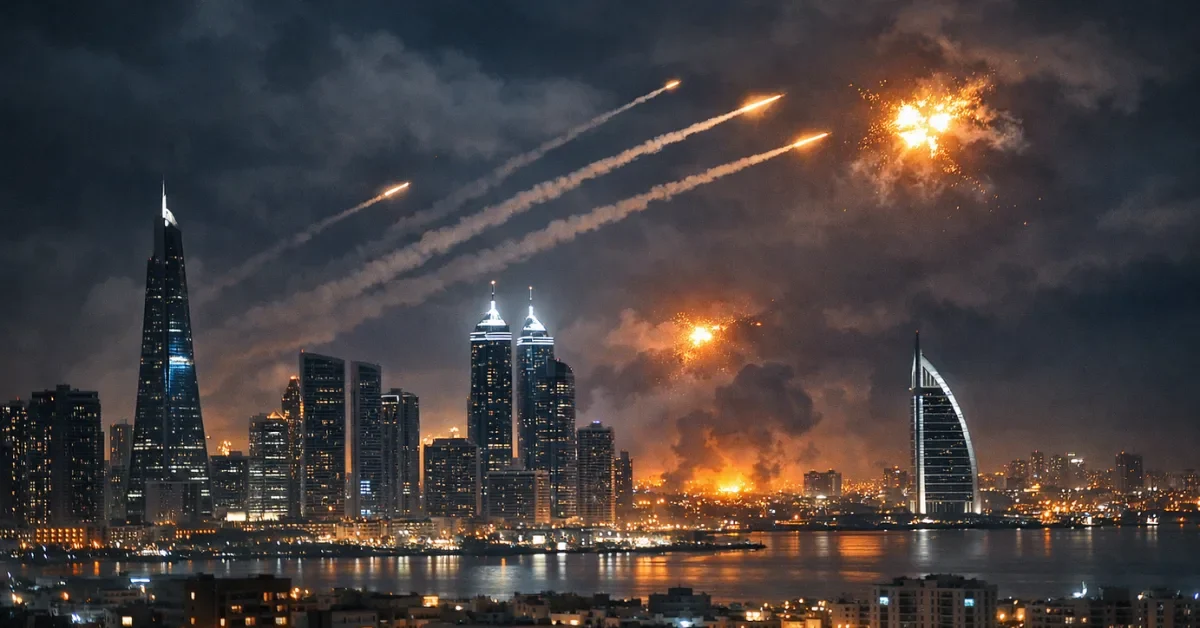
The rapidly intensifying conflict between Iran, the United States, and Israel has triggered a reprehensible new wave of missile and drone attacks across the Middle East. Gulf nations, including the United Arab Emirates, Saudi Arabia, Bahrain, and Qatar, are now facing severe aerial threats and significant disruptions to vital energy infrastructure. As the Iran-US-Israel war widens, Tehran is betting on a strategy of endurance and energy market disruption to outlast its adversaries, while American and Israeli forces continue heavy bombardment campaigns.
Leadership Shifts and Military Strategies in Iran
The geopolitical landscape shifted dramatically following the death of Iranian Supreme Leader Ayatollah Ali Khamenei, who was killed during joint US-Israeli military strikes that began on February 28, 2026. Within hours of his death, Iran formally appointed his 56-year-old son, Mojtaba Khamenei, as the new Supreme Leader. The Iranian political and military elite quickly pledged allegiance to him, unveiling a new missile in his honor.
In response to the succession, Israeli Defense Minister Katz issued a stark warning, declaring that the new supreme leader would also become a military target. US President Donald Trump initially downplayed Mojtaba Khamenei’s significance, stating he should have had input regarding the selection of a new leader. However, Trump has since stated that the conflict will be over soon.
Despite the heavy bombardment, Iran is preparing for a prolonged war of attrition. Rather than seeking a swift military victory, Iran’s strategy focuses on endurance. By unleashing continuous drone and ballistic missile attacks, cutting vital energy routes, and jolting global markets, Tehran aims to force Washington and Israel to concede first. Internally, Iran is shifting to a war economy. Goods at ports are being cleared immediately to maintain supply lines, and the Islamic Revolutionary Guard Corps is consolidating state control. Reports from Tehran indicate that despite the constant bombardment and shaking windows, life continues; shops and banks remain open, and there are currently no signs of public protests or fractures within the ruling establishment.
Gulf Nations on High Alert Amid Aerial Assaults
The spillover of the Iran-US-Israel war has placed the entire Gulf region on high alert. Gulf states have lambasted Iran for its continued strikes on their territories, prompting widespread closures of regional airspace. In the United Arab Emirates, the Ministry of Interior issued emergency warnings, placing Abu Dhabi on high alert as advanced defense operations responded to incoming missile threats. Residents received urgent notifications to seek immediate shelter, stay indoors, and avoid windows or open areas. Authorities also cautioned the public against filming or approaching incident sites to allow emergency personnel to work effectively. Loud explosions rocked the capital as UAE air defense systems successfully intercepted and neutralized the aerial threats before they could hit critical targets.
Similar chaotic scenes unfolded across the region. In Qatar, alerts were issued around 3:15 AM local time, with interceptor missiles countering incoming Iranian projectiles and resulting in approximately 12 to 13 loud explosions over Doha. Qatar’s Prime Minister Mohammed bin Abdulrahman Jassim Al Thani expressed profound disappointment, characterizing the assaults as a significant betrayal by the Iranian leadership. He emphasized that the attacks commenced despite prior assurances from Gulf nations that they would not participate in the conflict against Iran. Kuwait has also reported multiple missile strikes within its borders.
Widespread Energy Disruptions and Regional Casualties
The deliberate targeting of Gulf energy sites has caused immediate disruptions to global oil production and distribution. Bahrain’s national oil company, BAPCO, was forced to declare force majeure after an Iranian strike caused a massive fire at its largest refinery, sending thick black smoke into the sky. In Saudi Arabia, defense forces intercepted four drones heading toward the Shaybah oilfield. Tragically, a projectile that landed in a residential area in Saudi Arabia’s al-Kharj governorate resulted in two fatalities and twelve injuries.
The conflict has also severely impacted international trade routes. Drone strikes and widespread GPS jamming are disrupting cargo ships at sea, further threatening global supply chains. Meanwhile, the war continues to expand on multiple fronts, with reports of Mossad’s alleged involvement in an Aramco attack and the conflict spreading to include Hezbollah rocket and drone strikes from Lebanon and Beirut.
The human toll of the war continues to climb. In Iran, the ongoing US and Israeli airstrikes have resulted in at least 1,255 fatalities and thousands of injuries, with reports indicating 40 killed in Tehran alone. In a major escalation, Israel has also targeted multiple oil facilities in central Iran for the first time. As Gulf airspace remains closed and regional air defenses stay activated, the international community watches closely to see how long this brutal contest of endurance will last.
