

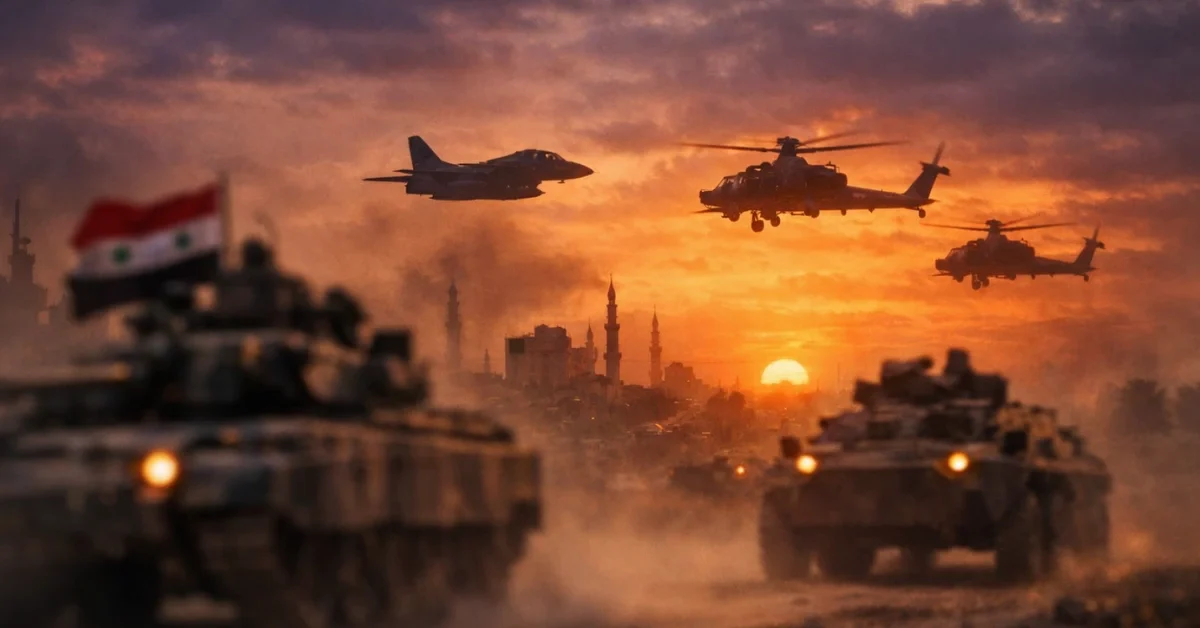
The Islamic State (IS) militant group has claimed responsibility for two recent, targeted attacks on Syrian military personnel, simultaneously declaring a “new phase of operations” against the country’s national leadership. This sudden resurgence of organized militant violence coincides with an expanding United States military footprint in the Middle East and rising geopolitical friction involving Iran and Russia.
On Saturday, the extremist organization announced through its Dabiq news agency that it had targeted an “individual of the apostate Syrian regime” in the city of Mayadin, located in Deir al-Zor province, using a pistol. In a separate incident, the group attacked two other personnel with machine guns in the northern city of Raqqa. The Syrian Defense Ministry released a statement confirming that a Syrian army soldier and one civilian were killed on Saturday by “unknown assailants.” A regional military source later clarified that the deceased soldier belonged to the Syrian army’s 42nd Division.
These incidents follow another recent attack. Just two days prior, IS claimed responsibility for a strike in Deir al-Zor that killed a member of the Interior Ministry’s internal security forces and left another wounded. Concurrently, several social media accounts and Telegram channels affiliated with IS supporters have broadcasted calls for intensified guerrilla-style attacks utilizing motorcycles and firearms.
Escalating Violence Against Syria’s New Leadership
The targeted violence represents a severe challenge to the transitional government of President Ahmed al-Sharaa. A former al-Qaeda commander who severed ties with the organization in 2016, Sharaa led a coalition of Islamist factions that successfully overthrew Bashar al-Assad at the end of 2024. Since Assad’s removal, the Islamic State has executed six distinct attacks against Syrian government targets.
According to a comprehensive report released last week by the United Nations Office of Counter-Terrorism, Sharaa and two of his senior cabinet ministers have already been the targets in five thwarted assassination attempts orchestrated by IS.
In an audio message disseminated on Saturday evening, IS spokesperson Abu Hudhayfa al-Ansari proclaimed that Syria had transitioned from “Iranian occupation to Turkish-American occupation.” He explicitly branded President Sharaa as a “watchdog” for the global coalition and threatened that his ultimate fate would mirror Assad’s. Sharaa officially aligned his nation with the global anti-ISIS coalition during a November 2025 visit to the U.S., where he met with U.S. President Donald Trump.
U.S. Counter-Terrorism and Regional Military Build-Up
In direct response to the persistent militant threat within Syrian borders, the United States has maintained active military engagement. U.S. Central Command reported that American forces conducted five precision airstrikes against IS targets in Syria between January 27 and February 2. These operations successfully destroyed a munitions depot housing 50 precision-guided weapons.
However, the counter-terrorism campaign in Syria is unfolding against a complex backdrop of broader regional instability. The U.S. is engaged in a massive military buildup across the Middle East, a deployment that a senior American official indicated will be finalized by mid-March. This strategic mobilization includes the dispatch of aircraft carriers, warships, and fighter jets, primarily aimed at countering perceived threats from Tehran.
Rising Geopolitical Tensions Over Iran
During the inaugural meeting of his Board of Peace in Washington, President Trump noted that nuclear negotiations with Tehran were progressing but demanded a “substantial” agreement. “Otherwise, bad things happen,” Trump remarked, reiterating previous threats of military action. He referenced American airstrikes from June that he claimed significantly diminished Iran’s nuclear capabilities, suggesting the U.S. might escalate its response if necessary.
The escalating U.S. threats of military action against Iran have already triggered an uptick in global oil prices. The U.S. and Israel, accusing Tehran of attempting to develop nuclear weaponry, are pressing Iran to completely abandon uranium enrichment. Additionally, diplomats are demanding that Iran relinquish its long-range ballistic missile programs and cease support for various militant groups throughout the Middle East. U.S. Secretary of State Marco Rubio is scheduled to meet with Israeli Prime Minister Benjamin Netanyahu on February 28 to discuss the situation.
Despite maintaining that its nuclear endeavors are strictly for peaceful purposes, Iran has been reluctant to make substantial compromises. Iranian officials refuse to entertain negotiations on issues beyond their nuclear program, labeling any attempts to limit their defensive missile capabilities as a non-negotiable red line.
This aggressive U.S. posture has drawn international scrutiny. On Thursday, Russian Kremlin representative Dmitry Peskov cautioned against an “unprecedented escalation of tensions” surrounding Iran. Emphasizing the need for diplomatic avenues, Peskov urged all involved regional stakeholders to exercise prudence and restraint. Demonstrating its continued alliance with Tehran, a Russian corvette recently joined Iranian naval exercises in the Gulf of Oman, a maritime route critical for international energy supplies.
