

Early Monday morning, intense Israeli airstrikes on Beirut and across southern Lebanon targeted Hezbollah positions. The bombardment answered a midnight missile and drone attack by the Iran-backed militant group directed at northern Israel. This sudden escalation marks the collapse of a U.S.-brokered ceasefire that had maintained peace between the two sides since November 2024. The exchange significantly widens the ongoing military conflict involving Israel, the United States, and Iran, following the recent killing of Iranian Supreme Leader Ayatollah Ali Khamenei.
The hostilities shattered weeks of diplomatic efforts by Lebanese officials to prevent Hezbollah from entering the broader regional war. Israel had explicitly warned its Lebanese counterparts that any aggression would trigger a comprehensive military response against the entire country. Despite these warnings, the militant organization initiated its first claimed assault on Israeli territory in over a year, prompting retaliation that has forced widespread evacuations across Lebanon.
Hezbollah Breaks Ceasefire with Retaliatory Strikes
The escalation began around midnight when Hezbollah launched projectiles, including rockets and drones, from Lebanese territory. The group targeted the Mishmar al-Karmel missile defense facility near the northern Israeli city of Haifa. In a statement claiming responsibility, Hezbollah declared the strikes were conducted “in defense of Lebanon and its people” and served as retaliation for the killing of Ayatollah Ali Khamenei.
The Israel Defense Forces confirmed warning sirens were activated in northern Israel as projectiles crossed the border. According to initial military reports, the Israeli Air Force intercepted at least one projectile from Lebanon. Remaining rockets reportedly fell into uninhabited areas, and Israeli authorities stated there were no immediate reports of injuries or structural damage.
Following the midnight assault, the Israeli military announced that it was striking Hezbollah targets “with force” across Lebanon. The military accused the Shiite Muslim militia of operating under the direction of the Iranian regime and of directly firing on Israeli civilians, justifying the subsequent expansion of its military campaign into Lebanese territory.
Israeli Airstrikes Target Beirut and Southern Lebanon
At approximately 3:00 a.m., the sounds of roughly a dozen loud explosions jolted residents awake in Beirut. The Israeli airstrikes heavily targeted the southern suburb of Dahieh, an area widely recognized as a stronghold for Hezbollah. The massive detonations reverberated throughout the capital city, shaking windows and remaining audible from several miles away.
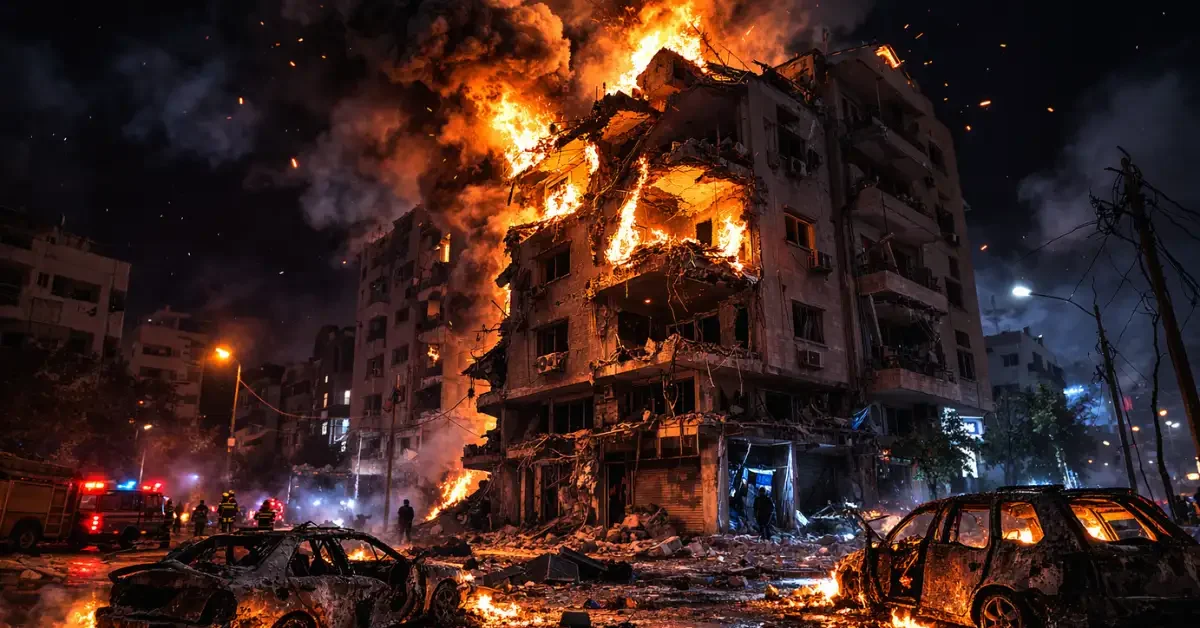
The bombings left a trail of heavy destruction in the densely populated suburbs. Witnesses observed the upper floors of buildings in Dahieh engulfed in flames, while charred remnants of destroyed vehicles scattered across the streets. Following the operations, the Israeli military claimed its strikes successfully killed several high-ranking Hezbollah officials.
The aerial assault extended beyond the capital, hitting Hezbollah positions throughout the Bekaa Valley and southern Lebanon. In southern regions, residents reported hearing warplanes followed by heavy bomb detonations. The airstrikes caused substantial damage, including the collapse of several buildings in villages near Tyre. Witnesses also reported seeing ongoing rocket fire directed from southern Lebanon toward Israel, indicating a sustained response from Hezbollah.
Mass Displacement and Civilian Evacuations
The sudden and severe escalation triggered immediate panic among the civilian population in Lebanon. As the bombings commenced in the early hours of Monday, residents of Beirut’s southern suburbs and southern Lebanon quickly attempted to flee the targeted zones. The mass exodus created significant traffic congestion starting as early as 2:40 a.m., with desperate civilians evacuating both on foot and in vehicles.
Lebanon’s state-run National News Agency confirmed reports of major displacement as families rushed to escape the areas where Hezbollah traditionally holds sway. In conjunction with the military operations, Israel issued formal evacuation orders directing local civilians to leave 50 villages spread across southern Lebanon and the Bekaa Valley.
Conflict Expands Amid Broader U.S.-Israel War on Iran
The outbreak of violence between Israel and Hezbollah represents a severe widening of the Middle Eastern conflict. Clashes in Lebanon coincided with new Israeli airstrikes targeting Tehran. Hezbollah, a key regional ally for Tehran, had largely refrained from direct attacks on Israel since a prolonged conflict weakened the group prior to the 2024 ceasefire.
As the military campaign expands to include Hezbollah militants in Lebanon, the broader offensive against Iranian targets shows no signs of concluding. U.S. President Donald Trump has publicly signaled that the coordinated U.S.-Israeli military assault on Iran and its allied proxy networks could continue for several weeks.
