

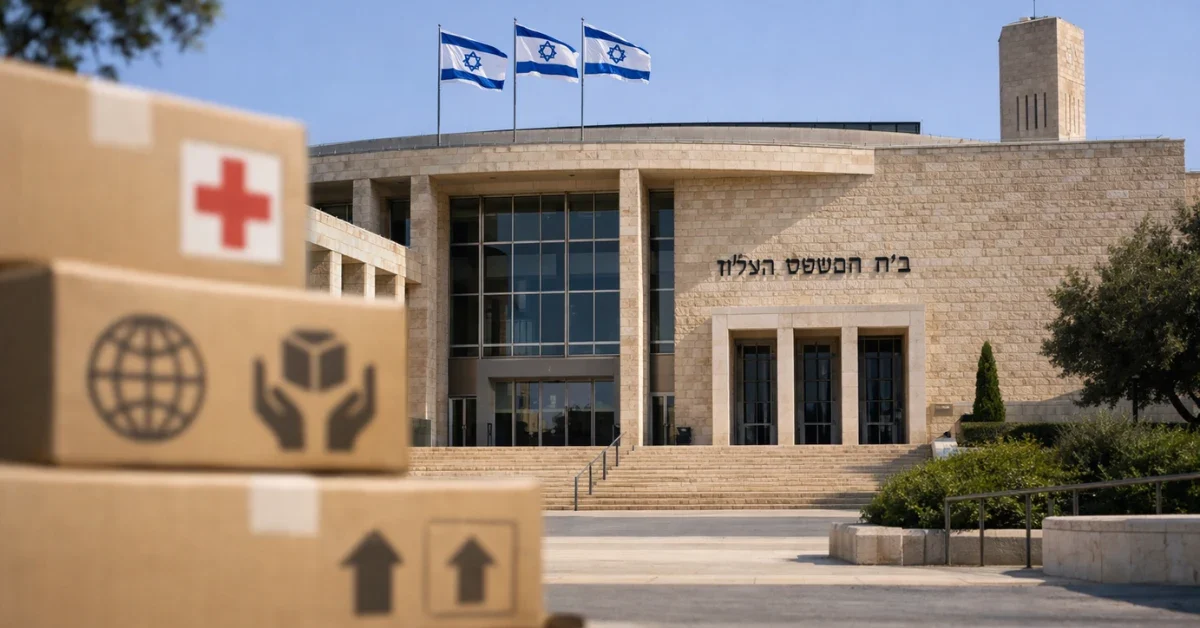
Israel’s highest court has temporarily suspended a government directive that would have stopped 37 international humanitarian organizations from operating in the Gaza Strip and the West Bank. The recent ruling on the Gaza aid groups ban arrives just days before a March 1 deadline.
The temporary injunction effectively freezes the government’s decision while the court reviews a petition filed by 17 non-governmental organizations and the Association of International Development Agencies (AIDA). The legal challenge surrounding the Gaza aid groups ban highlights an ongoing dispute over new Israeli regulations requiring humanitarian workers to disclose personal details.
The Dispute Over Humanitarian Worker Regulations
The Israeli government issued an order in December giving 37 foreign organizations a 60-day window to comply with new operational rules or face a complete halt to their work. The regulations mandate that aid groups register the names and contact information of their Palestinian employees, along with comprehensive details regarding their funding and daily operations.
According to Israeli officials, these measures are necessary to prevent humanitarian aid from being diverted to Palestinian armed factions and to ensure militant groups do not infiltrate aid networks.
The military body overseeing civilian affairs in Gaza, COGAT, stated that the organizations facing revoked licenses contribute less than one percent of the total assistance entering the territory. COGAT also noted that more than 20 other humanitarian organizations have agreed to comply with the new rules and will continue their operations.
Aid Organizations Warn of Consequences
The petitioning organizations, which include prominent groups like Doctors Without Borders (MSF), Oxfam, and the Norwegian Refugee Council, strongly oppose the requirements. The aid groups argue that forcing them to share staff information creates a severe safety risk, pointing out that hundreds of humanitarian workers have already been killed or injured during the ongoing war. Furthermore, humanitarian agencies dispute the Israeli government’s claims that substantial amounts of assistance have been diverted to armed groups.
The organizations maintain that the new regulations are arbitrary, invasive, and a violation of international privacy laws. Their legal petition argues that Israel, acting as an occupying power, has a legal obligation to ensure food and medicine reach the civilian population. The petition also contends that the Israeli government lacks the legal authority to shut down organizations operating in areas nominally controlled by the Palestinian Authority.
Reactions to the Supreme Court Injunction
The Israeli Supreme Court stated that its interim order was issued “without taking any position” on the final outcome of the case. No timeline has been established for a permanent ruling.
Legal representatives for the aid organizations stated that the temporary suspension provides essential “breathing room” for Palestinians living in Gaza and the West Bank.
Athena Rayburn, the executive director of AIDA—an umbrella organization representing over 100 groups in the Palestinian territories—welcomed the pause but remained cautious. Rayburn described the injunction as a step in the right direction but noted there is still a long way to go to deliver life-saving assistance.
She added that the organizations are waiting to see how the state interprets the injunction and whether it will genuinely increase their operational capacity, noting that the conditions inside Gaza remain “catastrophic.” Israeli government spokespeople did not immediately respond to requests for comment.
A Fragile Ceasefire and Continued Violence
The court’s decision coincides with ongoing violence threatening a U.S.-brokered ceasefire implemented in October. The two-year conflict, triggered by the Hamas attack on Israel on October 7, 2023, has left much of the Gaza Strip in ruins. Currently, most of Gaza’s two million Palestinian residents rely entirely on international assistance.
The October truce agreement stipulates that Hamas must disarm and transfer governing power to a committee of Palestinian administrators. It also requires Israeli forces to withdraw from the territory as international forces are deployed. However, there is no established timeline for implementing these conditions, and the Hamas-run police force continues to operate in roughly half of the territory it controls.
Recent Israeli airstrikes have repeatedly disrupted this fragile truce. Overnight strikes killed at least five Palestinians, four of whom were members of the Hamas-run police force. According to Dr. Ahmed al-Farra at Nasser Hospital, three individuals were killed in a strike on a police checkpoint in southern Gaza near Khan Yunis, while another strike in western Khan Yunis killed one person. A separate strike on a checkpoint in the Bureij refugee camp resulted in another death, according to the Hamas-run Interior Ministry.
The Israeli military stated it also killed several militants in Rafah, framing the strikes as a direct response to a ceasefire violation.
Diplomatic Shifts in the West Bank
In a separate development in the occupied West Bank, the United States Embassy began offering consular services in an Israeli settlement for the first time on Friday. Services were provided to citizens in Efrat, a settlement home to approximately 4,000 American citizens.
This move reflects a continuation of policy shifts initiated under President Trump’s administration, which has shown greater support for Israeli settlements than previous U.S. leaders. Most of the international community considers these settlements illegal and views them as a significant barrier to peace.
Israel captured the West Bank, east Jerusalem, and Gaza during the 1967 Mideast war. Today, more than 500,000 Israelis live in West Bank settlements alongside roughly three million Palestinians who live under military rule. The Palestinian Authority holds limited autonomy in certain population centers.
Efrat Mayor Dovi Sheffler welcomed the diplomatic presence, stating the U.S. recognizes Efrat as part of Israel and the settlement is “going to be forever here.” Previously, the U.S. Embassy only provided these consular services in Palestinian cities such as Ramallah.
