

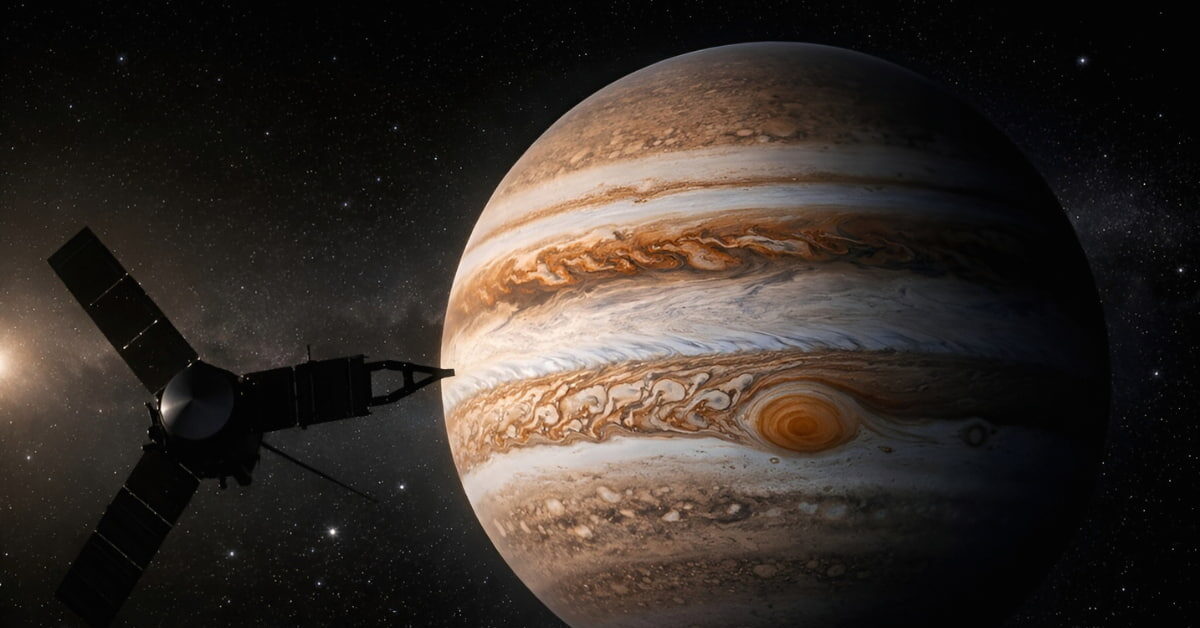
Textbooks may soon need a revision after new data from NASA’s Juno mission revealed that Jupiter is slightly smaller and flatter than scientists have believed for decades. Using advanced measurements from the spacecraft, researchers have determined that the solar system’s largest planet is not quite as massive or spherical as earlier estimates suggested.
The findings, published in Nature Astronomy, show that Jupiter is approximately 5 miles (8 kilometers) narrower at the equator and about 15 miles (24 kilometers) flatter at the poles than previously thought. While these differences might seem negligible for a planet of Jupiter’s immense scale, they represent a significant leap in precision for planetary science.
Redefining the Gas Giant
For nearly 50 years, our understanding of Jupiter’s dimensions relied on data from the Voyager and Pioneer missions. Those probes provided the best available measurements at the time, but they could not account for the complexities of the planet’s deep atmosphere and powerful winds.
The Juno spacecraft, which has been orbiting the gas giant since 2016, used a technique called radio occultation to capture a sharper picture. During 13 separate flybys, Juno transmitted radio signals back to Earth as it slipped behind Jupiter. As these signals passed through the planet’s dense atmosphere, they slowed and bent, allowing scientists to map the atmosphere’s temperature and pressure with unprecedented accuracy.
By combining this radio data with information about Jupiter’s high-speed winds, the research team produced the most precise measurements of the planet to date. The data revealed that the gas giant’s “1-bar” pressure level—the standard boundary used to define its surface—is deeper than earlier models assumed.
“The size of Jupiter hasn’t changed, of course, but the way we measure it has,” said Yohai Kaspi, a study co-author and planetary scientist at the Weizmann Institute of Science in Israel. “Textbooks will need to be updated.”
Implications for Planetary Science
The revised dimensions solve a long-standing puzzle for astronomers. Previous models of Jupiter’s interior struggled to reconcile gravity data with atmospheric measurements gathered by the Galileo probe in the 1990s. The new, slightly smaller shape resolves this tension, providing a consistent model that fits both datasets.
“These few kilometers matter,” explained Eli Galanti, a co-author and expert on gas giants at the Weizmann Institute. “Shifting the radius by just a little lets our models of Jupiter’s interior fit both the gravity data and atmospheric measurements much better.”
The adjusted size suggests that Jupiter’s interior may be cooler and contain a more metal-rich outer layer than previously hypothesized. These insights are crucial not only for understanding our own solar system but also for studying gas giants orbiting other stars.
A Squashed Shape
The new data also confirms that Jupiter is significantly “squashed,” or oblate. The planet spins incredibly fast, completing a full rotation in less than 10 hours. This rapid spin causes the middle to bulge outward, making the equator about 7% wider than the distance from pole to pole.
While this flattening was already known, the Juno measurements indicate the effect is more pronounced than earlier calculations showed. Understanding this shape helps scientists better grasp how mass is distributed inside the planet and how its massive gravity field functions.
“Jupiter was probably the first planet to form in our solar system,” Kaspi noted. “Examining its internal processes brings us closer to understanding how the solar system and planets like ours came into existence.”
