

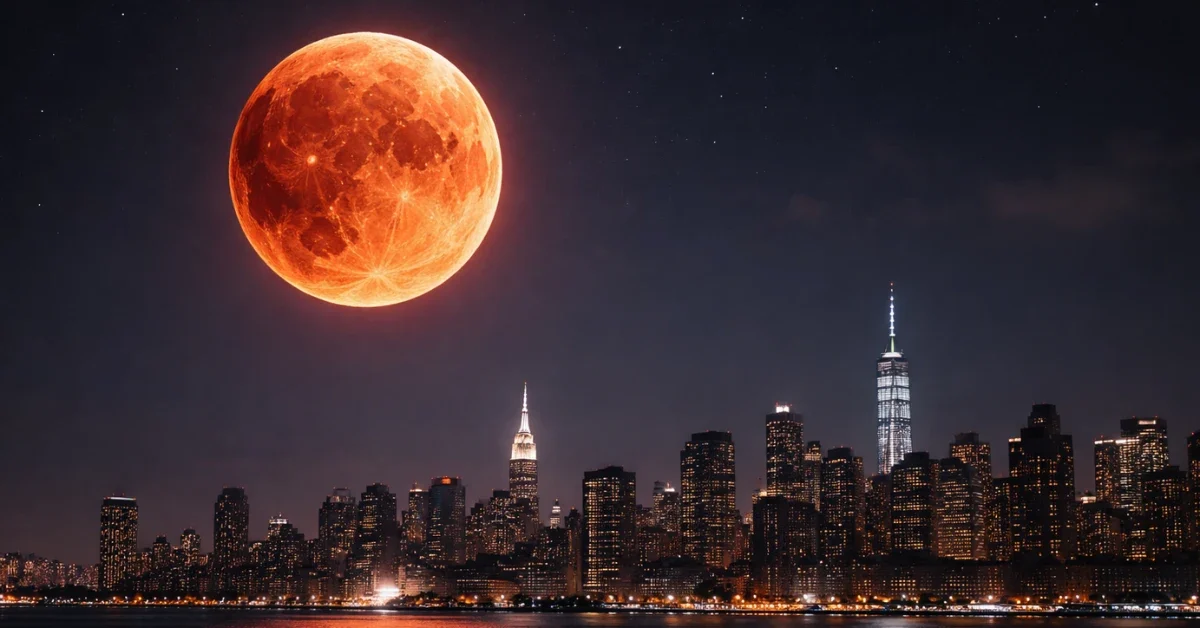
Millions of astronomy enthusiasts across the globe experienced a spectacular celestial display during the March 2026 total lunar eclipse. As the Earth’s shadow completely covered the full Worm Moon, the lunar surface transitioned into a brilliant copper-red sphere, treating observers to a striking blood moon.
As the first and only total lunar eclipse of 2026, the March 2-3 event offered skywatchers their final opportunity to see a blood moon until the next scheduled occurrence spans late 2028 into early 2029. Favorable weather in prime viewing locations allowed for spectacular sights, while online livestreams brought the event to those in obscured regions.
Global Visibility and Prime Viewing Locations
The March 2026 total lunar eclipse was highly visible across western North America, eastern Asia, eastern Australia, New Zealand, and the Pacific region. According to Star Walk and IBTimes, observers in cities like Los Angeles, Sydney, and Auckland enjoyed uninterrupted views of the entire sequence from start to finish. In these areas, the moon was positioned high enough in the sky to clearly display its deep red transformation.
Conversely, regions such as Europe, Africa, and most of the Middle East missed the celestial show entirely, as the moon remained below the horizon during all key phases. In eastern North America and western South America, viewers caught the eclipsed moon sitting very low on the horizon right around dawn or moonset.
Conflicting Timings and Visibility in India
While the eclipse was a celebrated global phenomenon, media reports presented conflicting information regarding the exact timing of the event, particularly for audiences in India. According to IBTimes, Star Walk, and Outlook Traveller, the totality phase—when the moon turns fully red—occurred between 11:04 UTC and 12:03 UTC. This translates to 4:34 PM and 5:33 PM Indian Standard Time (IST). However, Sunday Guardian Live reported a completely different timeline, stating that totality took place earlier, from 3:34 AM to 4:32 AM IST.
A similar disagreement appeared regarding local moonrise times. Outlook Traveller reported that moonrise in major cities like Delhi and Mumbai would occur between 6:20 PM and 6:40 PM, while Sunday Guardian Live placed Delhi’s moonrise much earlier, at approximately 5:45 AM. Despite these conflicting reports, the sources agree that central and western India largely missed the peak totality phase due to the moon being below the horizon, whereas northeastern states and the Andaman and Nicobar Islands had a much better vantage point.
The Science Behind the Red Hue
The entire lunar event spanned over five hours, moving through penumbral and partial phases before reaching totality. During a total lunar eclipse, the Earth passes directly between the sun and the moon, cutting off direct sunlight. However, the moon does not go completely dark. Instead, it turns a vibrant red due to a process involving the Earth’s atmosphere.
The atmosphere scatters shorter blue light wavelengths away while bending longer red wavelengths toward the lunar surface. This refraction process is akin to the visual effect of a sunset or sunrise, ultimately projecting a copper or brick-red glow onto the moon. The astronomical event also coincided with the traditional Worm Moon, a seasonal name for the March full moon that marks the approaching spring and thawing soil in the Northern Hemisphere.
Cultural Ties and Safe Viewing Practices
The eclipse held deep cultural significance in various regions. In East Asian traditions, the astronomical event coincided with the final full moon of the Lunar New Year celebrations during the Lantern Festival. In Indian tradition, the lunar eclipse is known as Chandra Grahan and is historically tied to Puranic mythology involving the shadow planets Rahu and Ketu. While traditional beliefs often suggest dietary or outdoor restrictions during a Chandra Grahan, Sunday Guardian Live noted that pregnant women and the general public do not need to follow these precautions from a scientific standpoint.
Watching the eclipse required no specialized equipment. Unlike solar eclipses, a blood moon is completely safe to view with the naked eye. Many observers used binoculars, telescopes, and tripod-mounted cameras with long exposures to capture the subtle color variations across the lunar surface.
Livestreams and Digital Broadcasts
For those trapped under cloudy skies or located in regions where the eclipse was not visible, digital platforms provided extensive access. Millions of people tuned into online streams from organizations like Timeanddate.com, the Virtual Telescope Project, and the Griffith Observatory in Los Angeles. These broadcasts featured high-resolution footage, expert commentary, and collaborative visual feeds from telescopes stationed in Hawaii, California, and Australia, ensuring the astronomical event was truly a global experience.
