

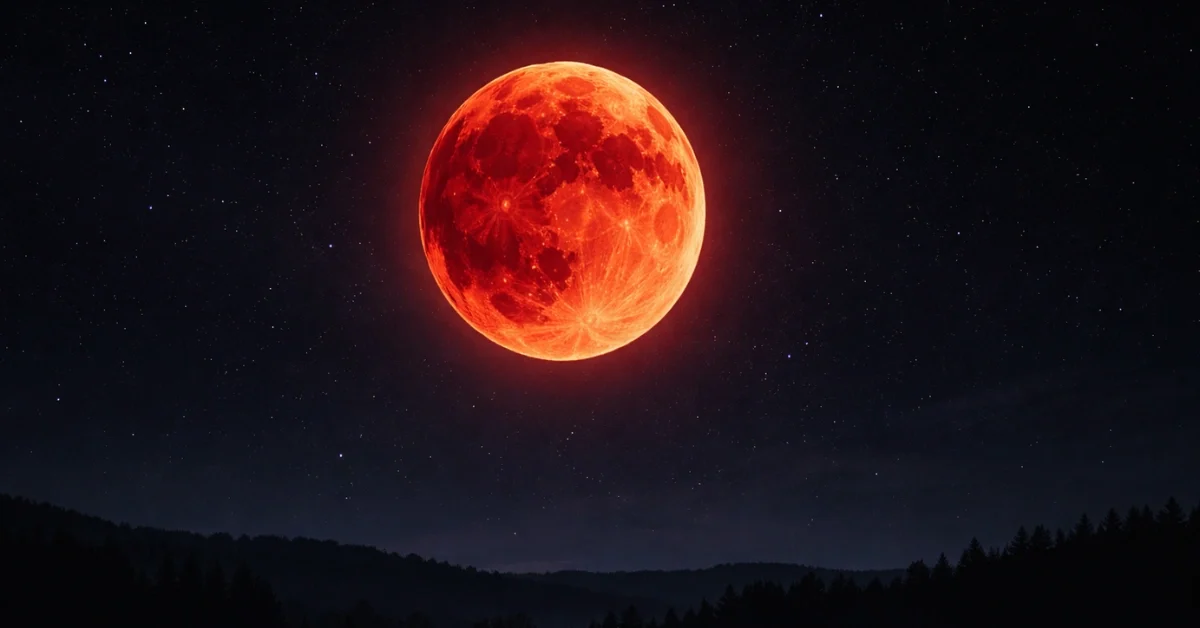
Skywatchers across the globe are preparing for the March 2026 total lunar eclipse, a stunning celestial event that will bathe the moon in a deep reddish-orange hue. On Tuesday, March 3, the Earth will align perfectly between the sun and the moon, casting its shadow directly across the lunar surface. This phenomenon, widely known as a blood moon, will be visible to varying degrees across the Americas, Asia, Australia, and the Pacific Islands.
This event holds special significance because it marks the final chapter in a series of three consecutive total lunar eclipses. According to NASA experts, the previous eclipses in this sequence occurred in March and September of 2025. Once this upcoming March spectacle concludes, observers globally will have to wait until December 31, 2028, to witness another total lunar eclipse.
The Science Behind the Blood Moon
A total lunar eclipse happens during a cosmic alignment known as syzygy, where the Earth sits exactly at the center of the sun and the moon. As the moon moves into the umbra—the darkest part of Earth’s shadow—it loses its typical bright white glow. Instead of going completely dark, the moon turns a vibrant crimson. This color shift happens because sunlight filters through the edges of Earth’s atmosphere, projecting the warm, reddish colors of global sunrises and sunsets onto the lunar surface.
This specific eclipse coincides with March’s full worm moon. While the moon officially reaches its fullest phase early in the morning, it will appear full to the naked eye throughout the following day. As the bright moonlight dims during the height of the eclipse, stargazers will also have an easier time spotting constellations, along with the planets Jupiter and Mars shining clearly in the western sky.
North American Timings and Global View
Visibility for the eclipse depends heavily on geographic location and local weather conditions. In North America, the event will unfold in the early morning hours before dawn. The initial penumbral phase, where the moon enters the Earth’s faint outer shadow, begins at 3:44 a.m. Eastern Time. The partial eclipse follows at 4:50 a.m. ET, leading up to the main visual event.
The totality phase, when the moon is fully engulfed in deep red, will last for exactly 58 minutes. It begins at 6:04 a.m. ET, though scientific sources disagree slightly on the exact minute of the peak and conclusion. According to CNN, the eclipse reaches its climax at 6:34 a.m. ET and totality ends at 7:03 a.m. ET. However, Time and Date calculations place the maximum eclipse at 6:33 a.m. ET, with totality wrapping up at 7:02 a.m. ET. The entire event, concluding with the final penumbral phases, officially finishes at 9:23 a.m. ET.
While North America, Central America, eastern Asia, and Australia enjoy prime viewing, other regions will miss out. The eclipse will not be visible at all from Europe or Africa. In South America, observers will only catch a partial eclipse near moonset, with totality strictly limited to the far western edges of the continent.
Chandra Grahan Viewing in India
In India, the lunar eclipse, locally referred to as a Chandra Grahan, will play out much differently. Because the total eclipse occurs globally during the daytime for India, the moon will rise while the eclipse is already in progress. Consequently, Indian skywatchers will only be able to see the final partial and penumbral phases of the event during the late afternoon and early evening.
According to the India Meteorological Department, the eclipse technically begins at 3:20 p.m. Indian Standard Time, with the total phase spanning from 4:34 p.m. to 5:33 p.m. IST. The moon will rise in cities like Delhi, Mumbai, Bengaluru, and Chennai just in time for residents to catch the tail end of the spectacle between 6:20 p.m. and 6:40 p.m. IST.
There is a minor disagreement among sources regarding the exact end time in India. While the India Meteorological Department reports the eclipse ending at 6:48 p.m. IST, other news and astrology outlets calculate the conclusion at 6:47 p.m. IST. The total duration of the event stands at roughly three hours and 27 minutes. Furthermore, adhering to traditional scriptures, the Sutak period—a window of time holding ritual importance—will commence exactly nine hours prior to the eclipse at 6:20 a.m. IST.
Whether viewed from the early morning chill of North America or the evening twilight of India, this blood moon promises a memorable celestial show for those under clear skies.
