

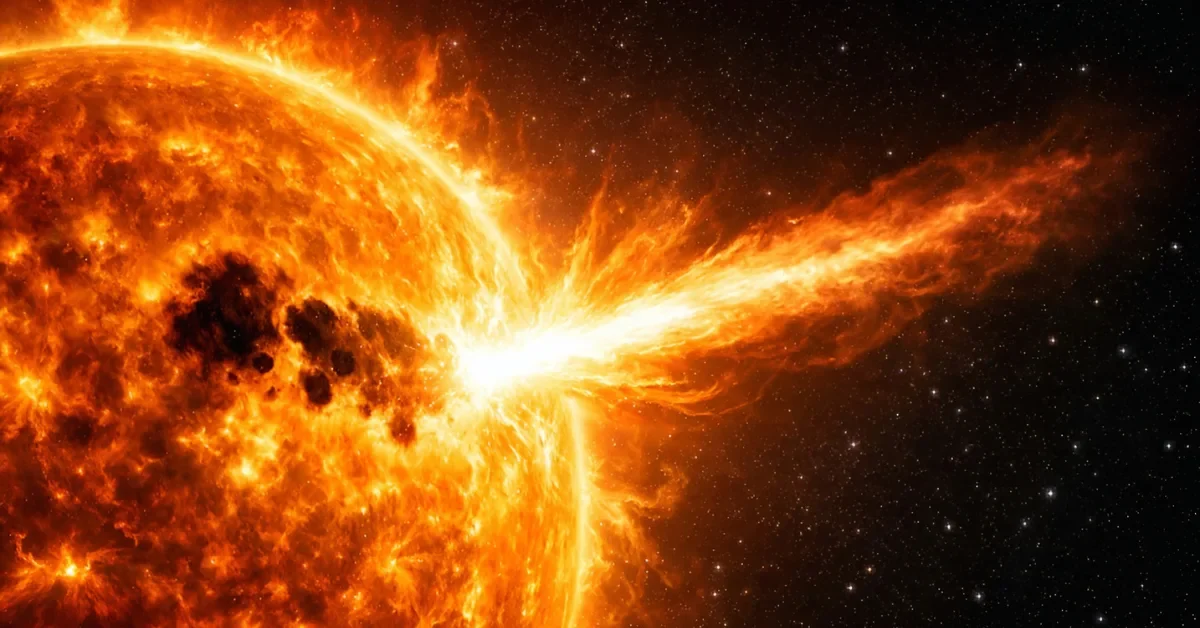
A massive X8.1 solar flare has erupted from the sun, marking one of the most significant solar events in recent years. The powerful explosion occurred on Sunday evening and was triggered by a highly active area on the sun’s surface known as sunspot region 4366. This event is the strongest flare recorded since October 2024 and has already caused immediate impacts on Earth’s radio frequencies.
The eruption peaked at 6:57 p.m. EST on Sunday, releasing a burst of energy that space weather forecasters classified as an X8.1 flare. X-class flares are the strongest category of solar flares, and this specific event surpassed the peak activity of 2025, which saw an X5.1 eruption in November. The sheer intensity of this week’s blast places it among the most notable solar outbursts of the current solar cycle.
Following the flare, space weather experts are tracking a coronal mass ejection (CME) that was launched into space. While the bulk of this plasma cloud is expected to miss Earth, forecasts indicate that a glancing blow could impact our planet’s magnetic field later this week. This interaction has the potential to trigger geomagnetic storms and visible auroras.
A “Monster” Sunspot Unleashes a Barrage of Flares
The source of this intense solar activity is sunspot region 4366, described by observers as a “monster” sunspot due to its rapid growth and instability. In just a few days, this dark region on the sun expanded to roughly half the size of the famous sunspot responsible for the 1859 Carrington Event. Its magnetic field became highly unstable, turning the region into what observers have called a solar flare factory.
Within a single 24-hour period between Sunday and Monday, region 4366 launched a relentless barrage of more than 20 solar flares. According to NASA data, this flurry of activity included at least 23 M-class flares and four separate X-class flares. The X8.1 eruption was the most powerful of this sequence, but the sheer volume of explosions highlights just how volatile this sunspot has become.
The flare immediately impacted Earth by triggering partial radio blackouts across the South Pacific. These blackouts are a common consequence of intense bursts of X-ray and ultraviolet radiation reaching our atmosphere. However, the physical blast of particles—the coronal mass ejection—travels much slower than the light from the flare and takes days to cross the distance between the sun and Earth.
Geomagnetic Storm and Aurora Forecast
As the coronal mass ejection travels through space, forecasters from the National Oceanic and Atmospheric Administration’s Space Weather Prediction Center (SWPC) have updated their predictions for Earth’s space weather. Current models suggest that the majority of the solar material will pass to the north and east of Earth. However, the cloud is expansive enough that its edge is likely to clip the planet.
This “glancing blow” is forecast to arrive on Thursday, February 5. The SWPC has issued an alert for a G1 (Minor) geomagnetic storm beginning on that day. While a G1 storm is the lowest level on the geomagnetic storm scale, it can still produce noticeable effects. The primary outcome for skywatchers is the potential for vibrant northern lights, or auroras, which may be visible at lower latitudes than usual.
The arrival of the CME on February 5 coincides with ongoing instability in region 4366. The sunspot remains facing Earth and shows no signs of weakening, continuing to produce both M-class and X-class flares into the start of the week. Forecasters warn that more activity is possible as long as this volatile region remains directed toward our planet.
Solar Cycle 25 Continues to Intensify
This week’s explosive events are part of the broader pattern of Solar Cycle 25, which NASA confirmed is currently in its maximum phase. Solar maximum is the period in the sun’s 11-year cycle when its magnetic poles flip and sunspot activity peaks. During this time, the frequency and intensity of solar flares and CMEs increase significantly.
The current solar maximum has been well underway since 2024, and experts predict that violent space weather will remain high through 2026. The activity from sunspot region 4366 is consistent with these predictions. For context, the X8.1 flare is the most significant since the sun launched an X9.0 outburst in October 2024. The persistence of high-level activity suggests that the sun is far from quieting down.
While the G1 storm forecast for Thursday is minor compared to the extreme storms seen in May 2024, the heightened state of the sun means that space weather conditions can change rapidly. Intense radiation storms from these events can disrupt GPS signals, damage satellites, and cause radio blackouts, making the monitoring of regions like 4366 critical for modern technology.
