

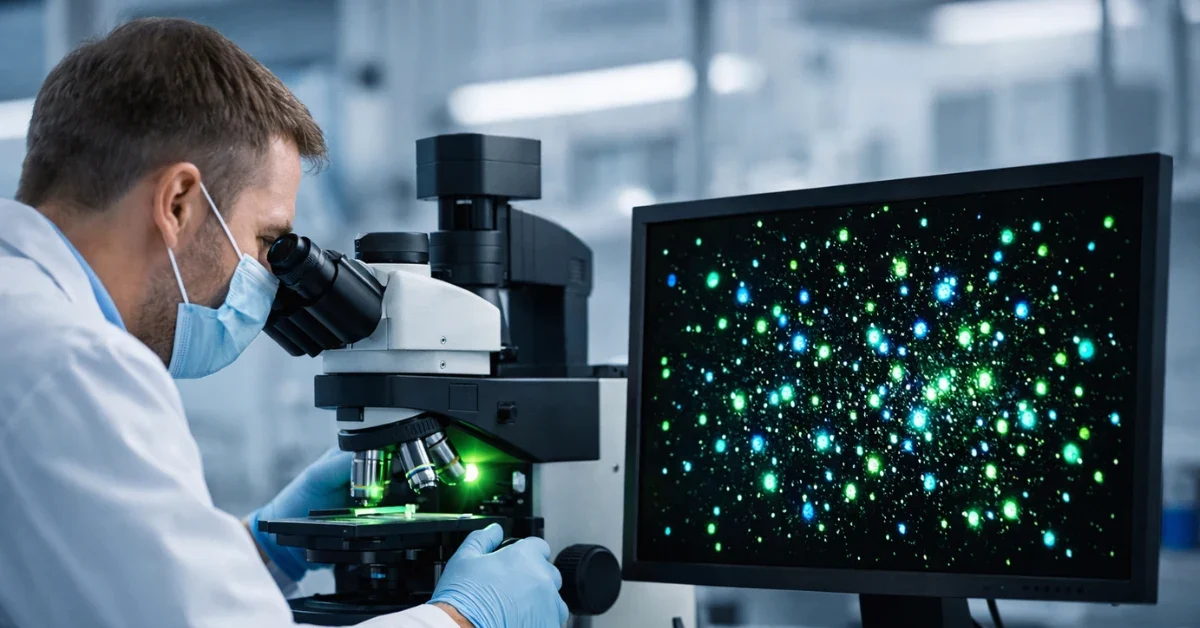
Scientists have outlined a new way to make microplastics and nanoplastics “glow,” aiming to help researchers track these tiny plastic particles in real time as they move through living organisms. The approach is designed to reveal what the particles do after they enter the body—something researchers say remains difficult to observe with today’s tools.
Microplastics and nanoplastics have been reported across the planet, including deep ocean waters, agricultural soils, and inside the human body. The study, published in the journal New Contaminants, focuses on dynamic tracking—following particles over time rather than measuring them at a single moment.
Why scientists want real-time tracking
Researchers say a major challenge in microplastics research is that many established detection methods provide only “a snapshot in time,” limiting what scientists can learn about how particles travel, build up, chemically change, or break down in living systems. Corresponding author Wenhong Fan said current approaches can quantify particles in a tissue but cannot directly show their movement and transformation inside an organism.
This matters because plastic production is described as exceeding 460 million tons per year globally, with millions of tons of microscopic plastic particles entering the environment annually. The ScienceDaily and EurekAlert summaries also report that microplastics and nanoplastics have been detected in animals and in human tissues, including samples of blood, liver, and brain.
What limits today’s detection methods
The researchers describe common analytical tools—such as infrared spectroscopy and mass spectrometry—as methods that typically require destructive sampling of tissue. Because samples must be processed in ways that prevent repeat measurements on the same living system, scientists cannot easily watch particle behavior unfold over time.
Fluorescence imaging is presented as a promising alternative, but the study notes drawbacks with some existing labeling approaches. These include issues like fading signals, dye leakage, and reduced brightness in complex biological environments (also described as fluorescence quenching).
The “make microplastics glow” strategy
To address those problems, the team proposes what it calls a “fluorescent monomer controlled synthesis strategy,” which builds fluorescence into the plastic itself instead of coating particles with a dye. In the descriptions provided by ScienceDaily and EurekAlert, this is done by incorporating light-emitting components directly into the polymer structure.
A key part of the approach is the use of “aggregation induced emission” materials, which are described as emitting stronger light when clustered together. The study summary says this design is intended to improve signal stability during imaging and reduce the loss of brightness that can happen in biological settings.
The researchers also say the method allows fine control over features such as brightness, the color (or emission wavelength) of light, and particle size and shape. Because the fluorescent components are reported to be distributed throughout each particle, both intact plastics and smaller fragments created during degradation could remain visible—potentially allowing tracking across a particle’s “life cycle.”
What the study does—and doesn’t—claim yet
The strategy is described as still undergoing experimental testing or validation, even as it draws on established principles from polymer chemistry and biocompatible fluorescence imaging. The researchers say a tool like this could help scientists study how microplastics interact with cells, tissues, and organs.
ScienceDaily’s summary also notes that laboratory experiments have suggested links between exposure and effects such as inflammation, organ damage, and developmental problems, while emphasizing that big knowledge gaps remain about what happens once particles enter living systems. In that context, Fan said that “clarifying the transport and transformation processes” of microplastics inside organisms is important for assessing ecological and health risks, and that dynamic tracking could help move beyond exposure measurements toward understanding toxicity mechanisms.
The ScienceDaily health page, which listed the microplastics headline among its top stories, reflects the broader attention the topic is getting as researchers try to understand what these particles do inside the body. Separately, a consumer-focused write-up also describes microplastics as particles smaller than five millimeters and notes they can enter the body through routes such as ingestion and inhalation, underscoring why tracking movement and accumulation in tissues has become a growing area of interest.
