

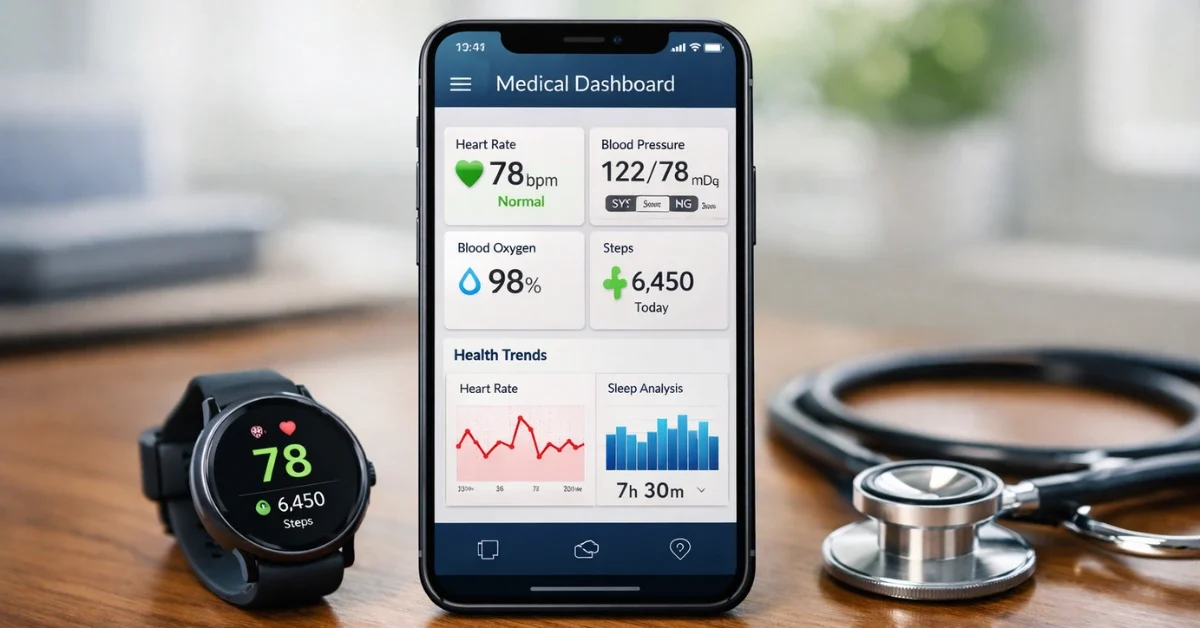
Microsoft has officially introduced Microsoft Copilot Health, a dedicated artificial intelligence chatbot designed to help consumers manage personal health information and understand complex medical data. Launching initially through a waitlist for U.S. adults, the new AI assistant allows users to securely consolidate medical records, health histories, and wearable device data into a single interface.
By analyzing these datasets, Microsoft Copilot Health provides contextual insights, explains laboratory results, and helps patients prepare for medical appointments. The tool represents Microsoft’s latest move in a rapidly growing race among major technology companies to provide consumer-facing health AI products.
Unifying Personal Health Data and Wearables
The new health assistant operates as a separate tab within the broader Copilot interface. Users can manually upload information or connect directly to external healthcare networks. Through an integration with HealthEx, a cloud platform that aggregates medical data, the chatbot accesses records from over 50,000 U.S. hospitals and healthcare providers. This includes visit summaries, medication lists, and test results.
Additionally, Microsoft Copilot Health integrates laboratory results from Function Health Inc. and pulls biometric data from more than 50 wearable devices, including the Apple Watch, Oura ring, and Fitbit. By syncing data like heart rate, skin temperature, and sleep patterns, the AI can highlight connections between various health indicators.
Beyond interpreting lab results, the chatbot functions as a healthcare search engine. In the U.S., it connects to real-time provider directories, enabling users to find physicians based on specialty, location, language, and insurance.
The Big Tech Race for Medical AI
Microsoft’s launch follows a wave of similar health-focused AI assistants. In January 2026, OpenAI released ChatGPT Health, which similarly isolates medical information and integrates clinical data. Amazon recently rolled out its own Health AI tool, offering features like prescription renewal, while Anthropic added personal health data integrations to its Claude AI model.
The demand for these tools is massive. Microsoft reports its consumer platforms currently handle more than 50 million health-related questions daily.
Speaking at the 2026 HIMSS conference in Las Vegas, Dr. Dominic King, vice president of health at Microsoft AI, outlined the company’s vision. “We firmly believe that we’re on the path to medical super intelligence,” King stated. “And by that we mean the ability to combine both the breadth of knowledge that a general physician or a GP or a family doctor has, and the deep expertise of a specialist.”
Consumer Health Trends and AI Usage
To develop the platform, Microsoft analyzed over 500,000 de-identified health conversations from January 2026. The findings revealed that health is the most discussed topic on mobile devices.
Approximately 40% of queries relate to specific symptoms, conditions, and treatments. Another 10.9% of users ask the AI to explain lab results, while nearly 9% seek lifestyle and fitness guidance. About 5.8% of queries involve navigating the healthcare system, such as understanding insurance benefits.
The analysis highlighted behavioral trends based on the time of day. Questions regarding emotional wellbeing and sudden symptoms spike at night, suggesting consumers turn to AI chatbots when clinics are closed. Furthermore, one in seven health conversations involves a user asking questions on behalf of someone else, such as a child or older adult.
Strict Privacy Controls and Clinical Safety
Given the sensitive nature of medical data, Microsoft implemented stringent security measures. Information in Microsoft Copilot Health is kept separate from general AI chat logs and is never used to train broader AI models.
The data is encrypted at rest and in transit. Users retain full control, with the ability to disconnect third-party integrations and delete their health history anytime.
Accuracy remains a primary concern for medical AI, as researchers note consumer health chatbots can sometimes make triage errors. To mitigate risks, Microsoft relies on information verified by an internal clinical team using National Academy of Medicine principles. The system was developed with guidance from an external panel of more than 230 physicians across 24 countries, featuring expert-written answer cards created with Harvard Health Publishing.
Microsoft also partnered with the National Health Council and AARP, which represents approximately 38 million older Americans.
While holding the ISO/IEC 42001 certification for AI management systems, Microsoft emphasizes the tool is not intended to diagnose diseases and should never substitute professional medical advice.
