

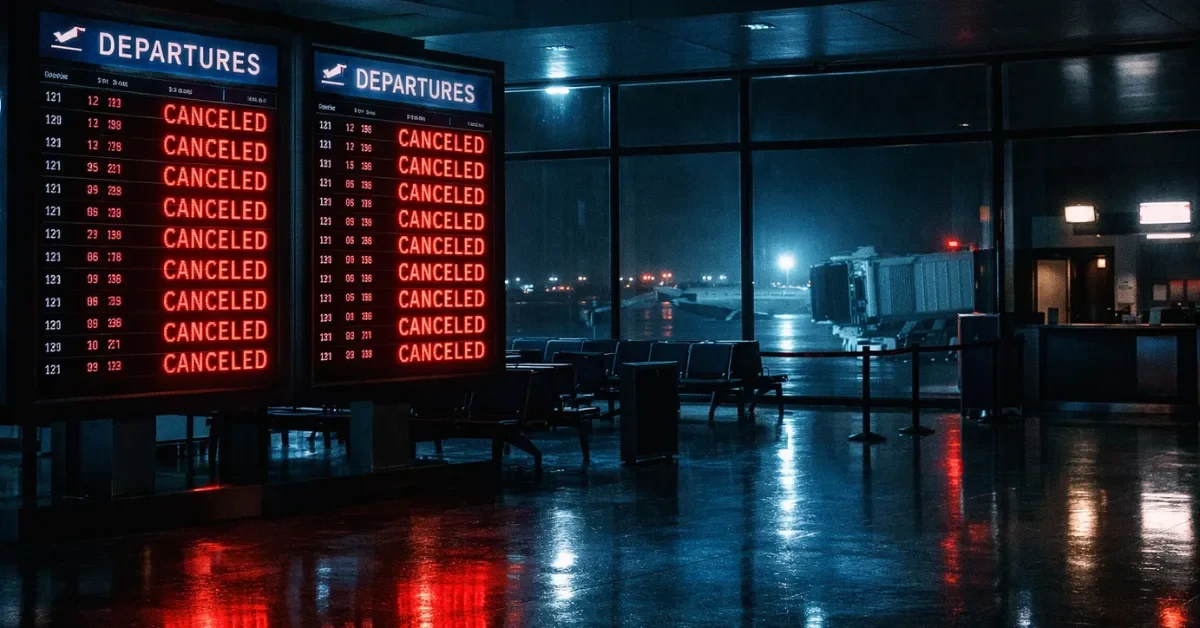
Massive travel disruptions are sweeping across the globe as escalating military conflicts between the United States, Israel, and Iran trigger extensive Middle East flight cancellations. Airlines have halted operations and rerouted schedules after U.S. and Israeli forces launched strikes against Iran on Saturday, February 28, 2026, prompting immediate retaliatory missile attacks from Tehran. The intense exchanges have forced widespread airspace closures and brought commercial aviation in the region to a virtual standstill.
Preliminary aviation data reveals that approximately 24 percent of all scheduled flights to the broader Middle East were canceled on the first day of the strikes. Israel experienced a nearly 40 percent drop in incoming flights, while countries like Qatar and Kuwait also faced substantial aviation impacts. As military actions persist into Sunday, March 1, the aviation shock continues to deepen, leaving hundreds of thousands of international travelers stranded or facing severe delays.
Dubai Airport Sustains Missile Damage
The conflict directly impacted critical aviation infrastructure when Iranian missiles and drones targeted the United Arab Emirates overnight. At Dubai International Airport, the world’s busiest hub for international travel, a concourse at Terminal 3 sustained minor damage. Dubai government authorities confirmed the incident, stating that emergency response teams were quickly deployed to manage the situation. Four airport workers were injured during the strike.
The retaliatory attacks on the UAE resulted in further casualties and property damage across the nation. In Abu Dhabi, falling debris and drone interceptions left one person dead and seven others injured. Meanwhile, intercepted drone fragments ignited a fire on the outer facade of Dubai’s iconic Burj Al Arab hotel, and another blaze broke out near a hotel situated on the Palm Jumeirah. While UAE air defenses successfully intercepted multiple incoming missiles, authorities urged residents to remain indoors as falling debris sparked localized panic.
Extensive Airspace Restrictions
Following the initial U.S. and Israeli operations, Iran fired retaliatory missiles toward several neighboring countries, specifically targeting nations that host American military bases. This barrage forced the UAE, Qatar, Bahrain, Kuwait, and Jordan to immediately shut down their airspace to all commercial traffic. Iraq, Syria, and Israel also implemented strict airspace closures, rendering vast stretches of critical east-west aviation corridors completely deserted.
With regional skies deemed unsafe, major global carriers reacted swiftly by suspending or severely curtailing services. Flight tracking services reported staggering cancellation numbers from Gulf-based airlines on Saturday alone. Emirates canceled 492 flights, Flydubai grounded 329, and Etihad Airways halted 212 operations.
International carriers, including Lufthansa, Air France, British Airways, and Turkish Airlines, paused routes to key regional destinations such as Tel Aviv, Dubai, Beirut, Amman, and Tehran. Many of these airlines have extended their flight pauses through early March as the security situation remains highly volatile.
Qatar Airways Halts Operations
The closure of Qatari airspace prompted immediate action from the nation’s flag carrier. Qatar Airways suspended all flight operations into Doha, actively working with government stakeholders and the Qatar Civil Aviation Authority to monitor the situation. The airline confirmed that flights would remain paused until authorities officially declare the airspace safe for commercial travel.
To manage the sudden influx of stranded passengers at Hamad International Airport, Qatar Airways deployed additional ground staff. The airline is assisting affected travelers and has offered free ticket changes or full refunds for flights scheduled over the next seven days. Passengers have been advised to monitor the airline’s website and mobile app for real-time updates regarding the resumption of normal operations.
Ongoing Strikes Prolong Travel Chaos
The military confrontation shows no immediate signs of de-escalation. U.S. President Trump confirmed that the initial American and Israeli airstrikes successfully eliminated several senior Iranian officials, including Supreme Leader Ayatollah Ali Khamenei. In response to Iran’s subsequent missile barrage, Israel announced a fresh wave of strikes against Iranian targets on Sunday.
As these secondary operations unfolded, loud explosions were once again reported near Dubai, further complicating efforts to restore commercial aviation. With military engagements persisting for a second consecutive day, aviation experts anticipate prolonged disruptions to global travel schedules. Airlines continue to rely on alternative flight paths to navigate around the conflict zones, but the sheer volume of rerouted traffic and closed corridors ensures that travel chaos will persist as long as the regional airspace remains contested.
