

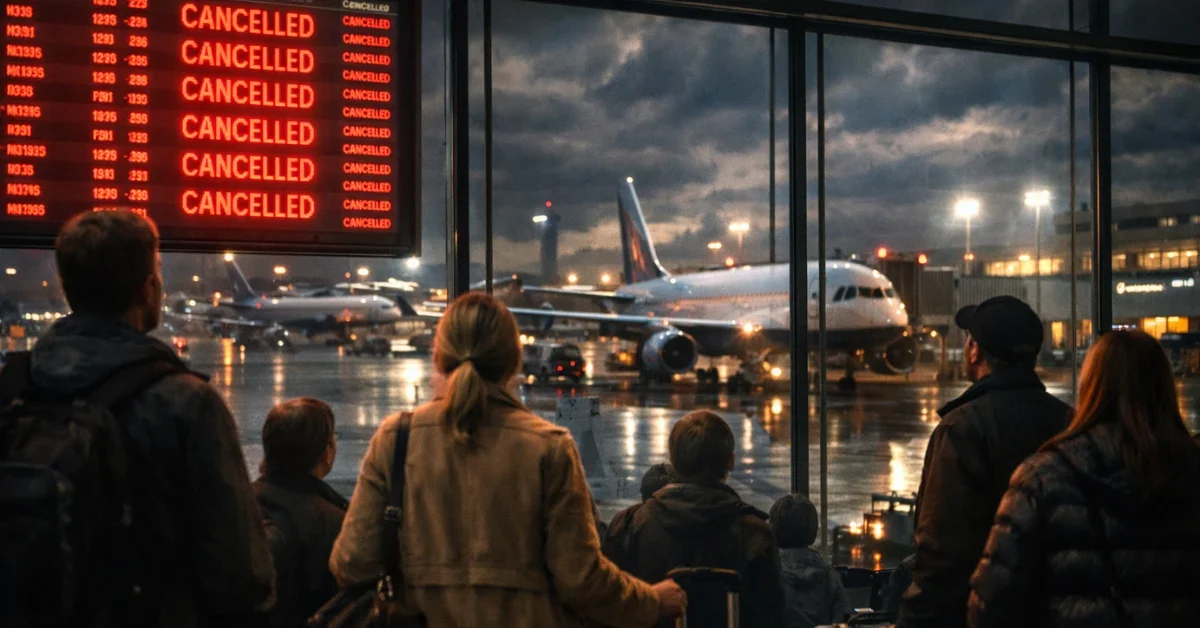
A massive wave of travel disruptions has engulfed the globe as an escalating military conflict leaves hundreds of thousands of foreign nationals stranded. Following widespread airspace closures, Middle East flights are facing severe delays and cancellations, prompting governments to launch emergency evacuation operations to bring their citizens home.
The current Middle East travel chaos began on February 28, when the United States and Israel launched airstrikes on Iran. According to the Iranian Health Ministry, those initial strikes killed Iranian Supreme Leader Ali Khamenei and 866 others, including more than 150 elementary school girls. Nearly 6,000 additional people were injured. Tehran retaliated by launching drones and missiles at US-affiliated locations across multiple Gulf nations, including Saudi Arabia, Qatar, Bahrain, Kuwait, Oman, and the United Arab Emirates. The retaliatory attacks killed six American service members and targeted major transit hubs, forcing a site evacuation at Dubai International Airport on Sunday.
Severe Aviation Disruptions
The expanding war has severely crippled Middle East flights. Aviation analytics firm Cirium reported that out of 36,000 scheduled flights traveling to or from the Middle East since the conflict began, more than 20,000 were canceled by Wednesday. Specifically, on Tuesday alone, nearly 1,900 out of over 5,450 regional flights were grounded.
FlightAware data indicated that global daily flight cancellations dropped slightly from roughly 3,150 on Monday to 2,018 by Wednesday afternoon. Despite this modest improvement, major airlines have struggled. Qatar Airways temporarily halted all operations due to Qatari airspace closures.
However, a cautious recovery is underway. UAE Minister of Economy and Tourism Abdulla Bin Touq Al Marri announced the establishment of safe air corridors capable of handling 48 flights per hour. He noted plans to eventually increase capacity to 80 flights per hour to accommodate 27,000 passengers using Gulf national carriers. Major hubs like Dubai International Airport—which processed over 95 million passengers last year—are slowly resuming activity. By Tuesday morning, several Emirates Airbus A380 jets departed Dubai for cities including London, Paris, and Jeddah, while flydubai operated limited services from two of its terminals. Etihad Airways advised travelers to avoid the Abu Dhabi airport unless they possessed confirmed ticket details.
Global Repatriation Efforts
With ticket prices skyrocketing—one Hong Kong expatriate in the UAE reported securing commercial tickets to Singapore for $2,200 per person after considering a $268,000 private jet—nations are organizing emergency extractions. Authorities are utilizing transit hubs in Oman, Egypt, Jordan, and Saudi Arabia to move vulnerable populations.
France successfully landed its first repatriation flight in Paris early Wednesday. The aircraft departed from Muscat and stopped in Cairo before arriving in France. French authorities are prioritizing the sick, the elderly, and families with children among the estimated 400,000 French residents and visitors in the region.
The United Kingdom is chartering planes from Oman for its citizens, having recorded over 130,000 British nationals registering their presence in the conflict zone. Similarly, Italy is organizing buses to move people out of the UAE and Oman, while Ireland is chartering flights to assist its roughly 23,000 citizens in the region. South Korea is evaluating military and chartered flights to rescue its citizens, including 186 seafarers currently stranded in the Hormuz Strait.
Asian nations are also heavily involved in extraction efforts. China successfully evacuated over 3,000 citizens from Iran prior to Monday, adding another 470 people by Wednesday. The Indian government launched a control room to protect its 10 million nationals living in Gulf states. Meanwhile, Indonesia plans to move citizens overland from Tehran to Baku before flying them to Jakarta.
Widespread Panic Among Travelers
For those caught in the crossfire, the experience has been terrifying. An Italian student returning to Milan after attending a United Nations program in Dubai described hearing military aircraft and seeing missiles pass by his window. A Chinese tourist trapped in Abu Dhabi reported receiving constant mobile missile alerts while worrying about her family’s safety and her mother’s medication supply.
The ongoing war has also claimed the lives of foreign workers. Five South Asian citizens—originating from India, Pakistan, Nepal, and Bangladesh—were killed in the recent violence, alongside a Chinese national who died in Tehran.
The fallout extends thousands of miles away. In Bali, roughly 6,000 tourists remain stranded after their long-haul connections through the Gulf were canceled. Indonesian authorities have responded by waiving overstay fines and issuing emergency permits.
While nations scramble to clear the massive passenger backlog—a process expected to take up to two weeks for routes to Australia—options remain incredibly limited in certain areas. The US government advised Americans to immediately leave more than a dozen countries, including Israel, Iran, Lebanon, and Syria. However, due to a lack of commercial flights, the US Ambassador to Israel suggested travelers consider taking shuttle buses to Egypt, noting the embassy cannot currently facilitate direct evacuations.
