

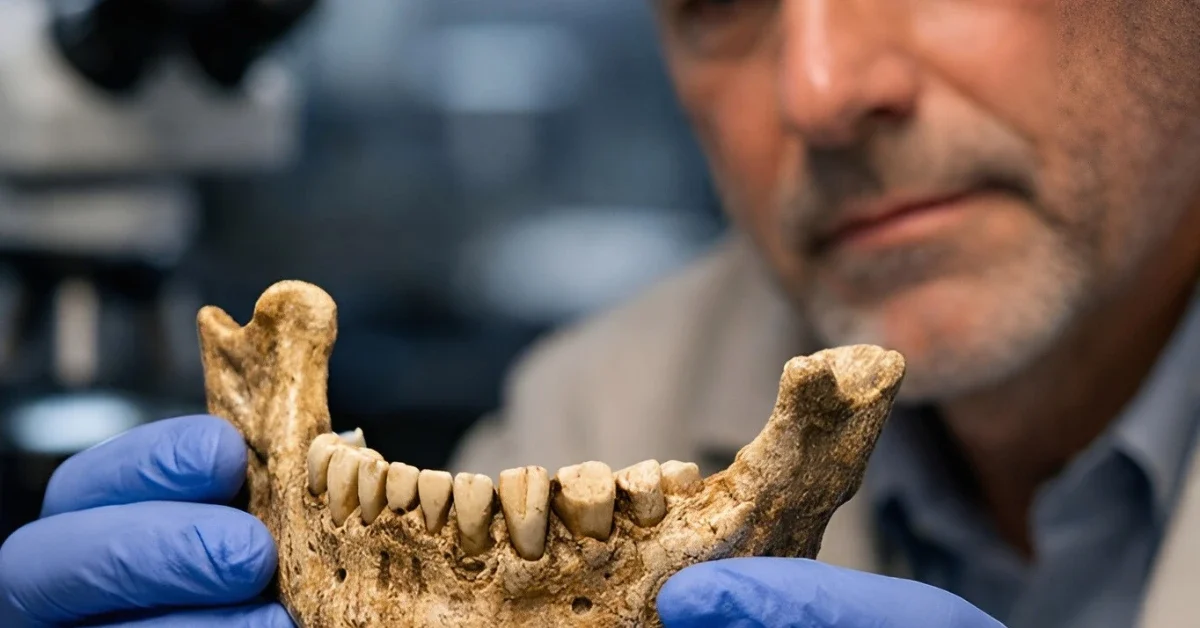
A groundbreaking discovery of ancient fossils in Morocco is rewriting the story of human origins. International researchers have identified 773,000-year-old remains that may belong to the last common ancestor of modern humans and Neanderthals. Found in a cave near Casablanca, these fossils offer one of the most precise glimpses ever obtained into a mysterious chapter of human evolution.
The discovery places North Africa at the center of the debate about where and when early human lineages diverged. The fossils, which include jawbones and teeth from both adults and children, display a unique mix of ancient and modern features. Scientists say this combination suggests a population that lived right before the evolutionary split between the lineage that stayed in Africa to become Homo sapiens and the group that moved to Europe and Asia to become Neanderthals and Denisovans.
A Precise Window into the Past
The fossils were uncovered at Thomas Quarry I, a well-known archaeological site on the coast of Casablanca. For decades, researchers have studied this area, but the new finds from a specific section known as the “hominid cave” are particularly significant because of how accurately they have been dated.
Determining the exact age of such old bones is usually difficult. However, the sediment layers in this cave preserved a clear record of a major global event: a reversal of Earth’s magnetic field that happened exactly 773,000 years ago. This natural time-stamp allowed scientists to pin down the age of the fossils with a margin of error of only about 4,000 years.
Jean-Jacques Hublin, a lead researcher from the Max Planck Institute for Evolutionary Anthropology, noted that these fossils might be the “best candidates” currently known for the African population that sits at the root of our shared ancestry. The dating matches genetic evidence, which estimates that modern humans and Neanderthals split from a common ancestor between 550,000 and 765,000 years ago.
Connecting the Human Family Tree
The physical traits of the fossils tell a complex story. The teeth and jaws do not look exactly like Homo erectus, an older human ancestor, nor do they look like the later Neanderthals. Instead, they occupy a middle ground.
Detailed scans of the teeth revealed internal structures that are distinct from other ancient groups. While they share some similarities with Homo antecessor, a species found in Spain, the Moroccan fossils lack specific traits that later defined Neanderthals. This suggests that while there may have been distant connections between groups in North Africa and Southern Europe, the population at Thomas Quarry I was distinct.
According to the researchers, the cave where the bones were found was likely used by carnivores, not humans, as a den. Some of the human bones, including a thigh bone, show clear signs of being gnawed by animals. This accidental preservation has given science a rare collection of evidence from a “forgotten” population.
Morocco’s Growing Role in Evolution
This discovery adds to a growing list of finds that are transforming Morocco’s reputation in archaeology. Once considered a fringe area in the study of early humans, North Africa is now seen as a core region for human evolution.
Recent excavations across the country have yielded other major finds. At Taforalt Cave in eastern Morocco, archaeologists have uncovered evidence of early burial rituals and complex social behavior dating back 15,000 years. Another site, Bizmoune Cave, recently produced the world’s oldest known jewelry—shell beads dated to around 142,000 years ago.
These discoveries challenge the long-held view that East and South Africa were the only important stages for early human development. As researchers continue to explore the caves and quarries of Morocco, the region is proving to be a vital crossroads where the ancestors of modern humanity lived, evolved, and eventually spread across the globe.
