

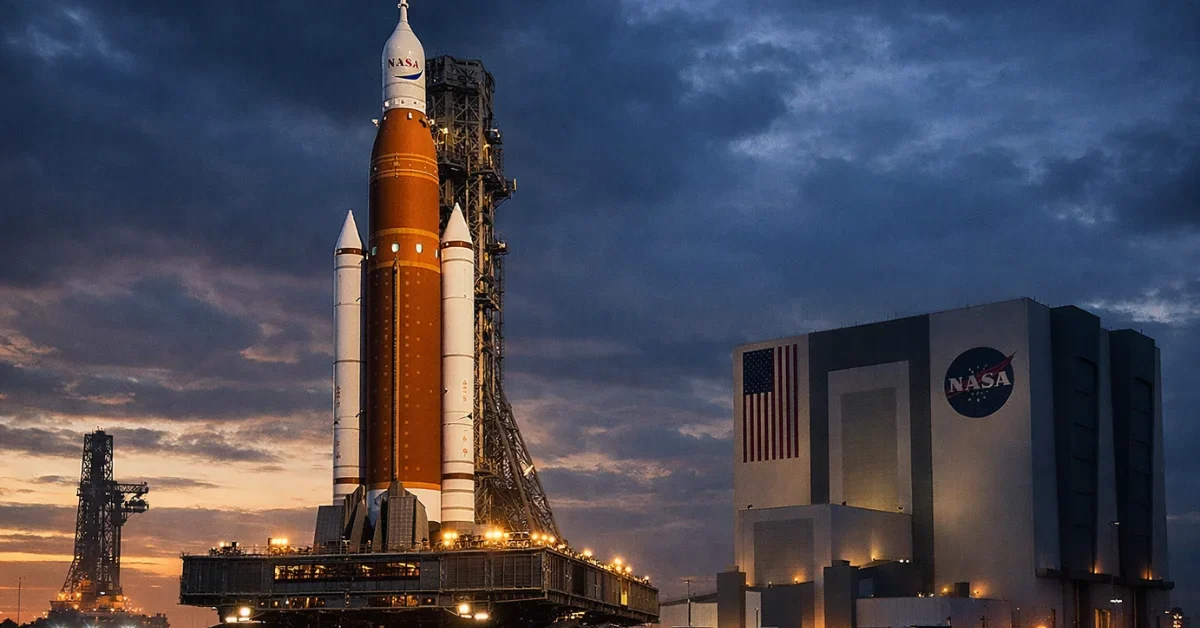
The highly anticipated lunar flyby mission is temporarily on hold. A new helium flow anomaly has forced NASA to move the Space Launch System rocket and Orion spacecraft off Launch Pad 39B. This setback has triggered an Artemis II launch delay, pushing the historic four-astronaut mission from early March to no earlier than April 1. On Wednesday, February 25, the 322-foot-tall rocket completed a slow, four-mile crawl back to the Vehicle Assembly Building at the Kennedy Space Center in Florida for extensive troubleshooting and repairs.
Investigating the Helium Anomaly
Engineers discovered the pressurization problem while returning the rocket to normal operations after a fueling simulation known as a wet dress rehearsal. Sources disagree on the exact date of this simulation; according to NASA, the successful rehearsal occurred on February 21, whereas India Today reports it concluded on February 19. During the reconfiguration process, technicians noticed an interrupted flow of helium to the rocket’s upper stage, officially called the Interim Cryogenic Propulsion Stage.
Helium is a crucial inert gas used to pressurize propellant tanks, purge fuel lines to minimize fire risks, dry out tanks, and maintain proper environmental conditions for the engine. An irregularity in this system must be fully resolved before any crew boards the spacecraft.
Engineers have narrowed the likely cause to a few potential components. These include a seal on the tubing’s quick disconnect, a check valve, or a filter in an umbilical connection. NASA Administrator Jared Isaacman noted that a similar helium valve issue affected the uncrewed Artemis I mission in 2022, suggesting the same type of valve could be the culprit again.
The Rollback and Repair Process
Launch Director Charlie Blackwell-Thompson gave the formal approval for the rollback at 9:28 a.m. EST on February 25. Ten minutes later, a massive Apollo-era crawler-transporter began lifting the combined 23.6-million-pound load. The stack completed its journey to the Vehicle Assembly Building around 8 p.m. EST. NASA ordered the rollback because engineers could not access the upper stage and its gantry connections while the rocket remained exposed on the launch pad.
Inside the cavernous facility, technicians are setting up two sets of internal access platforms within the launch vehicle stage adapter. They must remove thermal blankets covering the affected area to reach the specialized joints and umbilicals.
Beyond fixing the helium leak, ground teams will use this time inside the hangar to complete several other maintenance tasks. Workers will install new batteries for the core stage, upper stage, and solid rocket boosters. They will also recharge the launch abort system batteries on the Orion spacecraft, retest the flight termination and avionics systems, and potentially refresh stowed items inside the crew module.
Addressing Past Leaks and Safety Concerns
This Artemis II launch delay follows earlier fueling hurdles. In early February, NASA paused liquid hydrogen loading twice due to leak rate spikes at the vehicle’s interface. Engineers successfully replaced the suspect seals, and the hydrogen system performed normally during the most recent fueling tests.
Safety remains paramount for the agency, especially following recent difficulties with Boeing’s Starliner program. An independent investigation recently classified Starliner’s crewed flight test as a serious mishap after propulsion anomalies and helium leaks turned a routine certification mission into a 93-day ordeal. The Starliner spacecraft returned uncrewed, and its astronauts ultimately came home on a SpaceX Crew Dragon in March 2025. Against this backdrop, NASA officials emphasize that the Artemis II rollback reflects engineering discipline, ensuring every system functions perfectly before risking human lives.
The Road Ahead for Lunar Exploration
When it eventually lifts off, Artemis II will carry NASA astronauts Reid Wiseman, Victor Glover, and Christina Koch, alongside Canadian Space Agency astronaut Jeremy Hansen. They will embark on a 10-day journey, traveling roughly 7,600 kilometers beyond the far side of the Moon. This mission marks the first time humans will venture beyond low Earth orbit since the Apollo 17 mission in December 1972.
The successful execution of Artemis II is vital for the broader lunar exploration architecture, serving as a direct precursor to Artemis III. Recently, the Aerospace Safety Advisory Panel recommended that NASA rebaseline the risk associated with Artemis III, which aims to return humans to the lunar surface.
To provide further updates on the test flight and the broader lunar campaign, NASA has scheduled a news conference for Friday, February 27, at 10 a.m. EST. The briefing will feature Administrator Jared Isaacman, Associate Administrator Amit Kshatriya, and Lori Glaze, the acting associate administrator for the Exploration Systems Development Mission Directorate.
