

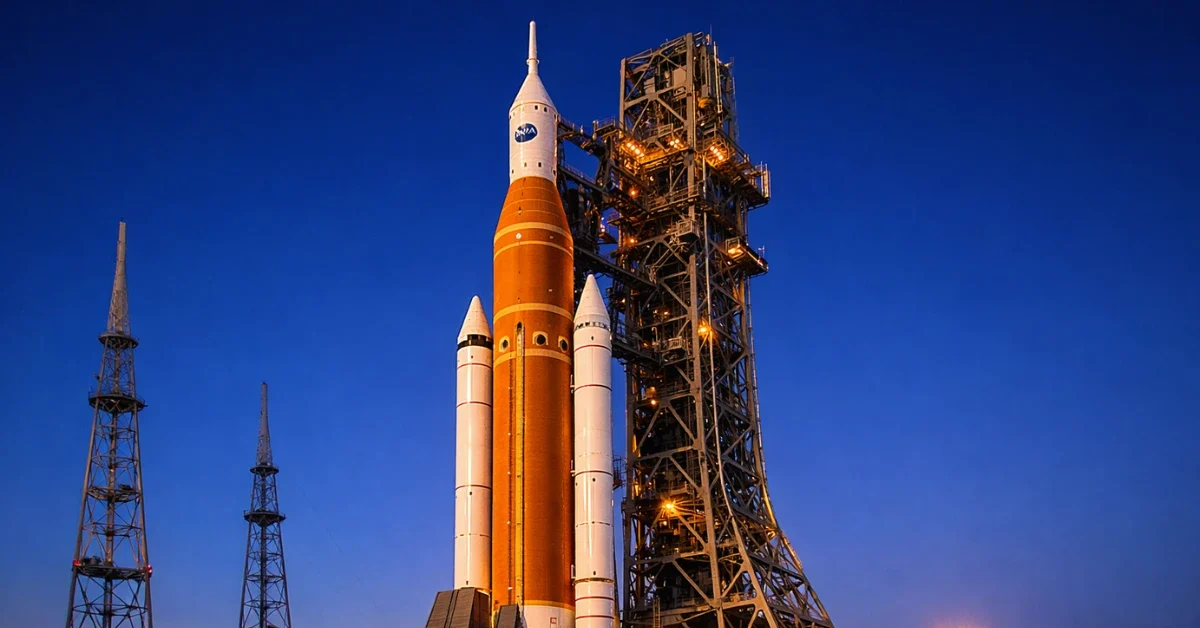
NASA is significantly shifting its approach to deep space exploration. Administrator Jared Isaacman announced a major overhaul of the NASA Artemis moon program on Friday, introducing a newly designed preparatory mission in 2027 and aiming for astronaut lunar landings in 2028 . This strategic pivot is engineered to accelerate the pace of launches while aggressively reducing the risks associated with testing unproven technologies .
Shifting Focus to an Orbital Test Flight
Under the revised architectural timeline, the Artemis III mission will launch in 2027, but it will no longer attempt to take astronauts to the lunar surface . Instead, an unnamed crew will travel to low Earth orbit to rendezvous and dock with commercially built lunar landers currently in development by SpaceX and Blue Origin . This orbital flight will serve as a critical testbed to evaluate navigation, propulsion, communications, and life support systems . Astronauts will also use the microgravity environment to test out new spacesuits that future moonwalkers will eventually wear .
The decision to add this low Earth orbit test flight follows a sharply worded report from NASA’s independent Aerospace Safety Advisory Panel . The panel warned that the agency’s original plan, which intended to go directly from the Artemis II lunar flyby to an Artemis III moon landing, involved too many complex firsts and created an unbalanced risk posture . Isaacman agreed with the panel’s direct observations, noting that a step-by-step approach safely rolls new information into subsequent designs .
Embracing the Apollo Mindset
This revised methodology heavily mirrors the successful strategy used during the space race . Specifically, the updated Artemis III profile is conceptually similar to the Apollo 9 mission, which kept its crew in Earth orbit to thoroughly test the command module and lunar lander . That crucial preparation paved the way for the historic Apollo 11 lunar landing just four months later .
Following the 2027 orbital test, NASA intends to launch the Artemis IV and V missions in 2028 . The primary goal for these flights is to execute one or two actual lunar surface landings . The missions will utilize whichever commercial landers from SpaceX or Blue Origin are deemed ready for service, incorporating all the operational lessons learned from the preceding orbital test .
Standardizing Rocket Hardware for Faster Launches
To support a faster, more reliable launch cadence, NASA is halting development on a more powerful version of the Space Launch System (SLS) rocket’s upper stage, previously known as the Exploration Upper Stage . Instead, the agency will stick strictly to a standardized “Block 1” configuration for the SLS and Orion spacecraft .
Amit Kshatriya, NASA’s associate administrator, explained that constantly altering the rocket’s configuration is needlessly complicated and introduces too much production risk . By keeping the vehicle design consistent, NASA avoids the need to transition to a taller mobile launch gantry at the Kennedy Space Center and allows engineers to test the vehicles exactly as they fly .
Commercial partners are already adjusting to the new directives . Steve Parker, CEO of Boeing Defense, Space & Security, stated that the SLS core stage remains the world’s most powerful rocket stage and that Boeing’s workforce is ready to meet the increased production demand . Meanwhile, SpaceX and Blue Origin have both expressed eagerness to proceed with uncrewed landing demonstrations and orbital integration testing .
Addressing Artemis II Delays and Future Goals
This massive restructuring comes as NASA works diligently to get its upcoming Artemis II mission off the ground . Originally targeted for an early February launch, the flight to send four astronauts around the moon is now delayed until at least April 1 . Teams rolled the SLS rocket back to the Vehicle Assembly Building on February 25 to repair a helium pressurization issue discovered in the rocket’s interim cryogenic propulsion stage and to replace batteries within the flight termination system .
Looking beyond the immediate hardware changes, NASA plans to fundamentally rebuild its civil servant workforce to support a transition from launching once every few years to a steady cadence of one lunar mission annually . The agency will focus on bringing more core competencies in-house and working side-by-side with commercial partners . Moving to a yearly flight rate will prevent critical technical skills from atrophying among the engineering teams .
Isaacman emphasized that maintaining a highly skilled, active workforce is essential for ensuring crew safety and reducing overall mission risk . To ensure the long-term success of the program, he argued that NASA must ignite a sustainable orbital economy, creating a system where the future of lunar exploration provides tangible value without remaining perpetually dependent on taxpayer funding .
