

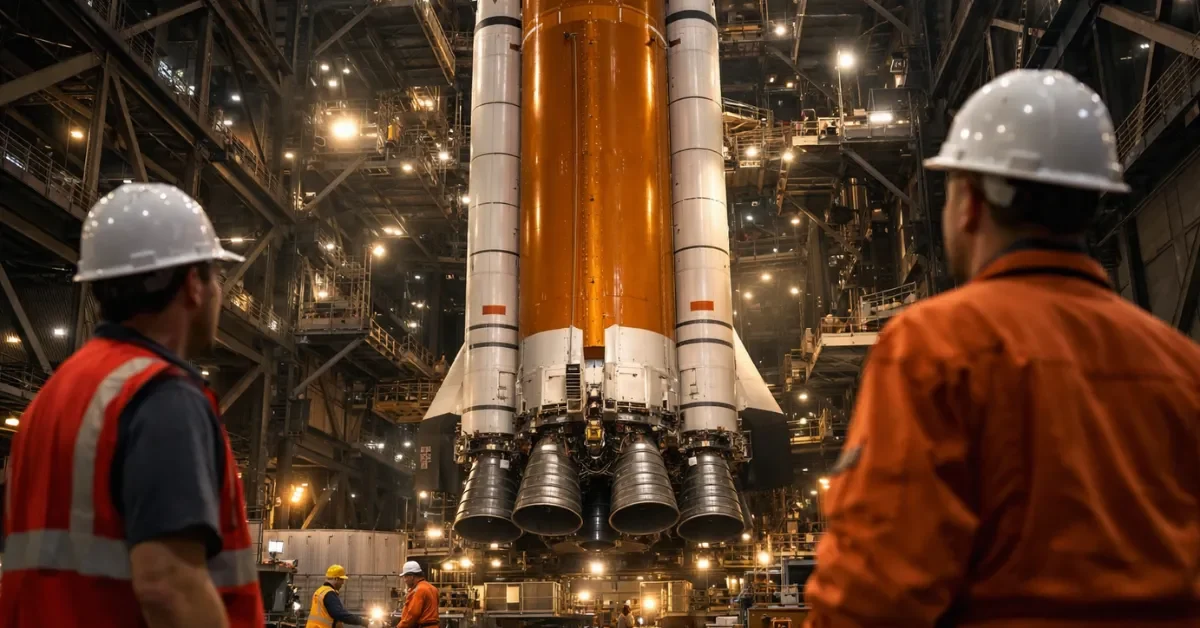
In a major shift for the future of American space exploration, the space agency announced a sweeping NASA Artemis program overhaul on Friday. The revised plan delays the first crewed lunar landing to 2028 and transforms the upcoming Artemis III flight into an Earth-orbit test mission.
NASA Administrator Jared Isaacman detailed the changes, emphasizing a need to reduce mission complexity and increase launch frequency safely. The restructuring aims to establish a more reliable pathway to returning humans to the lunar surface while standardizing the massive rockets that will take them there. Isaacman noted that eliminating delays and moving faster is crucial, citing increasing competition from geopolitical adversaries.
Artemis III Transitions to Earth Orbit Testing
Originally slated to be the historic mission that would return astronauts to the moon, Artemis III is now scheduled for 2027 as a critical testing phase in low Earth orbit. The flight will focus on proving the capabilities of essential hardware before anyone attempts a lunar descent.
During this mission, NASA’s Orion spacecraft will practice rendezvous and docking procedures with commercial lunar landers developed by SpaceX and Blue Origin. Astronauts will also conduct in-space tests of the docked vehicles, check integrated life support and propulsion systems, and try out new spacesuits designed for extravehicular activity.
The decision to change the flight plan follows a recent report from NASA’s Aerospace Safety Advisory Panel. The panel raised concerns about the previous architecture, stating that relying heavily on new landing systems posed significant risks at the mission level. Both SpaceX’s Starship and Blue Origin’s Blue Moon vehicles still need to demonstrate complex maneuvers—such as transferring cryogenic fuels in space and completing uncrewed landings—before they can safely carry a crew. Currently, Blue Origin’s pathfinder vehicle, known as Mark 1, is undergoing testing at the Johnson Space Center in Houston.
Isaacman noted that attempting a moon landing on Artemis III was no longer the right path forward. He stated that going straight to the moon is simply not a reliable pathway to success.
Standardizing Rockets to Speed Up Launches
To achieve its long-term goals, NASA is altering how it builds and launches its rockets. Instead of upgrading to a more complex version of the Space Launch System for future missions, the agency will standardize the rocket using its current configuration. This means relying on the existing upper stage and pad systems to keep manufacturing as straightforward as possible.
This standardization is designed to streamline production and significantly shorten the time between missions. Currently, the launch cadence sits at roughly one flight every three years. If everything goes according to the new plan, NASA hopes to launch a mission every ten months.
Agency leaders compared this strategy to the methodical, step-by-step approach used during the Apollo era. By prioritizing system reliability and moving through objectives in logical phases, NASA intends to mirror the success of the Mercury, Gemini, and Apollo programs. To support this faster cadence, the agency plans to rebuild its civil servant workforce and work side-by-side with its industry partners.
New Targets for Lunar Landings
With Artemis III repurposed, the milestone of landing astronauts on the moon will now fall to the Artemis IV mission in 2028. If that mission is successful, NASA has outlined the potential for a second lunar landing later that same year with Artemis V.
This updated timeline relies heavily on the success of the commercial landers and the accelerated production of the Space Launch System. Boeing, the primary contractor for the rocket’s core stage, has stated that its manufacturing facilities in New Orleans and its supply chain are prepared to meet the increased demand for rocket components.
Artemis II Repairs Underway
While the agency looks ahead to 2028, engineers at the Kennedy Space Center in Florida are actively working to get the Artemis II mission off the ground. The uncrewed test flight of Artemis I proved successful in late 2022, paving the way for the program’s first crewed journey.
Artemis II will send four astronauts—Reid Wiseman, Victor Glover, Christina Koch, and Jeremy Hansen—on a ten-day flight around the moon and back to Earth. However, the mission recently faced a setback during a fueling rehearsal on the launch pad.
On February 25, teams rolled the rocket back to the Vehicle Assembly Building to address a helium pressurization issue found on the upper propulsion stage. Engineers are currently removing the suspected component to determine the root cause of the problem. NASA hopes to implement hardware and operational fixes quickly, aiming to meet the upcoming launch windows that open on April 1, with additional opportunities extending through the end of the month.
